Houseplant profile
Cyclamen plant: how to identify florist's and hardy cyclamen
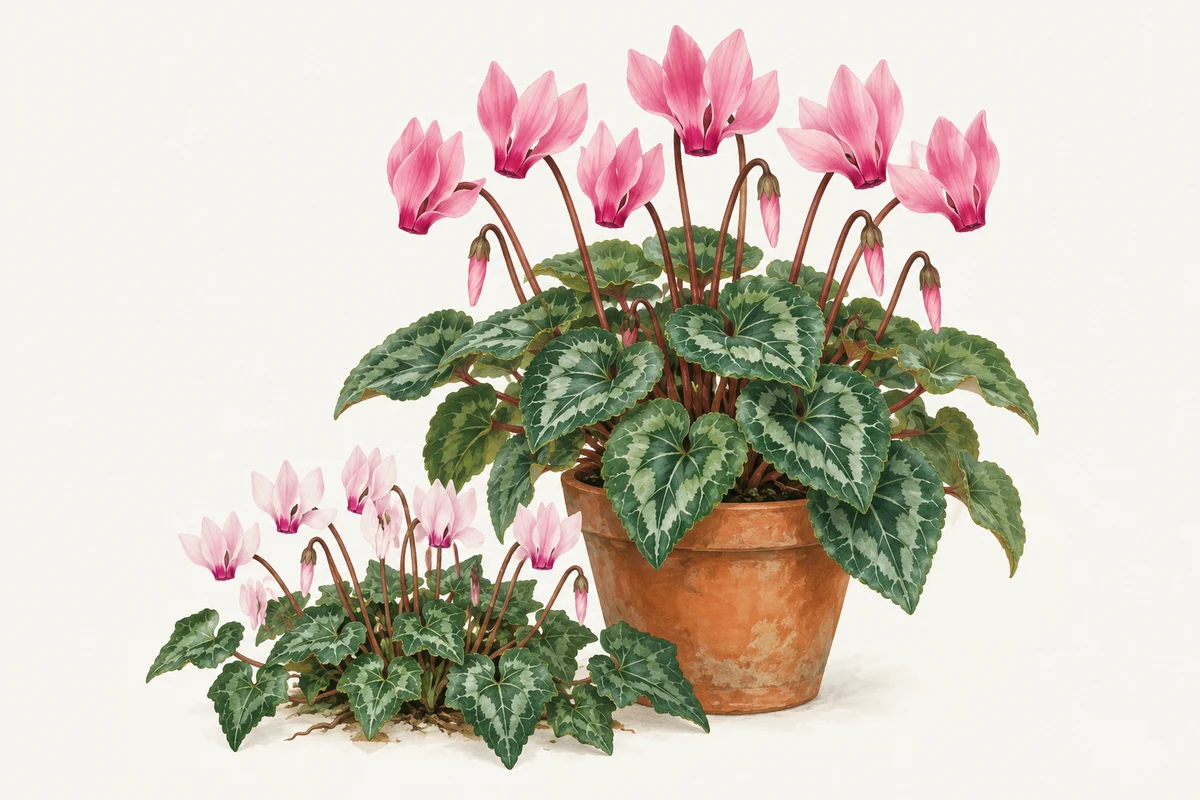
Heart-shaped leaves marbled with silver, one butterfly-like flower per stalk, and a round tuber at the soil surface. How florist's and hardy cyclamen differ, and what the ASPCA lists.
In short
The cyclamen plant sold for winter color is florist's cyclamen (Cyclamen persicum), a low tuberous plant of the primrose family. Recognize it by three marks: heart-shaped leaves marbled with silver, one swept-back, butterfly-like flower on each slender stalk, and a round brown tuber at the soil surface from which every stalk rises. The ASPCA lists all cyclamen as toxic to cats and dogs, the tubers above all.
- Each flower sits alone on a slender stalk that rises straight from the tuber.
- Florist's cyclamen (Cyclamen persicum) flowers indoors from early winter to spring; hardy ivy-leaved cyclamen (C. hederifolium) flowers outdoors in late summer and early fall.
- The ASPCA lists all cyclamen as toxic to cats, dogs and horses; its most serious signs follow large ingestions of the tubers.
Field marks at a glance
- Scientific name
- Cyclamen persicum
- Family
- Primulaceae (primrose family)
- Type
- Houseplant, perennial
- Leaves
- Dark green, heart-shaped, about 1 to 5.5 in long, usually marbled with silver on top and pale or purplish-green underneath; edges finely toothed.
- Flowers
- One flower per stalk, about 2 in, with 4 to 5 petals fused at the base and swept upward so the flower looks like a small butterfly.
- Flower colors
- White, pink, red, magenta or lavender; the wild species is sweetly scented, some cultivars are not.
- Tuber
- A round, dark brown tuber at or just below the soil surface; leaf and flower stalks rise straight from it. NC State calls the tuber poisonous.
- Size and habit
- A low mound 6 to 9 in tall, leaves and flowers on slender separate stalks.
- Season
- Flowers from early winter to spring; in summer the leaves yellow and the plant goes dormant, which is normal.
- Fruit
- A capsule about 0.5 in across with five chambers and 5 to 40 sticky, sugary seeds; it splits open when ripe.
- Native range
- Algeria to the eastern Mediterranean, on rocky slopes and in pine forests and oak thickets. Hardy outdoors only in USDA zones 9 to 11.
Cyclamen is the low pot plant with silver-marbled, heart-shaped leaves and flowers that look like small butterflies on slender stalks. Four marks identify it: the leaves, the single flower on each stalk, the tuber and the season. The ASPCA lists it as toxic to cats and dogs, and the part it ties to the most serious signs is the one you cannot see from above: the tuber.
How to identify a cyclamen: leaves, flowers, tuber
1. The leaves. NC State describes florist's cyclamen leaves as dark green and heart-shaped, 1 to 5.5 inches long, with a silvery variegated pattern on top and a pale or purplish-green underside; the margins are serrated. Every leaf stands on its own long stalk. The amount of silver differs from plant to plant, from a thin outline to a nearly silver leaf.
2. The flowers. Each stalk carries a single flower, about 2 inches, with 4 to 5 petals fused at the base. NC State says the flowers give the appearance of a delicate butterfly; on its hardy cyclamen page it describes nodding flowers with "reflexed petals" that are upswept, bent back away from the center. Colors run from white through pink, red and magenta to lavender. The wild species is sweetly scented; some cultivars are not.
3. The tuber. Look at the base of the plant. Leaves and flower stalks do not come from a stem: NC State says "the flower stalk rises directly from the tuber," a round, dark brown storage organ at or just under the soil surface. The genus name refers to it: NC State traces Cyclamen to the Greek kylos, circle, for the round tubers.
4. The habit and season. Florist's cyclamen forms a mound 6 to 9 inches tall, flowers from early winter to spring and goes dormant in summer. A plant with leaves yellowing in June is following its natural cycle.
When you are not sure what the pot plant on the windowsill is, one photo of a leaf and a flower in Plant Identifier gives you a name to check against these four marks. The app shows no confidence score and no list of alternatives, so confirm with the stalks rising from the tuber. The flower identifier works through flower shape for other plants.
What the ASPCA lists for cats and dogs
The ASPCA's cyclamen entry covers the whole genus (Cyclamen spp., also called sowbread) and lists it as toxic to dogs, cats and horses. It names terpenoid saponins as the toxic principle. The listed clinical signs are salivation, vomiting and diarrhea, and, "following large ingestions of tubers," heart rhythm abnormalities, seizures and death.
The NC State Extension Plant Toolbox agrees on the tuber: it calls the dark brown tuberous root poisonous. Its page on hardy cyclamen says the plant is toxic to humans, cats, dogs and horses if eaten and should be kept out of the reach of children and pets.
What to do:
- Pet chewed leaves, flowers or the tuber: call your vet or the ASPCA Animal Poison Control Center at (888) 426-4435 (the ASPCA says a consultation fee may apply). Mention whether the tuber was reached.
- A person swallowed part of the plant: call Poison Control at 1-800-222-1222 in the US, or NHS 111 in the UK; in an emergency, 911 or 999.
Plant Identifier's Toxicology tool gives AI-written notes for people, dogs and cats once the plant is named, but that note is not a substitute for the vet or poison-control call. The plants toxic to cats and poisonous plants for dogs guides list other common plants on the ASPCA's list.
Florist's cyclamen vs hardy cyclamen
The pot plant sold for winter color is Cyclamen persicum. World Flora Online accepts the name Cyclamen persicum Mill.; NC State notes that despite the name it is not from Persia, but native from Algeria to the eastern Mediterranean. It is frost tender and hardy outdoors only in USDA zones 9 to 11.
The garden cyclamen most people meet are hardy species. NC State's genus page counts 23 species, mostly from the Mediterranean, and lists C. hederifolium and C. coum among those that tolerate zones 4 to 8.
| Feature | Florist's cyclamen | Ivy-leaved cyclamen | Eastern cyclamen |
|---|---|---|---|
| Scientific name | Cyclamen persicum | Cyclamen hederifolium | Cyclamen coum |
| Where grown | Indoors, or outdoors in zones 9 to 11 | Outdoors, zones 5 to 9 per NC State | Outdoors, hardy |
| Leaf shape | Heart-shaped, finely toothed | Ivy-shaped, 2 or 3 angled lobes per side | Not described on the pages used here |
| Flower size | About 2 in | About 1.5 to 2 in, dark eye | Small, pink to white |
| Bloom time | Early winter to spring | Late summer to early fall | Winter |
| Height | 6 to 9 in | 4 to 6 in | Low |
Ivy-leaved cyclamen. The RHS describes C. hederifolium as producing large pink flowers before the leaves in early autumn, with marbled foliage that resembles ivy, and says it self-seeds freely. NC State adds that after pollination the flower stalk coils down toward the ground. If you find cyclamen naturalized under trees in autumn, this is the likely species.
Eastern cyclamen. NC State lists C. coum as a winter-flowering species with pink to white flowers that dislikes acidic clay soils. A cyclamen flowering in a garden bed in winter is more likely this than a florist's plant planted out.
For the other two pot plants sold for winter color, the poinsettia and Christmas cactus pages give the field marks.
A short care note
From NC State: bright indirect light, cool temperatures around 65 °F and moderate humidity. Water at the edge or the base of the pot rather than onto the crown, because water on the tuber leads to rot, and water only when the soil feels dry. Cut back watering as the leaves yellow in summer, and resume in fall when new growth starts. Removing spent flowers keeps more coming. Keep the pot where pets and children cannot dig into it.
Look-alikes and how to tell them apart
Hardy cyclamen, ivy-leaved cyclamen (Cyclamen hederifolium)
Smaller, 4 to 6 in tall, grown outdoors. Its leaves are ivy-shaped with 2 or 3 angled lobes on each side, and its pink or white flowers with a dark eye open in late summer and early fall, often before the leaves.
Eastern cyclamen (Cyclamen coum)
A hardy garden species that flowers outdoors in winter with small pink to white flowers. A pot plant flowering indoors with 2 in blooms is almost always florist's cyclamen; check the label if you bought it for the garden.
Poinsettia (Euphorbia pulcherrima)
A branched shrub with woody stems and a rosette of colored bracts around tiny yellow cups. Cyclamen has no stem above ground: every leaf and flower rises on its own stalk from the tuber.
What a photo can't settle
- A photo names the genus easily, but separating florist's cyclamen from some hardy species in a pot can need the label, the season and the leaf shape together.
- A photo cannot show whether a pet reached the tuber, the part the ASPCA links to the most serious signs; only a vet can assess a pet that chewed the plant.
- Cultivars vary in leaf marbling, petal frills and scent, so a picture can name the species but not confirm a cultivar.
Questions people ask
Is cyclamen poisonous to cats?
The ASPCA lists cyclamen as toxic to cats, dogs and horses, naming terpenoid saponins. Listed signs are salivation, vomiting and diarrhea, and after large ingestions of tubers, heart rhythm abnormalities, seizures and death. If your cat chewed any part, call your vet or the ASPCA Animal Poison Control Center at (888) 426-4435; a consultation fee may apply.
Which part of the cyclamen is most dangerous?
The tuber. The ASPCA ties its most serious signs to large ingestions of tubers, and NC State describes the dark brown tuberous root as poisonous. Dogs that dig in pots or garden beds can reach tubers that are otherwise hidden. Call your vet if a pet ate any part.
Is my cyclamen dead when the leaves turn yellow in summer?
Not necessarily. NC State explains that florist's cyclamen goes dormant in summer: the leaves turn yellow and drop, and most people throw the plant away at this point. With reduced watering it can grow again in fall. Yellow leaves in winter, while it should be flowering, point to a care problem instead.
How do I tell indoor cyclamen from hardy cyclamen?
Florist's cyclamen has heart-shaped leaves, flowers about 2 inches across and blooms indoors from early winter to spring. Hardy ivy-leaved cyclamen is smaller, has ivy-shaped leaves with angled lobes, and flowers outdoors in late summer and early fall. NC State lists florist's cyclamen as hardy only in zones 9 to 11.
Sources
- Cyclamen — ASPCA Poison Control
- Cyclamen persicum — NC State Extension Gardener Plant Toolbox
- Cyclamen hederifolium — NC State Extension Gardener Plant Toolbox
- Cyclamen — NC State Extension Gardener Plant Toolbox
- Cyclamen: growing guide — Royal Horticultural Society
- Cyclamen persicum Mill. — World Flora Online
Keep reading
- Houseplant profileAnthurium (flamingo flower): how to identify it
- Pet safety guidePoisonous plants for dogs, and what to do if your dog ate one
- Houseplant profilePoinsettia plant (Euphorbia pulcherrima): how to identify it
- Succulent profileChristmas cactus leaf identification: Christmas, Thanksgiving or Easter cactus
- Free toolFlower identifier by description