Houseplant profile
Anthurium (flamingo flower): how to identify it
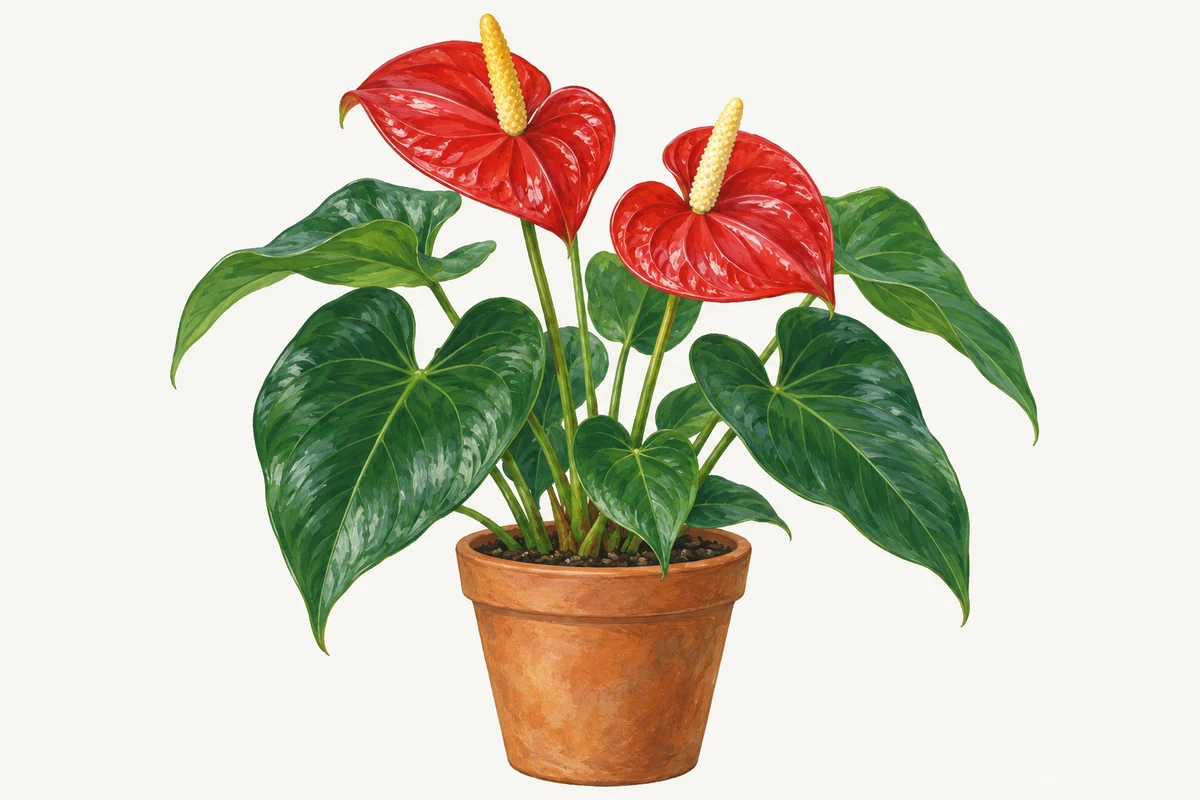
A glossy, heart-shaped 'flower' in red, pink or white with a rod sticking out of it, above dark, heart-shaped leaves. The angle between the two parts of the bloom is the quickest test.
In short
Anthurium, or flamingo flower, is a tropical houseplant of the arum family with glossy, heart-shaped leaves and long-lasting, waxy blooms. What looks like a flower is a spathe, a shiny heart-shaped bract in red, pink, orange or white, held flat at a right angle to a straight, rod-like spadix carrying tiny true flowers. The common indoor species is Anthurium andraeanum, 1 to 1.5 feet tall.
- A flat, waxy, heart-shaped spathe held at a right angle to the spadix is the identifying feature of the genus (NC State).
- A white spathe that curves around the spadix, on lance-shaped leaves, points to a peace lily instead.
- The ASPCA lists flamingo flower (Anthurium) as toxic to dogs, cats and horses.
Field marks at a glance
- Scientific name
- Anthurium andraeanum
- Family
- Araceae (arum family)
- Type
- Houseplant, perennial, evergreen
- Spathe
- The colored 'petal': flat, waxy, heart-shaped and deeply veined, red, pink, orange, green or white, held at a right angle to the spadix (NC State).
- Spadix
- An erect, cylindrical rod of tiny flowers, often tapering; straight in A. andraeanum, white to cream, yellowing at the tip (NC State).
- Flower stalk
- Long, usually standing taller than the leaves (NC State).
- Leaves
- Heart-shaped, glossy, dark green and moderately leathery, 8 to 12 in long in A. andraeanum, with palmate veins (NC State).
- Leaf stalk
- Long, with a swollen joint (pulvinus) just below the blade (NC State).
- Stem
- Short and erect, sometimes climbing, with aerial roots that can appear above the soil (NC State).
- Size indoors
- A. andraeanum 1 to 1.5 ft tall and 9 to 12 in wide (NC State); UF/IFAS gives 2 to 3 ft for anthuriums generally, dwarf forms smaller.
- Bloom
- Repeats through the year in good conditions; each bloom lasts about six weeks on the plant (UF/IFAS) or up to 4 weeks (NC State).
- Native range
- A. andraeanum: Colombia and Ecuador, an epiphyte of warm, humid rainforest (NC State). The genus spans the Caribbean and Central and South America.
Anthurium is the houseplant with the glossy, almost plastic-looking red heart and the yellow-white rod in front of it. It is sold as flamingo flower, flamingo lily, tail flower or laceleaf, and florists use the same blooms as long-lasting cut flowers. Three checks on the bloom and one on the leaf stalk identify it.
How to identify an anthurium: bloom first, then the leaf
1. The spathe. The part you notice is not a petal but a spathe, a modified leaf. The NC State Plant Toolbox describes it as heart-shaped, waxy and deeply veined, shiny red, pink, orange, green or white, usually flat and sometimes hooded or bent back. Press it gently: it feels thick and leathery.
2. The angle. Look at the bloom from the side. In anthuriums the spathe stands at a right angle to the spadix, which NC State calls an identifying feature for the genus. The spadix points forward or upward, and the spathe spreads out behind it like a plate.
3. The spadix. Look at the rod itself. It is erect, cylindrical and often tapering, covered in tiny flowers. In the common flamingo flower, Anthurium andraeanum, it is straight and white to cream, turning pale yellow toward the tip. A curly, corkscrew spadix means the pigtail anthurium instead.
4. The leaf stalk. Follow a leaf down from the blade. Anthurium leaf stalks are long, and NC State notes they are usually pulvinate at the apex: there is a short, swollen joint just below the blade. The leaves themselves are heart-shaped, glossy and leathery, with veins that fan out from the top of the stalk.
When there is no bloom, a photo of a whole leaf and its stalk is often enough for Plant Identifier to suggest anthurium. The app shows no confidence score and no list of alternatives, so check the joint on the leaf stalk, and the spathe angle when the plant blooms again.
Flamingo flower and other anthuriums
NC State counts over 1,300 species in the genus, from the Caribbean, Central and South America, growing on the ground or on trees as epiphytes. The ones you are most likely to meet indoors:
- Flamingo flower (Anthurium andraeanum): the florist's anthurium. NC State gives a plant 1 to 1.5 feet tall and 9 to 12 inches wide, with dark green, heart-shaped leaves 8 to 12 inches long and a red, pink, orange, green or white spathe; some cultivars are variegated. World Flora Online lists Anthurium andraeanum Linden ex André as an accepted name.
- Pigtail anthurium (Anthurium scherzerianum): a smaller plant with elongated leaves and a red, pink or orange spathe around a curly yellow or green spadix.
- Crystal anthurium (A. crystallinum) and A. clarinervium: grown for their large, velvety, heart-shaped leaves with pale green to white veins rather than for blooms.
- Bird's nest anthurium (A. hookeri): a rosette, or nest, of purple-black to dark green leaves.
UF/IFAS Gardening Solutions describes anthuriums as 2 to 3 feet tall, dwarf forms smaller, blooming continuously through the year, each bloom lasting about six weeks on the plant. NC State gives up to 4 weeks per bloom and several flushes a year in the right conditions, so a plant that is always in flower is normal.
Anthurium vs peace lily and calla lily
All three belong to the arum family and carry a spathe around a spadix, so the shape and angle of the spathe are what separate them.
| Feature | Anthurium | Peace lily | Calla lily |
|---|---|---|---|
| Scientific name | Anthurium andraeanum | Spathiphyllum | Zantedeschia aethiopica |
| Spathe color | Red, pink, orange, green or white | White, turning pale green | White (pink in some cultivars) |
| Spathe shape | Flat, waxy heart at a right angle to the spadix | Oblong, pointed, curving around the spadix | A funnel wrapped around the spadix |
| Leaves | Heart-shaped, glossy | Lance-shaped to elliptic, glossy | Arrow- to heart-shaped, wavy margins |
| Where you meet it | Houseplant all year | Houseplant all year | Garden or pond margin, blooms June to July |
The peace lily is the one most often confused with a white anthurium. NC State's Spathiphyllum page describes a white to greenish-white spathe that is oblong to lance-shaped, with a pointed tip, flat or concave and curving around the spadix, on leaves that come straight from the soil in a basal rosette. The calla lily is mainly a garden plant with a funnel-shaped spathe on a leafless stalk. For blooms you can't place, the flower identifier works through color and shape.
Is anthurium toxic to pets
The ASPCA lists flamingo flower, filed as Anthurium scherzeranum and also called flamingo lily, tail flower, oilcloth flower, pigtail plant and painter's palette, as toxic to dogs, cats and horses. It names insoluble calcium oxalates and lists oral irritation, pain and swelling of the mouth, tongue and lips, excessive drooling, vomiting and difficulty swallowing. NC State describes the same signs for A. andraeanum and adds that the sap can irritate skin and eyes. The peace lily is listed as toxic to dogs and cats for the same reason, so mixing the two up does not change what to do.
If a pet has chewed an anthurium, call your vet or the ASPCA Animal Poison Control Center at (888) 426-4435 (a consultation fee may apply). If a person has eaten part of the plant, call Poison Control at 1-800-222-1222. Plant Identifier's Toxicology tool gives AI-written notes for people, dogs and cats, but it does not replace that call. More houseplants on the ASPCA's list are in plants toxic to cats.
A short care note
NC State recommends bright, indirect light (direct sun scorches the leaves), moist, well-drained soil watered when the top inch feels dry, temperatures of 65 to 80°F and humidity of 60 to 80%, with no cold drafts. Too little light means fewer blooms; low humidity browns the leaf tips. Yellowing leaves, NC State notes, can come from overwatering, poor drainage or lack of nutrients; yellow leaves on plants covers how to tell those causes apart.
Look-alikes and how to tell them apart
Peace lily (Spathiphyllum)
Check the color and angle of the spathe. A peace lily spathe is white, turning pale green, oblong with a pointed tip, and curves around the spadix (NC State). An anthurium spathe is flat, waxy and heart-shaped, at a right angle to the spadix. Peace lily leaves are lance-shaped, not heart-shaped.
Calla lily (Zantedeschia aethiopica)
Look at the spathe shape and where the plant grows. A calla spathe is a white funnel wrapped around a yellow spadix on a leafless stalk, from June to July, on a garden plant with arrow-shaped leaves with wavy margins (NC State). An anthurium spathe opens flat like a heart.
Pigtail anthurium (Anthurium scherzerianum)
A different anthurium. Look at the spadix: in pigtail anthurium it is curly or corkscrew-like, yellow or green, on a smaller plant with elongated leaves (NC State). Flamingo flower, A. andraeanum, has a straight spadix and heart-shaped leaves.
Foliage anthuriums (A. clarinervium, A. crystallinum)
Same genus, grown for leaves rather than blooms: large, velvety, heart-shaped dark green leaves with white or silvery-white veins (NC State). If the plant has velvety, white-veined leaves and no colored spathe, it is likely one of these.
What a photo can't settle
- Anthurium hybrids and cultivars are mostly told apart by spathe color and size; a photo may confirm the genus and the common species but not the cultivar name.
- Out of bloom, a young anthurium's heart-shaped leaves resemble other aroids in a photo; a bloom or the swollen joint at the top of the leaf stalk helps.
- A photo cannot tell whether a pet ate enough to matter; call your vet or the ASPCA Animal Poison Control Center.
Questions people ask
Is the red part of an anthurium a flower?
No. The colored, heart-shaped part is a spathe, a modified leaf. The true flowers are tiny and packed on the rod-like spadix in the middle. NC State describes the spathe as wide, flat and waxy, and notes that each bloom lasts up to 4 weeks; UF/IFAS gives about six weeks on the plant.
What is the difference between anthurium and peace lily?
Both are arum family houseplants with a spathe and spadix. Anthurium has heart-shaped leaves and a flat, waxy, often red or pink spathe at a right angle to the spadix. Peace lily has lance-shaped leaves and a white spathe that curves around the spadix and turns pale green with age (NC State).
Why is it called flamingo flower?
It is one of several common names for Anthurium andraeanum, along with flamingo lily, tail flower, laceleaf and painter's palette (NC State). The ASPCA files flamingo flower under Anthurium scherzeranum, the pigtail anthurium, so the name is used for more than one species.
Is anthurium toxic to cats and dogs?
The ASPCA lists flamingo flower (Anthurium scherzeranum, as it spells it) as toxic to dogs, cats and horses, naming insoluble calcium oxalates. If a pet chewed a leaf or bloom, call your vet or the ASPCA Animal Poison Control Center at (888) 426-4435. For a person, call Poison Control at 1-800-222-1222.
Sources
- Anthurium — North Carolina Extension Gardener Plant Toolbox (NC State)
- Anthurium andraeanum — North Carolina Extension Gardener Plant Toolbox (NC State)
- Spathiphyllum — North Carolina Extension Gardener Plant Toolbox (NC State)
- Zantedeschia aethiopica — North Carolina Extension Gardener Plant Toolbox (NC State)
- Anthuriums — UF/IFAS Gardening Solutions
- Anthurium andraeanum Linden ex André — World Flora Online
- Flamingo Flower — ASPCA Animal Poison Control Center
- Peace Lily — ASPCA Animal Poison Control Center
Keep reading
- Houseplant profilePeace lily (Spathiphyllum): how to identify it
- Houseplant profileDieffenbachia (Dieffenbachia seguine): how to identify it
- Houseplant profileAlocasia elephant ear: how to identify it
- Free toolFlower identifier by description
- Plant healthYellow leaves on plants, and what each pattern means