Houseplant profile
Alocasia elephant ear: how to identify it
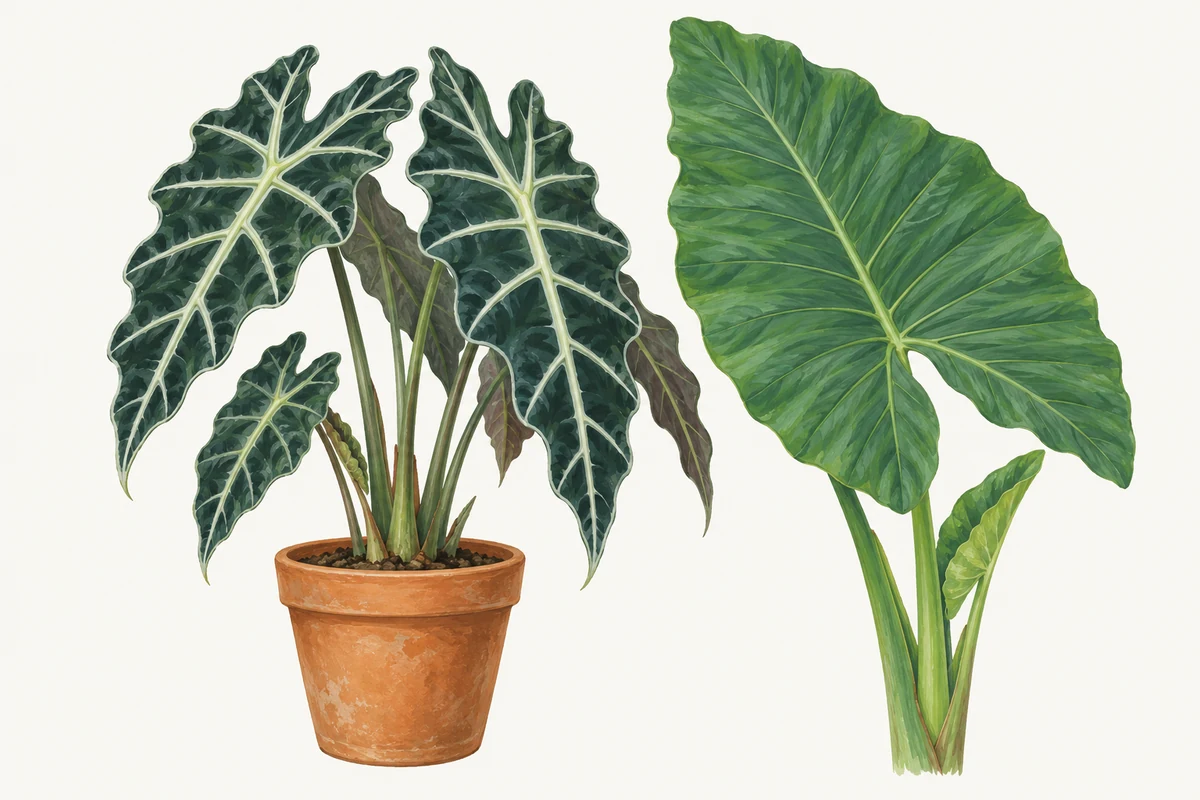
Arrow- or heart-shaped leaves held high on long, fleshy stalks, often with bold pale veins. The point where the stalk meets the leaf tells Alocasia from taro.
In short
To identify an elephant ear plant as an Alocasia, turn a leaf over and find where the stalk joins it. In Alocasia the stalk meets the leaf at or near the notch of the base, and the leaf is held upright, often pointing up. In Colocasia (taro) the stalk joins several inches inside the edge, and the leaf droops. Alocasia leaves are 12 to 36 inches long (NC State).
- Stalk joined at the notch and leaves held upright: Alocasia. Stalk joined inside the blade (peltate) and leaves drooping: Colocasia.
- 'Polly' is a compact form of Alocasia × amazonica, which NC State now files as Alocasia × mortfontanensis.
- The ASPCA lists Alocasia as toxic to dogs, cats and horses; NC State rates its poison severity as medium.
Field marks at a glance
- Scientific name
- Alocasia (A. × mortfontanensis, syn. A. × amazonica; A. macrorrhizos)
- Family
- Araceae (arum family)
- Type
- Houseplant, perennial
- Leaf shape
- Heart- to arrowhead-shaped, 12 to 36 in long, each held singly on a long, sturdy, succulent stalk; prominent veins, sometimes variegated (NC State).
- Leaf attachment
- The stalk joins the leaf at or near the base, and leaves are held upright, often pointing up (UF/IFAS). Wisconsin Extension says Alocasia leaves are usually not peltate.
- 'Polly' and A. × amazonica
- Thick, smooth, dark green arrowhead leaves with very prominent silvery to lime-white veins, purple undersides and wavy edges; 'Polly' stays compact, up to 2 ft (NC State).
- Giant taro (A. macrorrhizos)
- Glossy, arrow-shaped, ruffled green leaves 3 to 6 ft long and 2 to 4 ft wide; the cultivar 'Borneo Giant' reaches 15 ft (NC State).
- Growth habit
- Clumps of leaves rising straight from an underground tuber or corm; no woody trunk. New plants form as offsets.
- Flowers
- Seldom seen indoors: a creamy white spadix of tiny flowers inside a leaf-like, hooded, greenish spathe, as in other aroids (NC State).
- Size
- 1 to 4 ft for A. × mortfontanensis; up to 10 ft for the genus in the tropics, smaller in a pot (NC State).
- Native range
- Tropical and subtropical Asia to eastern Australia; about 80 species (NC State).
"Elephant ear" is a name shared by three genera of aroids with huge, arrow-shaped leaves, and this page is about the one most often kept as a houseplant: Alocasia, including the popular 'Polly'. The single most useful check is on the back of the leaf, where the stalk meets the blade.
How to identify an Alocasia elephant ear in four checks
1. Where the stalk joins the leaf. Turn a leaf over and follow its stalk to the blade. A UF/IFAS Extension article sets out the rule: in Alocasia the stalk attaches at or near the leaf base; in Colocasia it attaches slightly in from the edge on the underside, creating a notch. A leaf whose stalk joins inside the blade is called peltate, and Wisconsin Extension notes that Alocasia and Xanthosoma leaves are usually not peltate.
2. How the leaf is held. Step back. Alocasia leaves are held upright, often pointing up, on long, sturdy, succulent stalks, one leaf per stalk. Taro leaves tend to droop with their tips pointing down.
3. The shape and veins. The NC State Plant Toolbox describes heart- to arrowhead-shaped leaves 12 to 36 inches long with prominent veins. Many houseplant alocasias make the veins the show: 'Polly' and other forms of A. × amazonica have dark green leaves crossed by silvery to lime-white veins, with purple undersides and wavy edges.
4. The base. Look at soil level. There is no woody trunk: each leaf rises from an underground tuber or corm, and new offsets appear beside the clump. The flower, rarely seen indoors, is the typical aroid spathe and spadix.
If the label is gone, one photo of a whole leaf, ideally with the stalk joint visible, is enough for Plant Identifier to suggest a common and scientific name. The app shows no confidence score and no list of alternatives, so check its answer against the stalk joint yourself.
Alocasia 'Polly', amazonica and giant taro
Most alocasias sold as houseplants fall into two groups.
'Polly' and the amazonica hybrid. NC State on Alocasia × mortfontanensis describes the hybrid sold for decades as A. × amazonica: a cross of A. longiloba and A. sanderi bred in Mortefontaine, France, 1 to 4 feet tall, with large, smooth, thick, arrowhead-shaped leaves and very prominent silvery veins. Its listed cultivars are 'Polly' (compact, up to 2 feet), 'Bambino' (a dwarf with bold light green or white veins) and 'Ivory Coast' (silvery-green veins, stalks turning light pink). Common names include African mask and Amazon elephant's ear.
Giant taro, Alocasia macrorrhizos. NC State's genus page describes large, glossy, arrow-shaped, ruffled green leaves 3 to 6 feet long and 2 to 4 feet wide, with 'Borneo Giant' reaching 15 feet and 'Metallica' bearing silvery-green leaves with purple veins. These are floor or patio plants rather than windowsill plants.
NC State lists more than a dozen other alocasias in the trade, from the nearly black A. reginula 'Black Velvet' to A. zebrina, whose stalks are striped like a zebra.
Alocasia vs Colocasia and Xanthosoma
| Feature | Alocasia | Colocasia (taro) | Xanthosoma |
|---|---|---|---|
| Stalk joins the leaf | At or near the base | Several inches inside the blade (peltate) | Directly at the base, V-shaped notch |
| Leaf posture | Upright, often pointing up | Droops, tip down | Fairly upright, tip typically down |
| Native range | Tropical and subtropical Asia to eastern Australia | Tropical southern Asia and the Pacific | Tropical America |
| In Florida (UF/IFAS) | The genus to plant | Invasive (wild taro) | Invasive or a problem species |
Wisconsin Extension gives the native ranges: the first two genera come from tropical southern Asia, Indonesia, Malaysia, New Guinea, parts of Australia or the Pacific Islands, and Xanthosoma from tropical America. The taro figures come from the UF/IFAS plant directory on Colocasia esculenta, which describes peltate, arrowhead-shaped leaves up to 24 inches long and 20 inches wide, velvety dark green on top. The UF/IFAS entry on Xanthosoma sagittifolium describes light green, arrow-shaped leaves up to 6 feet long, with the stalk attached directly at the base. Other aroids with big leaves include monstera and the peace lily; the houseplant identification key sorts them by leaf.
Is Alocasia toxic to pets
The ASPCA lists Alocasia (elephant's ear) as toxic to dogs, cats and horses. It names insoluble calcium oxalates as the toxic principle and lists oral irritation, pain and swelling of the mouth, tongue and lips, excessive drooling, vomiting (not in horses) and difficulty swallowing. NC State rates the poison severity as medium, lists every part of the plant, and notes that the sap can cause skin irritation and eye injury; it advises caution around small children and pets.
If a pet has chewed a leaf, call your vet or the ASPCA Animal Poison Control Center at (888) 426-4435. If a person has eaten part of the plant or got sap in the eyes, call Poison Control at 1-800-222-1222 (poison.org). Plant Identifier's Toxicology tool gives AI-written notes for people, dogs and cats, but it does not replace that call. For dogs, see poisonous plants for dogs.
A short care note
NC State describes plants that want bright, indirect light, warmth and high humidity, and moist but well-drained, fertile soil; direct sun can scorch the leaves and air below 60°F harms A. × mortfontanensis. Plants grown outdoors for summer come in before the first fall frost, with less water over winter. Overwatering can cause root rot and leaf spots, and yellowing leaves can follow too much water, too little water or too little light. Watch for spider mites, mealybugs and aphids.
Look-alikes and how to tell them apart
Taro, elephant ears (Colocasia esculenta)
Turn a leaf over. In taro the leaf is peltate: the stalk attaches several inches from the base of the V of the leaf (UF/IFAS), and the leaf tends to droop with its tip pointing down. In Alocasia the stalk meets the leaf at or near the notch and the leaf is held upright.
Arrowleaf elephant ear (Xanthosoma sagittifolium)
Check the blade's position and color. UF/IFAS says the stalk is attached directly at the base of the light green, arrow-shaped leaf, which forms a V-shaped notch, and the blades are held fairly upright with the tips typically pointing down. Alocasia leaves usually point up or out.
What a photo can't settle
- The leaf-attachment rule has exceptions: some Alocasia leaves are partly peltate, and sources disagree on how Xanthosoma holds its leaves, so check several leaves and the label.
- Alocasia species and hybrids are numerous and many cultivars look alike in a photo; the cultivar name on the tag is a better guide than any app.
- Neither a photo nor this page can say whether a pet or child ate enough to matter; that is a question for your vet or Poison Control.
Questions people ask
What is the difference between Alocasia and Colocasia?
Where the stalk joins the leaf, and how the leaf is held. UF/IFAS says Alocasia's stalk attaches at or near the leaf base and its leaves stand upright, often pointing up, while Colocasia's stalk attaches slightly in from the edge on the underside and its leaves tend to droop, tips down.
Is Alocasia Polly the same as Alocasia amazonica?
'Polly' is a compact cultivar of the hybrid long sold as Alocasia × amazonica. NC State now files that hybrid as Alocasia × mortfontanensis, a cross of A. longiloba and A. sanderi, and describes 'Polly' as up to 2 feet tall with dark green leaves and silvery-green veins.
Are all elephant ear plants Alocasia?
No. UF/IFAS and Wisconsin Extension use the name elephant ears for three genera in the arum family: Alocasia, Colocasia and Xanthosoma. UF/IFAS adds that wild taro (Colocasia esculenta) and Xanthosoma sagittifolium are invasive in Florida and advises Florida gardeners to stick with Alocasia.
Is Alocasia toxic to cats and dogs?
The ASPCA lists Alocasia as toxic to dogs, cats and horses, naming insoluble calcium oxalates, with oral irritation, swelling of the mouth, excessive drooling, vomiting and difficulty swallowing. NC State rates the poison severity as medium. If a pet chewed a leaf, call your vet or the ASPCA Animal Poison Control Center.
Sources
- Alocasia — North Carolina Extension Gardener Plant Toolbox (NC State)
- Alocasia × mortfontanensis — North Carolina Extension Gardener Plant Toolbox (NC State)
- All (About Elephant) Ears — UF/IFAS Extension Pinellas County
- Colocasia esculenta, Plant Directory — UF/IFAS Center for Aquatic and Invasive Plants
- Xanthosoma sagittifolium, Plant Directory — UF/IFAS Center for Aquatic and Invasive Plants
- Elephant Ears (Colocasia, Alocasia, and Xanthosoma) — University of Wisconsin–Madison Extension
- Alocasia — ASPCA Animal Poison Control Center
- Poison Control — National Capital Poison Center
Keep reading
- Houseplant profileAnthurium (flamingo flower): how to identify it
- Houseplant profileMonstera deliciosa (Swiss cheese plant): how to identify it
- Houseplant profilePeace lily (Spathiphyllum): how to identify it
- Pet safety guidePoisonous plants for dogs, and what to do if your dog ate one
- Houseplant profileChinese money plant (Pilea peperomioides): how to identify it