Houseplant profile
Chinese money plant (Pilea peperomioides): how to identify it
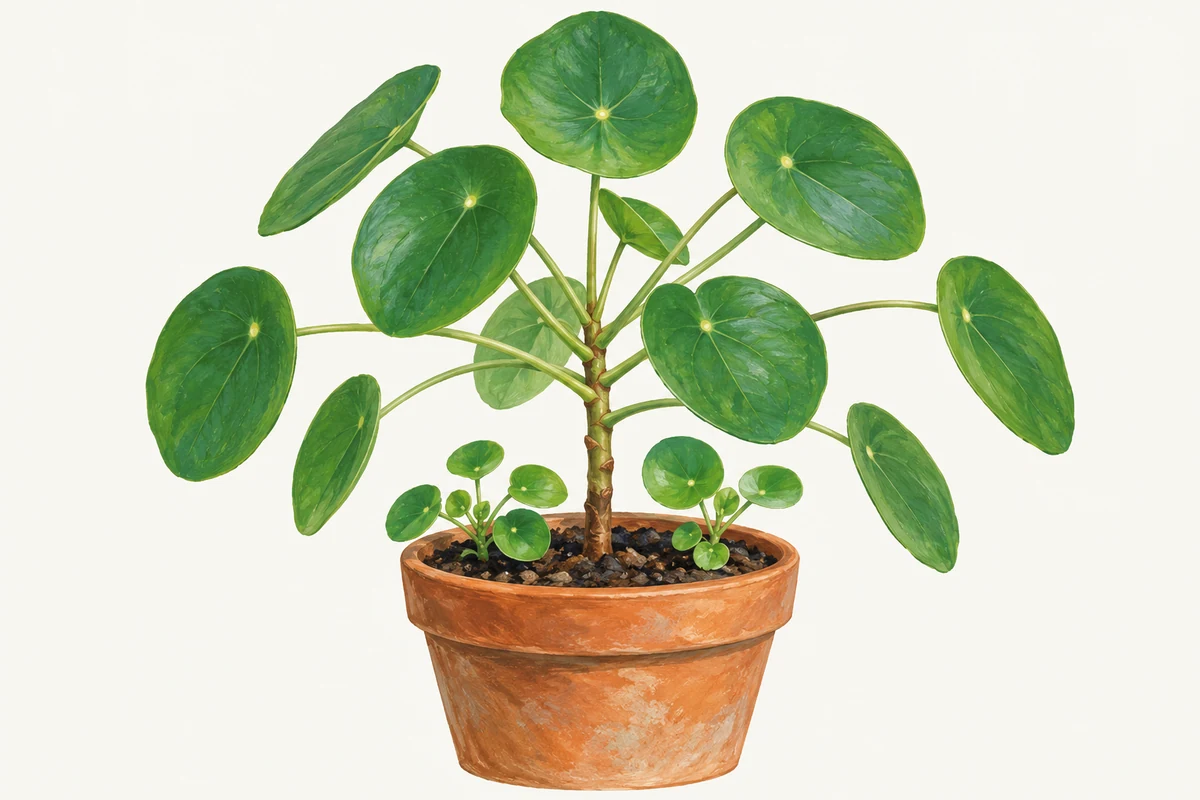
Round, glossy, coin-like leaves on long stalks that join each leaf at its center, like lily pads, on a compact, upright plant. Here is what to check, and how to rule out two look-alikes.
In short
A Chinese money plant (Pilea peperomioides) is a compact houseplant in the nettle family with glossy, round, dark green leaves about 4 inches across. Each long leaf stalk joins the underside of the leaf at its center, so the leaves look like lily pads floating on air. The plant grows 8 to 12 inches tall and wide, rarely flowers indoors, and comes from Yunnan in southern China.
- Round leaves with the stalk joined at the center, on a compact, upright clump, point to Pilea peperomioides.
- Teardrop-shaped leaves with a pointed tip and a small dimple mean raindrop peperomia (Peperomia polybotrya).
- The ASPCA's plant list has no entry for this species; call your vet if a pet chews it.
Field marks at a glance
- Scientific name
- Pilea peperomioides
- Family
- Urticaceae (nettle family)
- Type
- Houseplant, perennial, evergreen
- Leaves
- Simple, fleshy, glossy and dark green; orbicular (round), 3 to 6 inches long and wide, about 4 inches across on a typical plant (NC State). Hairless.
- Leaf stalk
- Long, and peltate: it joins the underside of the leaf at its center, not at the edge, so the leaf looks like a lily pad (NC State).
- Habit
- Compact, erect and clumping; it makes offsets, or pups, around the base (NC State).
- Size
- 8 to 12 inches tall and the same across (NC State).
- Flowers
- Small, white to pinkish, on a tall spike in spring; houseplants rarely flower (NC State).
- Native range
- Shady, cool mountain areas of Yunnan Province, southern China (NC State).
- Names
- Also called pilea, pancake plant and UFO plant in shops. GBIF accepts Pilea peperomioides Diels, family Urticaceae.
The Chinese money plant (Pilea peperomioides) is a compact houseplant from southern China, grown for its round, coin-like leaves. Several unrelated plants share the "money" nickname or the round leaf, so check the leaf shape, the stalk and the habit in the order below.
How to identify a Chinese money plant in three checks
1. The leaf shape. Hold a leaf flat. According to the NC State Plant Toolbox, the leaves are circular, fleshy, glossy and dark green, 3 to 6 inches long and wide and about 4 inches across on a typical plant. There is no pointed tip and the edge is smooth.
2. Where the stalk joins. Turn the leaf over. The long stalk attaches at the center of the underside, not at the edge. Botanists call this a peltate leaf, and NC State notes that it makes the leaves look like lily pads, or as if they were floating on air. This is the single most useful check.
3. The habit. Step back. The plant is compact, erect and clumping, 8 to 12 inches tall and the same across, and it produces offsets, or pups, from the base. NC State notes that it can carry small, white to pinkish flower spikes in spring, but houseplants rarely flower.
When a plant arrives without a tag, Plant Identifier can give a common and scientific name from one photo; include a whole leaf and the place where the stalk meets it. The app shows no confidence score and no list of alternatives, so compare its answer with the checks above.
Chinese money plant vs raindrop peperomia and pennywort
Two other plants have leaves with the stalk joined underneath, which is why they get mixed up. NC State's Peperomia polybotrya page says raindrop peperomia is often confused with Pilea peperomioides, and its Hydrocotyle umbellata page lists "money plant" among the common names of dollarweed.
| Feature | Chinese money plant | Raindrop peperomia | Dollarweed (pennywort) |
|---|---|---|---|
| Leaf shape | Round, no tip | Teardrop, pointed tip | Round, scalloped and lobed edge |
| Stalk join | Center of the underside | Underside, leaving a slight dimple | Center, umbrella-like |
| Habit | Upright clump, 8 to 12 in | Upright, about 1 ft | Creeping mats, 3 to 10 in |
| Family | Nettle (Urticaceae) | Pepper (Piperaceae) | Ivy (Araliaceae) |
| Where you find it | Pots indoors | Pots indoors | Wet ground, ditches, ponds |
For other small-leaved houseplants, see the peperomia page. The money tree, Pachira aquatica, is a different plant with braided trunks and hand-shaped leaves; it has its own page: money tree. For a step-by-step route through other houseplants, try the houseplant identification key.
The name
NC State describes Pilea peperomioides as a member of the nettle family, Urticaceae, native to the shady, cool mountain areas of Yunnan Province in southern China. The GBIF backbone taxonomy accepts the name Pilea peperomioides Diels in the same family. The species name means "like a peperomia", which is fitting, since a raindrop peperomia is its most common look-alike.
Is a Chinese money plant toxic to pets
The ASPCA's toxic and non-toxic plant list has no entry for Pilea peperomioides; its "aluminum plant" and "friendship plant" entries are other Pilea species and do not cover this one. A missing listing is not a guarantee.
If a pet has chewed a leaf, call your vet or the ASPCA Animal Poison Control Center at (888) 426-4435. For a person, call Poison Control at 1-800-222-1222 (poison.org). Plant Identifier's Toxicology tool gives AI-written notes for people, dogs and cats; treat them as a starting point, not as the answer. Houseplants that are on the ASPCA's lists are covered in plants toxic to cats.
A short care note
NC State recommends bright, indirect light, a moist, well-drained potting mix and moderate to high humidity, though the plant tolerates average home humidity. It advises keeping the plant away from cold drafts and heat sources, warns that overwatering can cause root rot and that wet foliage can lead to leaf spots, and says leggy growth means too little light. New plants are usually started from the pups or from stem cuttings in spring or early summer.
Look-alikes and how to tell them apart
Raindrop peperomia (Peperomia polybotrya)
Look at the leaf outline. Raindrop peperomia leaves are teardrop-shaped with a pointed tip, and the stalk joins the underside a little off center, leaving a slight dimple on the top (NC State). Chinese money plant leaves are round, with no point. NC State notes the two are often confused.
Pennywort, dollarweed (Hydrocotyle umbellata)
Check the edge and where it grows. Dollarweed also has round leaves with a central stalk, but their margins are scalloped and lobed, and it is a creeping, mat-forming plant of wet ground and ponds, only 3 to 10 inches tall (NC State). A Chinese money plant has smooth-edged leaves on an upright pot plant.
What a photo can't settle
- Young Pilea plants and small raindrop peperomias can look alike in a photo; check the leaf tip and where the stalk joins on several leaves.
- Shops sell Pilea under several nicknames, and 'money plant' is also used for other plants, so a label is not proof.
- Whether a pet that chewed a leaf needs treatment is for your vet or a poison control center to decide, not for this page or an app.
Questions people ask
Is a Chinese money plant the same as a money tree?
No. The Chinese money plant is Pilea peperomioides, a small nettle-family plant with round, single leaves. The money tree is Pachira aquatica, a woody plant with braided trunks and hand-shaped leaves of several leaflets. They share a nickname, not a family.
What is the difference between Pilea and raindrop peperomia?
The leaf shape. Pilea leaves are round, with the stalk at the center. Raindrop peperomia (Peperomia polybotrya) leaves are teardrop-shaped with a pointed tip and a small dimple where the stalk joins underneath (NC State). Raindrop peperomia is in the pepper family.
Why is my Chinese money plant tall and leggy?
NC State says leggy growth results from too little light. The plant prefers bright, indirect light; a bare, stretched stem with leaves only at the top is a light problem, not a different plant.
Is a Chinese money plant toxic to cats and dogs?
The ASPCA's toxic and non-toxic plant list has no entry for Pilea peperomioides, and that absence is not a guarantee. If your pet chewed it, call your vet or the ASPCA Animal Poison Control Center at (888) 426-4435. For a person, call Poison Control at 1-800-222-1222.
Sources
- Pilea peperomioides — North Carolina Extension Gardener Plant Toolbox (NC State)
- Peperomia polybotrya — North Carolina Extension Gardener Plant Toolbox (NC State)
- Hydrocotyle umbellata — North Carolina Extension Gardener Plant Toolbox (NC State)
- Pilea peperomioides, species match — GBIF Backbone Taxonomy (API)
- Poison Control — National Capital Poison Center
Keep reading
- Houseplant profilePeperomia: how to identify the radiator plant
- Houseplant profileMoney tree (Pachira aquatica): how to identify it
- Free toolHouseplant identification key
- Pet safety guidePlants toxic to cats, and what to do if your cat chewed one
- Houseplant profileBird of paradise (Strelitzia): how to identify it