Houseplant profile
Bird of paradise (Strelitzia): how to identify it
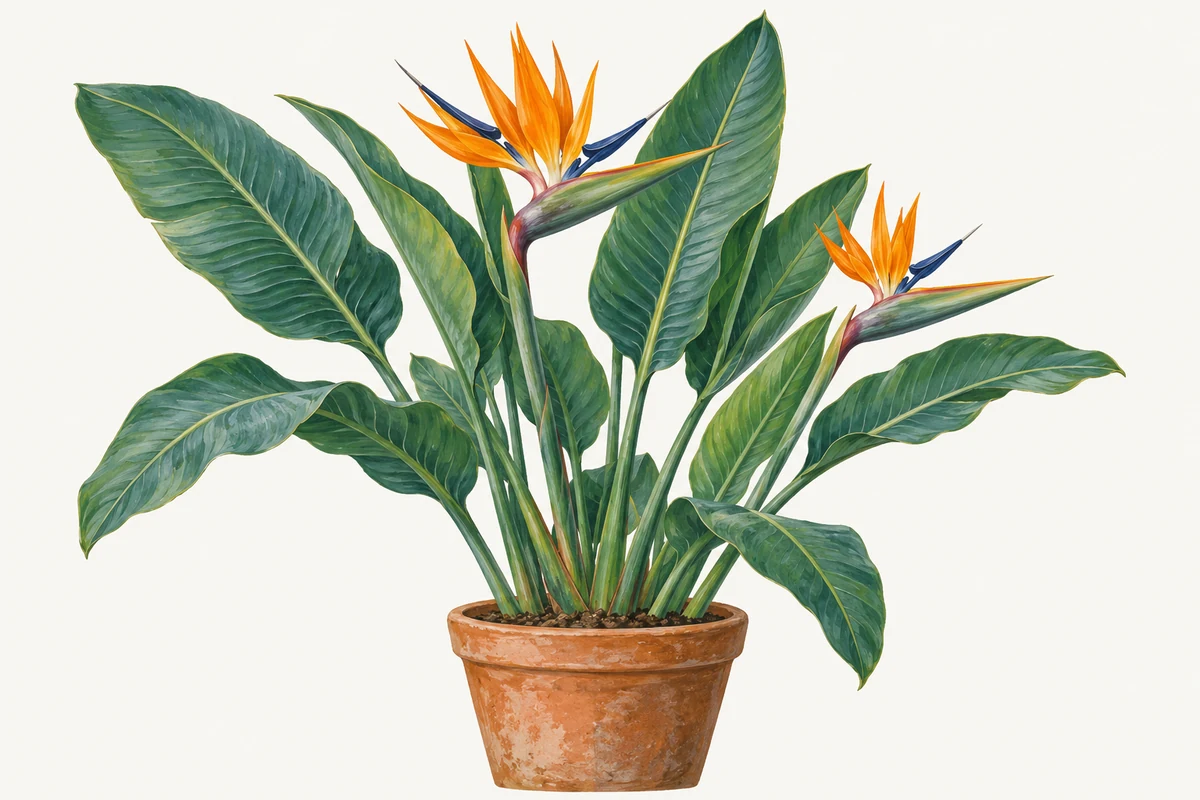
A clump of stiff, paddle-shaped, gray-green leaves and a flower like a bird's head: a beaked spathe with orange and blue, or white and blue, flowers. Here is how to tell which one you have.
In short
A bird of paradise plant (Strelitzia) is a clumping tropical plant with stiff, gray-green, banana-like leaves on long stalks and a flower shaped like a bird's head: a boat-shaped spathe from which the flowers emerge one at a time. Strelitzia reginae has orange and blue flowers and stays 3 to 5 feet tall. Strelitzia nicolai has white and blue flowers, a purplish-black spathe and a woody stem.
- Orange sepals and blue petals over a beak-like spathe point to Strelitzia reginae.
- White and blue flowers, a purplish-black spathe and a woody stem point to Strelitzia nicolai, the white bird of paradise.
- The ASPCA lists Strelitzia reginae as toxic to dogs, cats and horses; a separate ASPCA "Bird of Paradise" entry is a different plant, Caesalpinia gilliesii.
Field marks at a glance
- Scientific name
- Strelitzia reginae, Strelitzia nicolai
- Family
- Strelitziaceae (bird-of-paradise family)
- Type
- Houseplant, perennial, evergreen
- Leaves
- Simple, smooth-edged, hairless and gray-green to blue-green, shaped like banana leaves (NC State). On S. reginae the blades are oblong, 12 to 18 inches long, on long, stiff leafstalks (UF/IFAS).
- Leaf size
- NC State gives clumps of leaves 3.5 to 4 feet long for S. reginae, and leaves up to 6.5 feet long for S. nicolai.
- Growth habit
- A clump of leaves rising from underground rhizomes (S. reginae); S. nicolai forms clumping, upright, woody stems with old leaf scars (NC State).
- Flower head
- A boat- or beak-shaped spathe held sideways like a bird's head; the flowers emerge from it one at a time (NC State).
- Flowers, S. reginae
- Three brilliant orange sepals and three bright blue petals, two of them joined into an arrow-like nectary (NC State).
- Flowers, S. nicolai
- White and blue tepals from a purplish-black spathe, like a bird with a white crest and a dark blue beak (NC State).
- Size
- S. reginae: 3 to 4 ft tall and wide (NC State), up to 3 to 5 ft tall with a 2 to 4 ft spread (UF/IFAS). S. nicolai: 20 to 30 ft tall in its native habitat (NC State).
- Fruit
- A capsule with seeds carrying an orange aril; on S. nicolai the seeds are large and black (NC State).
- Native range
- South Africa: S. reginae from the Cape Provinces to KwaZulu-Natal; S. nicolai in Botswana, KwaZulu-Natal, Mozambique and Zimbabwe (NC State).
The bird of paradise (Strelitzia) is a clumping tropical plant from southern Africa, grown indoors and in frost-free gardens for its paddle-shaped leaves and its flower shaped like a bird's head. Two species are sold under the name, and the common name is also used for an unrelated shrub, so check the leaves, the flower and the base in the order below.
How to identify a bird of paradise plant in four checks
1. The leaves. A bird of paradise leaf is a simple, smooth-edged, hairless blade, gray-green to blue-green, shaped like a banana leaf and held on a long, stiff stalk. UF/IFAS Gardening Solutions describes the blades of Strelitzia reginae as oblong and 12 to 18 inches long, staying blue or blue-green all year. The NC State Plant Toolbox describes clumps of 3.5 to 4 foot leaves.
2. The flower head. Look for a stiff, boat-shaped spathe held sideways at the top of a stalk, like a bird's head and beak. The flowers come out of it one at a time, so a single head can show one open flower and more waiting inside.
3. The flower colors. This settles the species. S. reginae has three brilliant orange sepals and three bright blue petals; two of the blue petals are joined into an arrow-like nectary. The white bird of paradise, Strelitzia nicolai, has white and blue tepals rising from a purplish-black spathe, so the head looks like a bird with a white crest and a dark blue beak.
4. The base. Part the leaves at soil level. S. reginae grows as a clump of leaves from underground rhizomes, with no trunk. S. nicolai develops woody, smooth, gray stems marked with old leaf scars, up to 1.5 feet wide in the ground, so an older plant with a visible trunk and no flowers is more likely the white species.
If a plant arrives without a tag, Plant Identifier can give a common and scientific name from one photo; include a flower if there is one, because the leaves of the two species look alike. The app shows no confidence score and no list of alternatives, so compare its answer with the checks above.
Bird of paradise vs white bird of paradise
NC State and UF/IFAS give these figures for the two plants sold as bird of paradise:
| Feature | Bird of paradise (S. reginae) | White bird of paradise (S. nicolai) |
|---|---|---|
| Flower colors | Orange sepals, blue petals | White and blue tepals |
| Spathe | Gray-green, beak-like | Purplish-black, boat-shaped |
| Stem | None visible, leaves from rhizomes | Woody, gray, with leaf scars |
| Leaves | Oblong blades, 12 to 18 in (UF/IFAS); clumps of 3.5 to 4 ft leaves (NC State) | Oblong to linear, up to 6.5 ft |
| Size | 3 to 5 ft tall | 20 to 30 ft tall in its native habitat |
| Native range | Cape Provinces to KwaZulu-Natal, South Africa | Botswana, KwaZulu-Natal, Mozambique, Zimbabwe |
NC State notes that S. nicolai is found along coastal dunes and forests, flowers on mature plants and may take 5 to 6 years before flowering, and that each flower lasts about 3 days. It also describes a cultivar of S. reginae, 'Mandela's Gold', with grayish-green leaves, a gray and pink beak-like spathe and yellow and purple flowers, so a yellow-flowered plant can still be S. reginae. Both are hardy outdoors only in USDA zones 10 to 11 or 12 (NC State, UF/IFAS); elsewhere they are container plants.
Bird of paradise vs banana and traveller's tree
All three have big, paddle-shaped leaves that tear along the side veins, which is why young plants get mixed up. Check the stem and the way the leaves are arranged.
- Banana (Musa acuminata): NC State describes leaves 6 to 10 feet long whose overlapping sheaths form a soft, trunk-like false stem, and cream to yellow flowers growing sideways from that stem on mature plants (NC State on banana). The leaves are green rather than gray-green, and there is no beaked spathe.
- Traveller's tree (Ravenala madagascariensis): a tree from Madagascar with an unbranched trunk topped by a single flat fan of 20 to 30 long-stalked leaves, each 5 to 10 feet long, and white flowers from boat-shaped spathes similar to bird of paradise (NC State on traveller's tree). The flat, fan-shaped leaf arrangement is the giveaway.
Indoors, a tall, gray-green plant with a woody stem is more often S. nicolai, which some sellers label simply "bird of paradise". For other large-leaved houseplants, compare with the fiddle-leaf fig, whose leaves are leathery and violin-shaped, or follow the houseplant identification key.
Is a bird of paradise toxic to pets
The ASPCA lists bird of paradise flower (Strelitzia reginae, also crane flower and bird's tongue flower) as toxic to dogs, cats and horses. It names GI irritants as the toxic principle and lists mild nausea, vomiting and drowsiness, caused mainly by the fruit and seeds. NC State lists S. nicolai as toxic to humans, dogs, cats and horses and advises gloves when handling it, because of the chance of skin irritation.
Check which plant you have before reading a toxicity entry. A separate ASPCA entry titled "Bird of Paradise" is for Caesalpinia gilliesii (also called peacock flower, Barbados pride, poinciana and pride of Barbados), a plant in the pea family. The ASPCA lists it as toxic to dogs and cats, names possibly hydrocyanic acid, and says it should not be confused with the less toxic Strelitzia reginae.
If a pet has chewed a leaf, flower or seed, call your vet or the ASPCA Animal Poison Control Center at (888) 426-4435. For a person, call Poison Control at 1-800-222-1222 (poison.org). Plant Identifier's Toxicology tool gives AI-written notes for people, dogs and cats; treat them as a starting point, not as the answer. More houseplants on the ASPCA's lists are in plants toxic to cats and poisonous plants for dogs.
A short care note
NC State advises growing S. reginae indoors in a well-lit, sunny spot in fertile, well-drained loam, watering freely and feeding regularly in spring and summer, keeping it drier in winter, and giving it nights of 55 to 65°F. It warns that overwatering or poorly drained soil can cause root rot, and to watch for mealybugs, scale and spider mites. For S. nicolai, NC State recommends bright, indirect light, watering when the top layer of soil feels dry, temperatures of 65 to 85°F and never below 50°F, and higher humidity. If the leaves develop spots, Plant Identifier's Diagnose tool can suggest a likely cause from a photo; check it against the advice above.
Look-alikes and how to tell them apart
White bird of paradise (Strelitzia nicolai) vs bird of paradise (S. reginae)
Look at the flower and the base. S. reginae has orange and blue flowers and leaves rising from soil level. S. nicolai has white and blue flowers from a purplish-black spathe and, as it matures, a woody, gray stem with leaf scars (NC State). Without flowers, a tall plant with a visible trunk is more likely S. nicolai.
Banana (Musa acuminata)
Check the stem and the leaf color. A banana's overlapping leaf sheaths form a soft, trunk-like false stem, and its leaves are green and 6 to 10 feet long (NC State). Bird of paradise leaves are gray-green on long, separate leafstalks, and its flowers sit in a beaked spathe.
Traveller's tree (Ravenala madagascariensis)
Look at the leaf arrangement. Traveller's tree holds 20 to 30 long-stalked, deep green leaves in a single flat fan on an unbranched trunk, each 5 to 10 feet long (NC State). Bird of paradise leaves do not line up in one plane.
What a photo can't settle
- Without flowers, young S. reginae and S. nicolai plants look much alike; a photo of leaves alone may name the genus but not the species.
- The common name "bird of paradise" is also used for Caesalpinia gilliesii, a different plant; check the scientific name before acting on toxicity information.
- Whether a pet that chewed a leaf, flower or seed needs treatment is for your vet or a poison control center to decide, not for this page or an app.
Questions people ask
What is the difference between a bird of paradise and a white bird of paradise?
They are two species of Strelitzia. S. reginae has orange and blue flowers and stays about 3 to 5 feet tall. S. nicolai, the white bird of paradise, has white and blue flowers from a purplish-black spathe, grows a woody stem and can reach 20 to 30 feet in its native habitat (NC State, UF/IFAS).
Why are my bird of paradise leaves splitting?
Splitting along the side veins is typical of these banana-like leaves. NC State notes that S. nicolai leaves rip along their veins in wind, and that strong wind damages the leaves. Torn leaves on an otherwise healthy plant do not by themselves mean disease.
How long before a bird of paradise flowers?
NC State says a white bird of paradise (S. nicolai) may take 5 to 6 years before it flowers. For S. reginae, UF/IFAS says mature plants bloom periodically through the year and can produce up to three dozen flower spikes a year.
Is a bird of paradise plant poisonous to dogs and cats?
The ASPCA lists bird of paradise flower (Strelitzia reginae) as toxic to dogs, cats and horses, naming GI irritants and signs such as mild nausea, vomiting and drowsiness, mainly from the fruit and seeds. If your pet chewed it, call your vet or the ASPCA Animal Poison Control Center at (888) 426-4435. For a person, call Poison Control at 1-800-222-1222.
Sources
- Strelitzia reginae — North Carolina Extension Gardener Plant Toolbox (NC State)
- Strelitzia nicolai — North Carolina Extension Gardener Plant Toolbox (NC State)
- Bird of Paradise — UF/IFAS Gardening Solutions
- Bird of Paradise Flower — ASPCA Animal Poison Control Center
- Bird of Paradise — ASPCA Animal Poison Control Center
- Musa acuminata — North Carolina Extension Gardener Plant Toolbox (NC State)
- Ravenala madagascariensis — North Carolina Extension Gardener Plant Toolbox (NC State)
- Poison Control — National Capital Poison Center
Keep reading
- Houseplant profileFiddle leaf fig (Ficus lyrata): how to identify it
- Houseplant profileKentia palm (Howea forsteriana): how to identify it
- Houseplant profileChinese money plant (Pilea peperomioides): how to identify it
- Pet safety guidePoisonous plants for dogs, and what to do if your dog ate one
- Free toolHouseplant identification key