Houseplant profile
Peperomia: how to identify the radiator plant
A small, slow-growing pepper-family houseplant with thick, glossy, sometimes ridged or striped leaves and mouse-tail flower spikes. Here is what to check.
In short
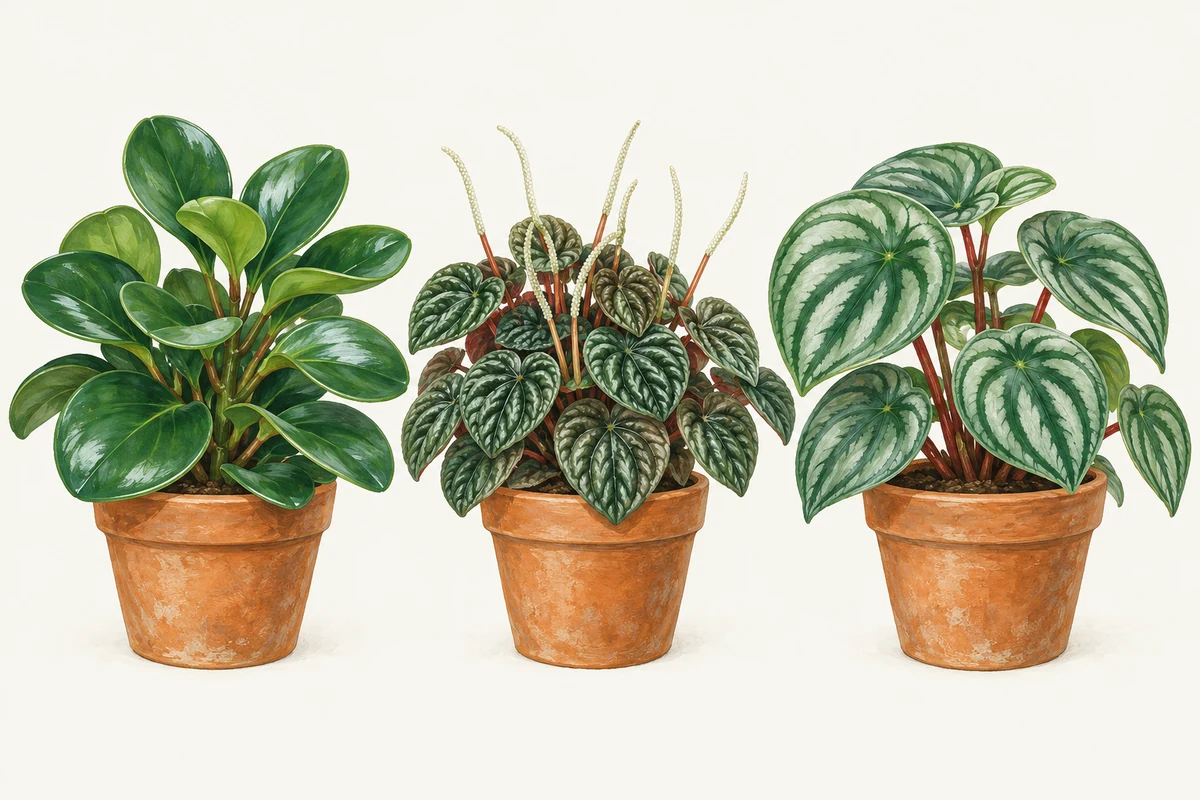
A peperomia plant is a small herbaceous perennial in the pepper family (Piperaceae), usually 6 to 12 inches tall and wide. Its simple leaves are smooth, often glossy and fleshy, and may be round, heart-shaped or lance-shaped, plain, striped or ridged. If it flowers, it sends up thin, upright spikes of tiny greenish-white to brown flowers with no petals.
- Thick, fleshy, smooth leaves on a compact plant under about a foot, plus thin flower spikes, point to Peperomia.
- Round leaves with the stalk joined at the centre, like a lily pad, mean Chinese money plant (Pilea peperomioides).
- The ASPCA lists baby rubber plant and emerald ripple peperomia as non-toxic to dogs and cats; that is its classification, not a guarantee.
Field marks at a glance
- Scientific name
- Peperomia
- Family
- Piperaceae (pepper family)
- Type
- Houseplant, perennial, evergreen
- Leaves
- Simple; heart-shaped, round or lance-shaped depending on the species, arranged alternate, opposite or whorled (NC State).
- Leaf surface
- Smooth, often glossy and fleshy; many species are succulent and store water in their leaves. Green, silver, chocolate brown or variegated. Hairless, except fuzzy P. incana (NC State).
- Stem
- Green or red, mostly smooth, some hairy (NC State). Habit can be erect, bushy, trailing or creeping.
- Flower
- Small, non-showy, greenish-white to brown flowers on thin, usually erect spikes. Rarely blooms as a houseplant (NC State).
- Size
- Usually 6 to 12 inches high and wide (NC State); the baby rubber plant, P. obtusifolia, reaches up to 2 feet.
- Native range
- Tropics and subtropics of Central and South America, Africa, Southeast Asia, eastern Australia and New Zealand (NC State).
- Genus
- Over 1,000 species (NC State). The name comes from the Greek for pepper and resembling, after its relative black pepper.
Peperomia is a large genus of small, slow-growing houseplants in the pepper family, sold under dozens of species and cultivar names. Because the leaves vary so much, from round and striped to ridged or narrow, check the features the genus shares rather than the colour.
How to identify a peperomia plant in four checks
1. The size and habit. A peperomia is small. The NC State Plant Toolbox gives 6 to 12 inches high and wide for the species, with habits from erect and bushy to trailing or creeping. A plant several feet tall is something else.
2. The leaf texture. Press a leaf gently. Peperomia leaves are simple, smooth and often glossy, and many are thick and fleshy because the plant stores water in them. Only a few species, such as P. incana, are hairy.
3. The leaf shape and pattern. Here the genus varies widely. NC State lists heart-shaped, round and lance-shaped leaves, arranged alternate, opposite or in whorls, in green, silver, chocolate brown or variegated. That range is why it helps to know the common types below.
4. The flower spike. If there is a flower, it is not a bloom with petals but a thin, usually erect spike of tiny greenish-white to brown flowers. NC State notes that houseplants rarely flower, so do not wait for one.
If the label is gone, Plant Identifier can give a common and scientific name from one photo; frame a few leaves and the stems. The app shows no confidence score and no list of alternatives, so compare its answer with the checks above.
Common peperomia types
NC State lists many species grown as houseplants. These are among the easiest to tell apart:
- P. obtusifolia (baby rubber plant): erect and bushy, up to 2 feet, with glossy, cupped, spoon-shaped leaves 2 to 6 inches long on stalks usually tinged pink. See NC State on Peperomia obtusifolia.
- P. argyraea (watermelon peperomia): round leaves striped dark and light green, like a watermelon rind.
- P. caperata (ripple peperomia): deeply ridged, heart-shaped, dark green to burgundy leaves.
- P. clusiifolia: stiff, elliptical, deep green leaves with dark red edges.
- P. prostrata: a trailer whose tiny leaves look like a string of turtle shells.
- P. polybotrya: succulent, often confused with Pilea peperomioides.
NC State describes the baby rubber plant's leaves as waxy, glossy and almost as thick as a succulent's, with the midrib pressed into the surface and often red edges or cream variegation.
Peperomia vs Chinese money plant and rubber plant
| Feature | Peperomia | Chinese money plant | Rubber plant |
|---|---|---|---|
| Family | Pepper (Piperaceae) | Nettle (Urticaceae) | Mulberry (Moraceae) |
| Leaf attachment | Usually at the leaf edge | Centre of the leaf (peltate) | At the leaf edge |
| Leaf size | Small; 2 to 6 in on baby rubber plant | Round, about 4 in across | Up to 17 in, leathery |
| Height | 6 to 12 in, up to 2 ft | 8 to 12 in | A tree; 2 to 10 ft indoors |
The Chinese money plant facts come from NC State on Pilea peperomioides, which describes round, fleshy, dark green leaves whose long stalks join at the centre so they look like lily pads. The rubber plant facts come from NC State on Ficus elastica, and it has its own page: rubber plant. For thick-leaved plants from other families, see succulent identification and the jade plant, or try the houseplant identification key.
Is peperomia toxic to pets
The ASPCA lists baby rubber plant (Peperomia obtusifolia, also pepper face and American rubber plant) as non-toxic to dogs and cats, and its emerald ripple peperomia entry (P. caperata) as non-toxic to dogs, cats and horses. That is the ASPCA's classification, not a guarantee, and it covers only the species named. Its plant list warns that eating any plant material may cause vomiting and stomach upset in dogs and cats.
If a pet is unwell after chewing a leaf, call your vet or the ASPCA Animal Poison Control Center at (888) 426-4435. For a person, call Poison Control at 1-800-222-1222 (poison.org). Plant Identifier's Toxicology tool gives AI-written notes for people, dogs and cats; treat them as a starting point, not as the answer. Houseplants the ASPCA does list as toxic are gathered in plants toxic to cats.
A short care note
NC State recommends bright indirect light, though peperomias tolerate low light, and a moist, well-drained mix of loam and sand. Avoid overwatering and cold drafts; root rot and yellowing or curling leaves point to too much water, and direct sun can scorch the leaves. For other causes of yellowing, see yellow leaves on plants.
Look-alikes and how to tell them apart
Chinese money plant (Pilea peperomioides)
Find where the stalk joins the leaf. Pilea leaves are round, fleshy, about 4 inches across and peltate: the long stalk attaches at the centre, like a lily pad (NC State). It is in the nettle family. Most peperomias have the stalk at the leaf edge; NC State notes that P. polybotrya is often confused with Pilea.
Rubber plant (Ficus elastica)
Check the size and the leaf. The baby rubber plant (Peperomia obtusifolia) is a bushy plant up to 2 feet with cupped leaves 2 to 6 inches long on pink-tinged stalks (NC State). A rubber plant is a tree in the mulberry family, kept to 2 to 10 feet indoors, with stiff, leathery leaves up to 17 inches (NC State).
What a photo can't settle
- With over 1,000 species and many cultivars, a photo can often name the genus but not the exact species or cultivar.
- Small, fleshy-leaved peperomias can look like succulents from other families; check the leaf attachment and any flower spike.
- Whether a pet that chewed a leaf needs treatment is for your vet or a poison control center to decide, not for this page or an app.
Questions people ask
Why is it called a radiator plant?
NC State explains that the common name radiator plant refers to the plant's preference for warm conditions. The genus name, Peperomia, comes from the Greek for pepper and resembling, because it is related to black pepper, Piper nigrum.
Is a peperomia a succulent?
Many are. NC State notes that many peperomia species are succulent and store water in their fleshy leaves, and describes the baby rubber plant's leaves as almost as thick as a succulent's. Botanically, though, the genus belongs to the pepper family, not to a succulent family.
Does peperomia flower?
It can. In the wild, peperomias produce thin, upright spikes of small greenish-white to brown flowers, usually in summer. NC State notes that as a houseplant it typically does not flower, so most plants are identified by their leaves.
Is peperomia poisonous to cats?
The ASPCA lists baby rubber plant (Peperomia obtusifolia) and emerald ripple peperomia (P. caperata) as non-toxic to dogs and cats. That is the ASPCA's classification, not a guarantee, and it does not cover every species. If your pet is unwell, call your vet or the ASPCA Animal Poison Control Center at (888) 426-4435.
Sources
- Peperomia — North Carolina Extension Gardener Plant Toolbox (NC State)
- Peperomia obtusifolia — North Carolina Extension Gardener Plant Toolbox (NC State)
- Pilea peperomioides — North Carolina Extension Gardener Plant Toolbox (NC State)
- Ficus elastica — North Carolina Extension Gardener Plant Toolbox (NC State)
- Baby Rubber Plant — ASPCA Animal Poison Control Center
- Emerald Ripple Peperomia — ASPCA Animal Poison Control Center
- Toxic and Non-Toxic Plant List — ASPCA Animal Poison Control Center
- Poison Control — National Capital Poison Center
Keep reading
- Houseplant profileRubber plant (Ficus elastica): how to identify it
- Plant profileJade plant (Crassula ovata): how to identify it
- Field guideSucculent identification: how to identify succulents by shape, leaf and sap
- Pet safety guidePlants toxic to cats, and what to do if your cat chewed one
- Plant healthYellow leaves on plants, and what each pattern means