Houseplant profile
Philodendron: how to identify the vining and split-leaf types
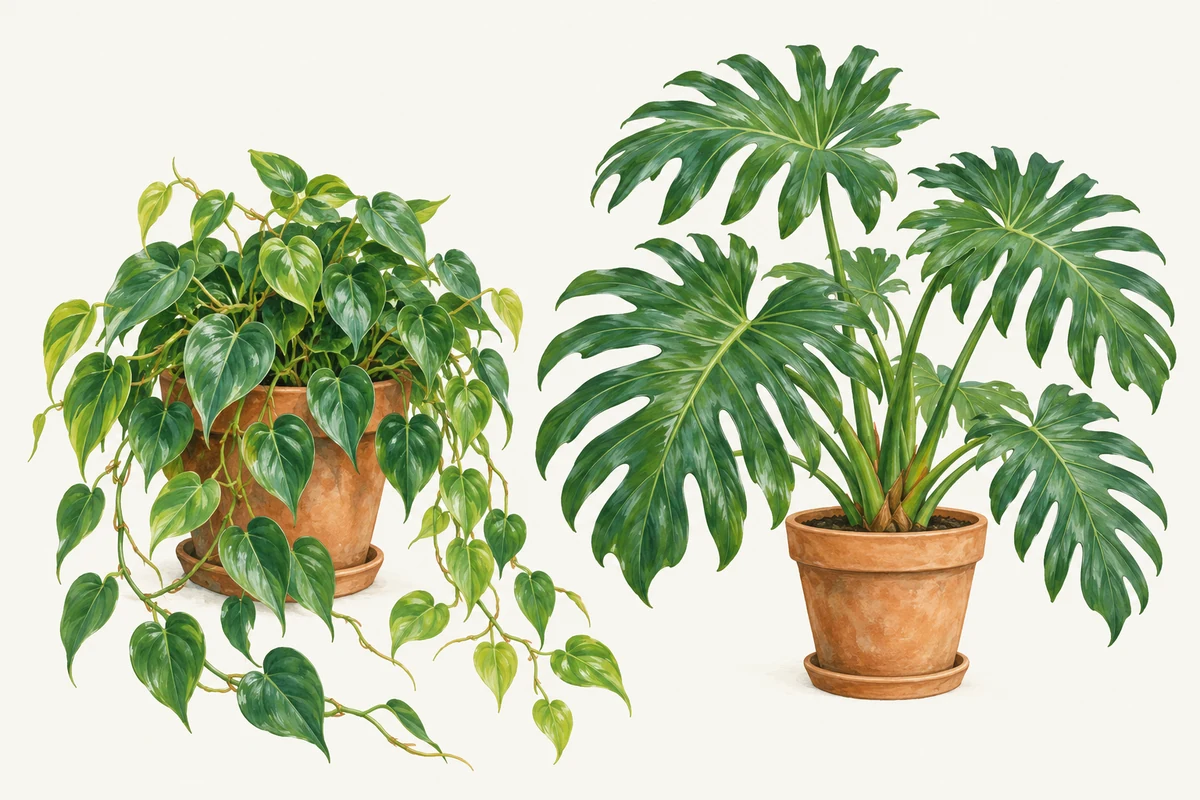
Two very different plants share the name: the trailing heartleaf philodendron and the big, deeply lobed tree philodendron. The newest leaf and the stem tell you which one you have.
In short
Philodendron is a genus of over 600 species in the arum family, sold as two types. Vining philodendrons such as heartleaf philodendron (Philodendron hederaceum) trail on slender stems with glossy, heart-shaped leaves, rounded stalks and a papery sheath around each new leaf. Self-heading types such as the tree philodendron (P. bipinnatifidum) grow upright, with huge, deeply lobed leaves and leaf scars on a stout stem.
- A papery sheath that dries brown at the base of each new leaf is the best single sign of a philodendron.
- Deeply lobed leaves with no holes on a stout, scarred stem point to tree philodendron; leaves with holes and a hinge at the top of the stalk point to monstera.
- World Flora Online lists Thaumatophyllum bipinnatifidum as a synonym of Philodendron bipinnatifidum.
Field marks at a glance
- Scientific name
- Philodendron
- Family
- Araceae (arum family)
- Type
- Houseplant, perennial, evergreen
- Growth type
- Climbing or vining (trailing stems with aerial roots) or self-heading (upright, very short stem, leaves in a rosette), per NC State.
- New leaves
- Emerge from a papery sheath (cataphyll or stipule) that dries brown and falls; old stems carry messy remains (NC State).
- Heartleaf leaves
- Glossy, leathery and heart-shaped, green or red-purple beneath; they emerge bronze and quickly turn green (NC State).
- Leaf stalk (vining types)
- Slender, rounded and not grooved, shorter than the blade; a grooved stalk means pothos instead.
- Tree philodendron leaves
- Very large, glossy, deeply lobed (pinnatifid) and up to 4 ft long on long, smooth stalks, without holes (NC State).
- Stems
- Vining types: slender, green, with aerial roots, to 4 ft or more. Tree types: stout, with prominent leaf scars and aerial roots (NC State).
- Flowers
- A white spadix in a spathe, often purplish-red outside; houseplants rarely bloom, and tree philodendron can take 10 to 15 years indoors (NC State).
- Size
- From 3 to 30 ft tall across the genus; heartleaf vines 4 in to 6 ft indoors, tree philodendron 4 to 10 ft tall and 6 to 10 ft wide (NC State).
- Native range
- Tropical forests of Central and South America and the Caribbean, where many climb tree trunks or grow as epiphytes (NC State).
Philodendron is one of the largest houseplant genera, and the name covers plants that look nothing alike: a trailing vine with small heart-shaped leaves and a shrub with leaves as long as your arm. Start by deciding which of the two types you have, then confirm the genus with the newest leaf.
How to identify a philodendron: type first, then the new leaf
Step 1: climbing or self-heading. The NC State Plant Toolbox divides the genus into two groups. Climbing or vining philodendrons send out slender stems with aerial roots that grip a pole or trail from a basket; heartleaf philodendron is the classic example. Self-heading philodendrons grow upright on a very short stem, with large leaves held in a rosette; tree philodendron and hybrids such as 'Birkin' and 'Moonlight' belong here.
Step 2: the sheath on the newest leaf. Go to the growing tip. Each new philodendron leaf emerges from a papery sheath, which NC State calls a stipule and many growers call a cataphyll. It dries brown and falls, and older stems carry its messy remains at the nodes. NC State describes these large, free sheaths on both heartleaf and tree philodendron, which makes them the most useful sign across both types.
Step 3: the leaf itself. Vining types have simple, glossy, leathery leaves, heart-shaped in heartleaf philodendron, often bronze when they first open. Self-heading types have big, often deeply lobed leaves on long stalks. NC State notes that leaves across the genus range from 3 inches to 3 feet, heart-shaped, arrow-shaped or deeply cut, glossy or velvety, green, red, purple, copper or variegated.
Step 4: the stem. On a vine, the stem is slender and green, with roots at the nodes. On a tree philodendron, NC State describes a stout green stem with prominent leaf scars surrounded by stiff scales and thick aerial roots.
If you are unsure where to start, one photo of a stem tip with its newest leaf gives Plant Identifier enough to suggest a name. The app shows no confidence score and no list of alternatives, so check the sheath before you relabel the pot.
Heartleaf philodendron and the vining types
The heartleaf philodendron (Philodendron hederaceum) is the philodendron most people own. NC State describes glossy, heart-shaped, pointed leaves, green or red-purple underneath, on slender trailing stems that can grow 4 feet or more. Its leaf stalks are slender, shorter than the blade and not grooved. NC State's cultivar list covers the variegated forms you will see:
- 'Brasil': a yellow to light-green stripe down the center, dark green borders.
- 'Lemon Lime': bright chartreuse leaves.
- 'Cream Splash' and 'Rio': cream to silver centers with dark green edges.
- 'Silver Stripe': cream to light green with a silver stripe.
Other climbing species NC State lists include the blushing philodendron (P. erubescens), with reddish-purple stems and a red tint beneath the leaves, the silver sword (P. hastatum), with silvery-blue, sword-shaped leaves, and the velvety P. melanochrysum and P. verrucosum.
Because golden pothos and heartleaf philodendron are sold side by side, the stalk groove and the sheath are worth learning; the pothos vs philodendron page sets out both tests and the cultivars that look the most alike.
Tree philodendron and other split-leaf types
The tree philodendron (Philodendron bipinnatifidum, often sold as 'Selloum') is the big self-heading type. NC State gives glossy, leathery, dark green leaves up to 4 feet long, deeply lobed, on long, smooth stalks, and a plant 4 to 10 feet tall and 6 to 10 feet wide that reclines or creeps with age. Low light and overwatering make the leaves smaller, with fewer or no lobes, so a young or struggling plant can look less cut than the photos you find.
Xanadu (Philodendron xanadu) is smaller and denser: a mounding clump 3 to 5 feet tall and wide with deeply lobed leaves up to 12 to 18 inches long and stout red stems (NC State).
About the name Thaumatophyllum
In 2018 botanists proposed moving the tree philodendron group into a separate genus, Thaumatophyllum, and some labels now say Thaumatophyllum bipinnatifidum or Thaumatophyllum xanadu. World Flora Online currently lists Thaumatophyllum bipinnatifidum as a synonym of Philodendron bipinnatifidum, and NC State files both plants under Philodendron, listing the Thaumatophyllum names among their other names. Either name on a tag points to the same plant.
Philodendron vs monstera, pothos and arrowhead vine
| Field test | Philodendron | Pothos | Monstera deliciosa | Arrowhead vine |
|---|---|---|---|---|
| Newest leaf | From a papery sheath | No sheath | Whole when young; holes develop as it matures | Stalk sheathing at the base |
| Leaf stalk | Rounded (vining types) | Grooved | Long, with a hinge below the blade | Long, green to reddish |
| Holes in the blade | None | None | Yes, on mature leaves | None |
| Leaf shape | Heart-shaped or deeply lobed | Heart-shaped | Heart-shaped, then split and perforated | Arrow-shaped, later 3 to 11 segments |
The monstera is the plant most often called split-leaf philodendron, and NC State is blunt that it is not a philodendron at all. Its mature leaves are perforated with holes and have a distinct junction where the blade meets the stalk; a tree philodendron's leaves are cut deeply from the edge but never perforated. Pothos is the vine sold as philodendron; check the stalk groove. For other heart-shaped leaves, the houseplant identification key narrows the choice by leaf, stem and habit.
Is philodendron toxic to pets
The ASPCA lists heartleaf philodendron as toxic to dogs, cats and horses, and its Split Leaf Philodendron entry as toxic to dogs and cats. Both name insoluble calcium oxalates, with oral irritation, pain and swelling of the mouth, drooling, vomiting and difficulty swallowing as clinical signs. NC State adds that the sap can irritate skin and that the genus is a problem for children if eaten.
If a pet has chewed a philodendron, call your vet or the ASPCA Animal Poison Control Center at (888) 426-4435 (a consultation fee may apply). If a person has eaten part of the plant, call Poison Control at 1-800-222-1222. Plant Identifier's Toxicology tool gives AI-written notes for people, dogs and cats, but it does not replace that call. Other common houseplants on the ASPCA's list are in plants toxic to cats.
A short care note
NC State recommends bright indirect light, temperatures between 65 and 85°F, moist, well-drained soil high in organic matter, and protection from cold drafts; direct sun scorches the leaves. Heartleaf philodendron tolerates long periods of very low light. Tree philodendron does not tolerate salt build-up, so NC State suggests flushing the soil or using distilled water. Overwatering causes root rot in both types; UF/IFAS notes that some philodendrons grow so large they are called tree philodendrons, while vining types suit hanging baskets.
Look-alikes and how to tell them apart
Pothos (Epipremnum aureum)
Run a fingernail along the upper side of a leaf stalk. Pothos stalks have a groove and its new leaves unfold without a papery sheath; heartleaf philodendron stalks are rounded and each new leaf comes from a sheath. The full test is on the pothos vs philodendron page.
Monstera deliciosa (sold as split-leaf philodendron)
Look for holes and a hinge. Mature monstera leaves are perforated with holes, some reaching the edge, and have a distinct junction where the blade meets the stalk (NC State). Tree philodendron leaves are deeply lobed but have no holes inside the blade.
Arrowhead vine (Syngonium podophyllum)
Check the leaf shape on several leaves. Young arrowhead vine leaves are arrow-shaped, often silvery or pink, and older leaves split into 3 to 11 separate segments like fingers (NC State). Heartleaf philodendron keeps one undivided heart-shaped blade.
Xanadu (Philodendron xanadu)
A philodendron too, not a separate plant: a dense, mounding clump 3 to 5 ft tall and wide with deeply lobed leaves up to 18 in long and stout red stems (NC State). Tree philodendron grows taller, with leaves up to 4 ft long.
What a photo can't settle
- UF/IFAS warns that identifying philodendron species is complicated by differences between juvenile and adult leaves and by the vast number of commercial hybrids; a photo may confirm Philodendron but not the species or cultivar.
- The papery sheath and the stalk groove are small details: a photo of a single leaf, or of an old stem without new growth, may show neither.
- Neither a photo nor this page can tell whether a pet or child ate enough to matter; call your vet or Poison Control.
Questions people ask
How do I know if my plant is a philodendron?
Look at the newest leaf. Philodendrons push each new leaf out of a papery sheath that dries brown and drops, leaving scraps on older stems. Then check the type: trailing stems with heart-shaped leaves mean a vining philodendron; a short, stout stem with huge lobed leaves means a self-heading one.
Is a split-leaf philodendron a philodendron?
It depends on the plant. The name is used for Monstera deliciosa, which NC State says is not a philodendron at all, and for Philodendron bipinnatifidum, the tree philodendron. Holes in mature leaves and a hinge where the blade meets the stalk mean monstera; deep lobes without holes mean tree philodendron.
Is philodendron now called Thaumatophyllum?
Only the tree philodendron group was proposed for that move, and World Flora Online currently lists Thaumatophyllum bipinnatifidum as a synonym of Philodendron bipinnatifidum. NC State also files it under Philodendron. Heartleaf philodendron has always kept the name Philodendron hederaceum.
Is philodendron toxic to cats and dogs?
The ASPCA lists heartleaf philodendron as toxic to dogs, cats and horses and split-leaf philodendron as toxic to dogs and cats, both for insoluble calcium oxalates. If a pet chewed one, call your vet or the ASPCA Animal Poison Control Center at (888) 426-4435. For a person, call Poison Control at 1-800-222-1222.
Sources
- Philodendron — North Carolina Extension Gardener Plant Toolbox (NC State)
- Philodendron hederaceum — North Carolina Extension Gardener Plant Toolbox (NC State)
- Philodendron bipinnatifidum — North Carolina Extension Gardener Plant Toolbox (NC State)
- Philodendron xanadu — North Carolina Extension Gardener Plant Toolbox (NC State)
- Philodendrons — UF/IFAS Gardening Solutions
- Thaumatophyllum bipinnatifidum (Schott ex Endl.) Sakur., Calazans & Mayo — World Flora Online
- Heartleaf Philodendron — ASPCA Animal Poison Control Center
- Split Leaf Philodendron — ASPCA Animal Poison Control Center
Keep reading
- Houseplant comparisonPothos vs philodendron: how to tell them apart
- Houseplant profilePothos (Epipremnum aureum): how to identify it
- Houseplant profileMonstera deliciosa (Swiss cheese plant): how to identify it
- Houseplant profileOxalis (purple shamrock and woodsorrel): how to identify it
- Pet safety guidePlants toxic to cats, and what to do if your cat chewed one