Weed profile
Spotted spurge (Euphorbia maculata): how to identify it
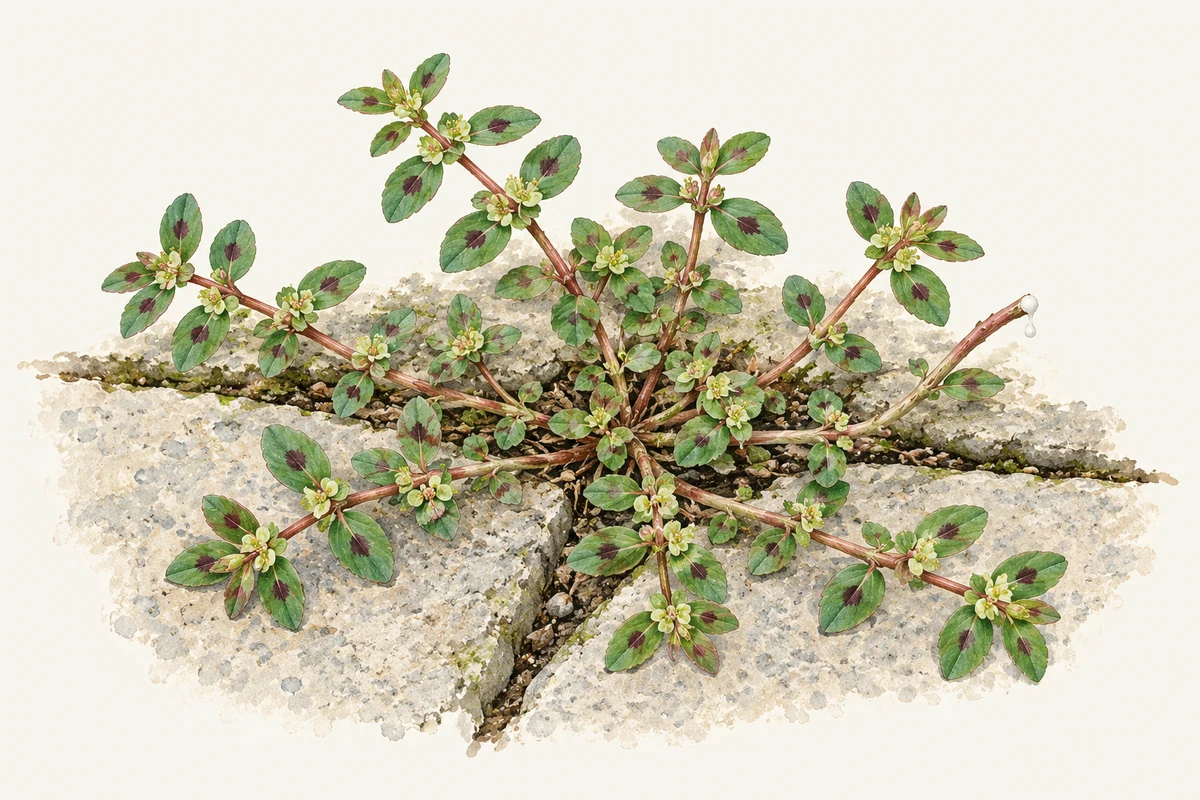
A low summer annual that spreads in a flat mat, with small paired leaves often marked by a red spot, hairy stems and a milky sap that bleeds from any break.
In short
Spotted spurge is a low summer annual that forms a flat mat in thin lawns, paths and sidewalk cracks. Its dark green leaves grow in opposite pairs, 1/8 to 1/2 inch long, and most carry a reddish spot halfway along the midvein. Stems, leaves and fruit are hairy, and a broken stem bleeds milky sap that irritates skin and eyes.
- Snap a stem: spotted spurge bleeds white, milky sap. Wear gloves, because the sap irritates skin and eyes.
- Look for leaves in pairs with a reddish spot in the middle; UC IPM says more than 95% of plants show it.
- Prostrate knotweed has alternate blue-green leaves with a papery sheath at each node and no milky sap; purslane has thick, fleshy leaves and smooth, succulent stems.
Field marks at a glance
- Scientific name
- Euphorbia maculata
- Family
- Euphorbiaceae (spurge family)
- Type
- Weed, annual
- Growth habit
- Grows flat against the ground, forming a dense mat that can reach 3 feet across (UC IPM).
- Leaves
- Dark green, in opposite pairs, 1/8 to 1/2 inch long and about 1/8 inch wide; most carry a reddish spot halfway along the center vein.
- Hairs
- Stems, leaves, flowers and fruit are all hairy; the fruit has hairs pressed flat over its whole surface.
- Sap
- Broken stems and branches bleed a milky sap. UC IPM calls the sap of the whole genus an eye and skin irritant.
- Flowers
- Tiny and pinkish, grouped in small cup-like structures (cyathia) in the leaf axils, one or two per axil.
- Fruit and seed
- A three-celled capsule 1/16 inch or less, each cell with one seed about 1/25 inch long; seeds are cross-wrinkled.
- Root
- A central taproot that can reach more than 24 inches into the soil.
- Season
- A summer annual; seeds sprout best at 75° to 85°F and plants can set seed about 5 weeks after sprouting.
- Origin
- Native to the eastern United States (UC IPM).
Spotted spurge (Euphorbia maculata) is a low summer annual that the UC Statewide IPM Program calls the most common weedy spurge in California; it is native to the eastern United States. It shows up as a flat, reddish-green mat in thin lawns, gravel, paths and sidewalk cracks from late spring through summer. Three checks identify it: the leaves, the hairs and the milky sap, and the sap is also the reason to handle it with gloves.
How to identify spotted spurge in three checks
1. The leaves. Kneel down and look at a stem. UC IPM describes dark green leaves in opposite pairs, 1/8 to 1/2 inch long and about 1/8 inch wide. Most carry a reddish spot halfway down the center vein; in UC IPM's key, more than 95% of plants have it. In a mat, the paired leaves line both sides of thin, branching stems that radiate from one central root.
2. The hairs. Run a finger along a stem or use a 10x hand lens. UC IPM says the flowers, fruit, stems and leaves of spotted spurge are all hairy. The fruit, a tiny three-celled capsule 1/16 inch or less, carries hairs pressed flat over its whole surface. The flowers are tiny and pinkish, held in small cup-like structures called cyathia in the leaf axils.
3. The sap. Snap a stem while wearing gloves. A bead of white, milky sap appears at the break. UC IPM says the sap of all members of the genus is an eye and skin irritant, so keep it off your hands and away from your face.
If you would rather start from a name, take one photo of the mat in Plant Identifier, close enough that the leaf pairs show. The app shows no confidence score and no list of alternatives, so confirm with the sap and the paired leaves. The Toxicology tool gives AI-written notes for people, dogs and cats; treat them as a starting point, not a verdict.
Spotted spurge vs prostrate knotweed, purslane and ground spurge
Three other weeds form low mats in the same thin, sunny turf.
| Feature | Spotted spurge | Prostrate knotweed | Common purslane |
|---|---|---|---|
| Leaf arrangement | Opposite pairs | Alternate | Alternate, clustered at joints and tips |
| Leaf texture | Thin, hairy, often a red central spot | Smooth, blue-green | Thick, fleshy, smooth |
| Leaf size | 1/8 to 1/2 inch | About 1 inch by 1/3 inch | 1 to 3 inches long (NC State) |
| Stem | Hairy, thin | Wiry, zigzag, papery sheath at each node | Round, thick, succulent, green to reddish-brown |
| Sap | Milky | Not milky | Not milky |
| Flowers | Tiny, pinkish, in cups in the leaf axils | Tiny, petal-less, green to pink or purple | Yellow, five petals, about 1/4 inch |
The table draws on UC IPM's Pest Note and on NC State's pages for prostrate knotweed and common purslane.
Prostrate knotweed is the closest look-alike in compacted, trodden turf. NC State describes alternate, smooth, blue-green leaves about 1 inch by 1/3 inch, a membranous sheath (ochrea) wrapping the stem at the base of each leaf, and wiry, zigzag stems. It has no milky sap and no paired leaves.
Common purslane also spreads in circular mats, but it is a succulent. NC State describes thick, fleshy, smooth oval leaves clustered at the stem joints and tips, and round, thick stems from light green to reddish-brown. Its small yellow flowers open only briefly in the morning. A broken purslane stem is juicy but not milky. NC State's Plant Toolbox lists purslane as a problem for cats, dogs and horses. This page covers purslane only as a look-alike to rule out.
Ground spurge (Euphorbia prostrata) is the hardest to separate, since it also grows flat and has milky sap. UC IPM says its leaves never carry a red central spot and its fruit is hairy mostly on the edges.
For other lawn weeds, see the lawn weed identification guide; for a grass-like weed of the same summer lawns, see nutsedge.
Sap, skin and pets
UC IPM says the milky sap of the genus irritates eyes and skin, and that all spurges have milky sap that can be toxic to some animals; it reports sheep deaths where spotted spurge dominated a pasture. Wear gloves when you weed, wash skin that touches the sap, and keep it away from your eyes. If sap gets in an eye or a rash develops, rinse with water and call your doctor or Poison Control. For more plants that irritate skin, see plants that cause skin rashes.
If you think a dog, cat or other animal has chewed spurge, call your vet or the ASPCA Animal Poison Control Center at (888) 426-4435 (a consultation fee may apply).
Where it grows and how it spreads
UC IPM says most weedy spurges are summer annuals that do not like competition and rely on heavy seed production: one plant can make several thousand seeds. Seeds sprout best at 75° to 85°F, need light, and do poorly when buried deeper than 1/2 inch. A young plant starts as a small rosette and grows into a mat up to 3 feet across, and it can set seed as soon as 5 weeks after sprouting. Seeds produced in summer sprout right away; those from late fall mostly wait until spring.
In a lawn, UC IPM says spotted spurge overgrows sparse turf and invades open ground, gravel and sidewalk cracks, and its seed attracts ants.
Managing spotted spurge in a lawn
UC IPM's main advice is prevention, because spurge is hard to control once established. Pull new plants before they set seed, with gloves on; plants often snap at the stem and regrow from the root left behind, so lift the taproot. Mowing does not control it, since it grows below the mower blades. Clean mowers and clothing to avoid carrying seed.
One of the best measures in turf, UC IPM says, is a dense, competitive stand of grass: gaps from stress, disease, low fertility, insects or wear let light reach the soil and the seeds sprout. It suggests raising the mowing height to 2 inches or more in tall fescue or perennial ryegrass and keeping thatch under 1/2 inch. If you use a herbicide, follow the label and local rules, and ask your local extension office about timing for your region.
To remember where spurge came back from one summer to the next, the Plant Map in Plant Identifier keeps each located identification.
Look-alikes and how to tell them apart
Prostrate knotweed (Polygonum aviculare)
Knotweed leaves are alternate (one per node), smooth and blue-green, up to about 1 inch by 1/3 inch, with a papery sheath wrapping the stem at the base of each leaf. Its wiry stems zigzag and its tiny flowers have no petals. A broken stem shows no milky sap.
Common purslane (Portulaca oleracea)
Purslane is a succulent: its smooth, hairless leaves are thick and fleshy, alternate and clustered at the stem joints and tips, on round, thick, reddish stems. Its flowers are yellow with five petals. Spotted spurge has thin, hairy leaves in pairs and bleeds milky sap.
Ground spurge (Euphorbia prostrata)
Ground spurge also grows flat and has milky sap, but UC IPM says its leaves never carry the reddish central spot, and its fruit is hairy mostly on the edges only.
What a photo can't settle
- A photo can't show milky sap or hairs well; snap a stem and look closely with a hand lens to confirm.
- Ground spurge and other prostrate spurges look almost the same; UC IPM separates them by the leaf spot, fruit hairs and seeds, which most photos do not show.
- Young seedlings before the leaf spot appears can be hard to tell from other small lawn weeds in a photo.
Questions people ask
What does spotted spurge look like?
A low, flat mat of branching stems that can spread to 3 feet across. The leaves come in pairs, 1/8 to 1/2 inch long, dark green and usually marked with a reddish spot along the midvein. The whole plant is hairy, and tiny pinkish flowers sit where the leaves meet the stem.
Does spotted spurge have milky sap?
Yes. UC IPM says broken stems and branches of spotted spurge secrete a milky sap, and that the sap of all members of the genus irritates the eyes and skin. Wear gloves when you pull it, and wash skin that touches the sap.
How do I tell spotted spurge from prostrate knotweed?
Break a stem: spurge bleeds milky sap, knotweed does not. Then look at the leaves. Spurge leaves are in pairs, hairy and often red-spotted; knotweed leaves are alternate, smooth and blue-green, with a papery sheath wrapping the stem at each node.
How do I tell spotted spurge from purslane?
Feel a leaf. Purslane leaves are thick, fleshy and smooth on round, succulent, reddish stems, and its flowers are yellow. Spotted spurge leaves are thin, hairy and arranged in pairs, and a broken stem bleeds milky sap.
Why is spotted spurge in my lawn?
UC IPM says spotted spurge overgrows sparse turf, because seeds need light to sprout well. Gaps from stress, disease, low fertility, insects or wear let it in. A dense, competitive lawn is one of the best defenses, and mowing does not control it because it grows below the blades.
Sources
- Pest Notes: Spotted Spurge and Other Spurges (Publication 7445) — UC Statewide IPM Program, University of California Agriculture and Natural Resources
- Polygonum aviculare (prostrate knotweed) — NC State Extension, North Carolina Extension Gardener Plant Toolbox
- Portulaca oleracea (common purslane) — NC State Extension, North Carolina Extension Gardener Plant Toolbox
- Euphorbia maculata L. — GBIF Backbone Taxonomy
- ASPCA Poison Control — ASPCA
Keep reading
- Lawn and gardenHow to identify weeds in your lawn
- Weed profileNutsedge (Cyperus esculentus and C. rotundus): how to identify it
- Weed profileCreeping Charlie (Glechoma hederacea): how to identify ground ivy
- Safety guidePlants that cause skin rashes, and how to tell which one
- Weed profileWhite clover (Trifolium repens): how to identify clover in a lawn