Also in Deutsch
Safety guide
Plants that cause skin rashes, and how to tell which one
Which plants in North America and Britain harm skin through oil, sap or stinging hairs, how to recognize them without touching, and the first steps official sources give after contact.
In short
To identify a plant rash, start with the plant and the timing. Poison ivy's oil can bring an itchy rash and blisters from 1 day to 2 weeks after contact (Poison Control). Giant hogweed and wild parsnip sap plus sunlight cause burns and blisters (RHS, Ontario). Nettle hairs burn and itch for minutes, and euphorbia latex irritates directly (NC State Extension). A doctor confirms the cause.
- Poison Control: after poison ivy contact, remove your clothes, shower with soap and water and clean under your fingernails as soon as possible.
- RHS: wash skin that touched giant hogweed immediately, keep it out of sunlight and seek medical advice.
- Giant hogweed, wild parsnip and rue harm skin only with sunlight; euphorbia latex, dieffenbachia sap and nettle hairs act directly.
- Recognize these plants by eye or by photo, never by handling them.
Most plant rashes start with a weekend job: pulling weeds along a fence, mowing a ditch, clearing a trail or repotting a houseplant. Some plants carry an oil that sets off an allergic rash days later, some have sap that burns skin only once sunlight hits it, and some sting or irritate on the spot. This guide starts with what official sources say to do after contact, then explains the three ways plants harm skin in the United States, Canada and Britain, and how to recognize each plant without touching it.
After skin contact: first steps from official sources
These steps are quoted from the sources named. They are not medical advice, and this page names no treatments: a poison centre, pharmacist or doctor decides what a rash needs.
Poison ivy, poison oak, poison sumac. Poison Control (National Capital Poison Center) says to do the following as soon as possible: remove all clothing and set it aside where no one will touch it; shower thoroughly with soap and water, cleaning under the fingernails; use tongs or a similar tool to put the clothing into a washing machine and run a full cycle with warm water and detergent; and, wearing disposable gloves, wash any objects and pets that might have been exposed. It also says not to burn these plants, because burning releases the oil into the air and can cause severe lung reactions.
Giant hogweed, wild parsnip and their relatives. The RHS says to wash any skin that touches giant hogweed immediately, keep it out of sunlight and seek medical advice, and warns that sap on clothes and tools can also damage skin. Ontario's guidance on wild parsnip says to wash sap carefully from clothing, equipment and pets, and to wash yourself immediately with soap and water after working near the plant.
Milky euphorbia latex and dieffenbachia sap. NC State Extension says sap from crown of thorns and from dieffenbachia in the eyes can damage the cornea. If sap reaches an eye, call a poison centre straight away.
When to contact a doctor. Poison Control lists these signs after poison ivy: the reaction is severe or widespread; your skin keeps swelling; the rash affects your eyes, mouth or genitals; blisters ooze pus; you have a fever over 100°F (37.8°C); or the rash isn't better within a few weeks. It says to seek emergency treatment if someone inhaled smoke from burning poison ivy and is having trouble breathing.
Who to call. In the US, call Poison Control at 1-800-222-1222, free, confidential and available 24 hours a day, or use its online tool. In the UK, call NHS 111, or 999 in an emergency. In Canada, call your provincial or territorial poison centre, or 911 in an emergency.
Three ways plants harm skin
An allergic rash (poison ivy, poison oak, poison sumac). Poison Control says poison ivy contains urushiol, an oil found in every part of the plant, still present in dried leaves and stems. Skin absorbs it quickly and an allergic-type reaction follows: intense itching and a rash 1 to 2 days after contact in people who have reacted before, and up to 2 weeks later in people who haven't, then red bumps and fluid-filled blisters. It estimates that 50 to 75% of people react. The NHS explains that allergic contact dermatitis appears only once the body has been sensitised, which is why a first contact can pass without a rash. Poison oak and poison sumac carry the same oil; how to tell the three apart is in the poison ivy identification guide.
Sap plus sunlight (giant hogweed, wild parsnip, rue). The RHS says giant hogweed contains high levels of furanocoumarins, chemicals that make skin very sensitive to sunlight; touching it with bare skin can lead to severe photodermatitis with burning, blistering, pigmentation and long-lasting scarring. Ontario says wild parsnip, like giant hogweed and other members of the carrot family, produces sap that can make skin react to sunlight, resulting in intense burns, rashes or blisters. NC State Extension lists furocoumarins among the toxic principles of common rue.
Direct irritation and stings (euphorbias, dieffenbachia, nettle, buttercups). The NHS lists many plants among the common skin irritants, naming Ranunculus (buttercups), spurge, Boraginaceae and mustards. These act on the skin directly, with no sunlight needed and no earlier sensitisation.
Plants that cause skin rashes, and how to recognize them
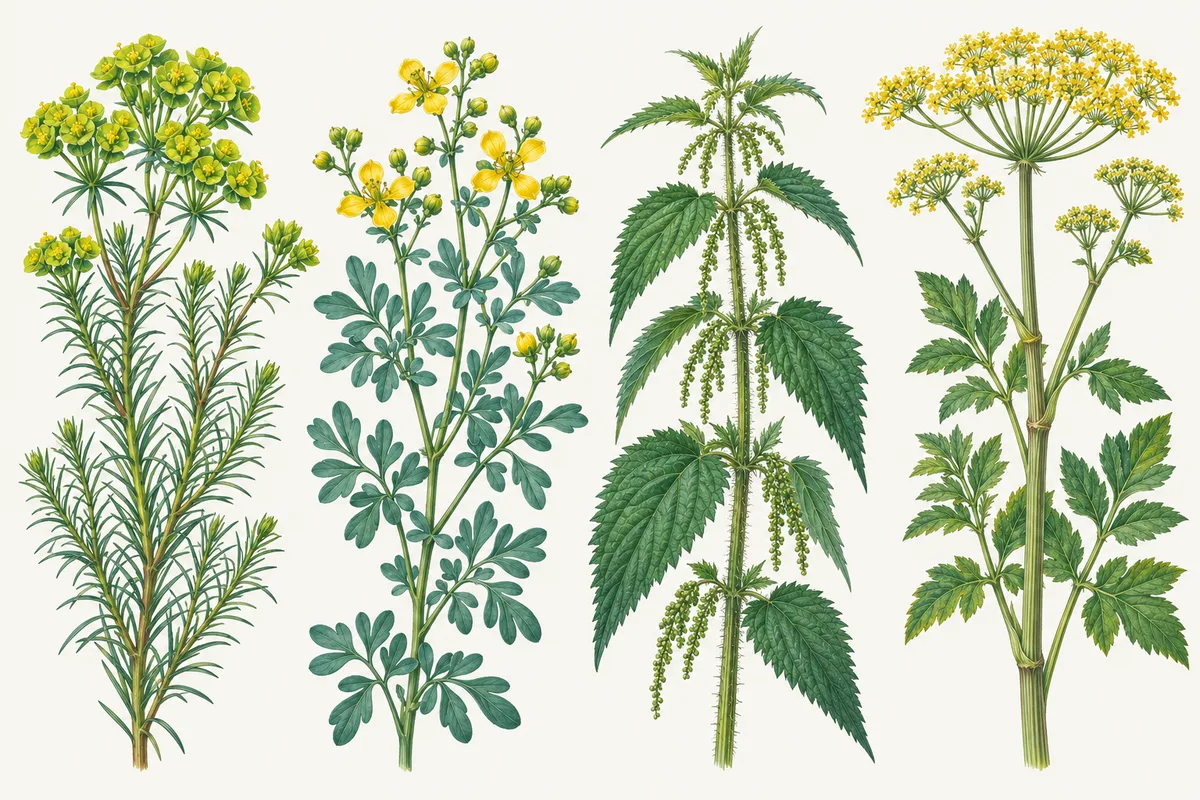
| Plant | Where you meet it | What harms skin | Recognize it by |
|---|---|---|---|
| Poison ivy | Throughout much of North America | Urushiol oil, every part | Leaves in groups of 3; vine or small shrub; white or off-white berries |
| Giant hogweed | Every part of the British Isles | Sap plus sunlight | 2.5 to 5 m (8 to 16 ft); white umbrella flower heads 30 to 90 cm across; hollow stem with purple blotches and coarse bristly hairs |
| Wild parsnip | Roadsides, meadows, abandoned yards | Sap plus sunlight | Up to 1.5 m (5 ft); yellowish-green umbrella flower clusters 10 to 20 cm across; mitten-shaped toothed leaflets |
| Common rue | Ornamental gardens | Leaves (furocoumarins) | Subshrub 2 to 3 ft tall with aromatic, blue-green, fern-like leaves |
| Stinging nettle | Stream banks, meadows, ditches, woodland clearings | Hairs on leaves and stems | Square stem; toothed, egg-shaped leaves in opposite pairs, 1 to 6 inches long |
| Crown of thorns (Euphorbia milii) | Houseplant; gardens in warm climates | Milky latex in all parts | Prickly stems, bright green leaves, red, pink or white bracts |
| Dieffenbachia (dumb cane) | Houseplant | Cell sap | Large, shiny leaves blotched with cream, white or yellow |
Poison ivy
Poison Control describes poison ivy as a vine or small shrub found throughout much of North America, usually with leaves in groups of three, yellow-green flowers, and white or off-white berries; spring shoots are often red and leaves turn red or yellow in fall. The four field marks, and the look-alikes they rule out, are in the poison ivy identification guide.
Giant hogweed
The RHS says giant hogweed was introduced to Britain from the Caucasus Mountains in the early 1800s and is now found in every part of the British Isles. Ontario's comparison table gives it a height of 2.5 to 5 m, white umbrella-shaped flower clusters 30 to 90 cm across, leaves up to 1.5 m long with prominently spiked edges, and a hollow stem 5 to 15 cm thick with prominent purple blotches and coarse, bristly hairs. Native cow parsnip is smaller, 1 to 2.5 m, with a green stem, few or no purple spots and soft, fuzzy hairs. Full field marks are on the giant hogweed page.
Wild parsnip
Ontario describes wild parsnip (Pastinaca sativa), also called poison parsnip, as an invasive member of the carrot family native to Europe and Asia and reported in every province and territory of Canada except Nunavut. In its first year it is a low rosette of leaves; in its second it flowers on a tall stalk up to 1.5 m with yellowish-green umbrella-shaped clusters. Ontario says the stem, leaves and flowers contain chemicals that increase skin sensitivity to sunlight and can cause severe dermatitis. The yellow flowers separate it from the white-flowered hogweeds; more field marks are on the wild parsnip page.
Common rue
NC State Extension describes common rue (Ruta graveolens) as an ornamental subshrub native to the Balkan peninsula, 2 to 3 feet tall, with aromatic, blue-green, fern-like leaves. It says skin contact causes short-term irritation and advises wearing gloves when working with the plant. It names furocoumarins among its toxic principles and lists the leaves as the poisonous part.
Stinging nettle
NC State Extension describes the effect of stinging nettle (Urtica dioica) as an intense burning and itching sensation lasting a few minutes, from hairs on the leaves and stems, and lists it as causing contact dermatitis. It grows in moist sites along streams, meadows and ditches, in woodland clearings and disturbed ground, often in dense colonies. Look for a square stem and egg-shaped, saw-toothed leaves 1 to 6 inches long in opposite pairs, with a heart-shaped base and stinging hairs.
Euphorbias: crown of thorns and other spurges
NC State Extension says the milky white latex found in all parts of crown of thorns (Euphorbia milii) can cause mild to severe contact dermatitis, and that the toxic principle is diterpene esters in the latex. It describes crown of thorns as a member of the spurge family with prickly stems, typically under 2 feet tall as a houseplant. The NHS lists spurge among plants that irritate skin. Poinsettia (Euphorbia pulcherrima) is also a spurge; see the poinsettia page for what sources say about it.
Dieffenbachia and other houseplants
For dieffenbachia, a houseplant native to Central and South America with large, shiny leaves blotched with cream, white or yellow, NC State Extension lists skin irritation if exposed to the cell sap, with calcium oxalate crystals as the toxic principle. The NHS adds that chrysanthemums, sunflowers, daffodils, tulips and primula can cause allergic contact dermatitis in some people.
Recognize the plant without touching it
The reflex with an unknown plant is to pick a leaf, turn it over or crush it to smell it. With the plants on this page, that is the mistake. Check by eye instead: overall height, how the leaves are arranged, the color and spots of the stem, the color and size of the flower heads, and whether a broken stem already shows milky sap.
A photo from a few steps away settles more than a close look by hand. Plant Identifier names a plant from one photo, with its common and scientific names, and its Toxicology tool adds AI-written notes on which parts may be toxic to people, dogs and cats. Treat the name as a search term for the sources above, not as a verdict: the app shows no confidence score and no list of similar species. Shoot the whole plant, the base of the stem and the flower head, using zoom rather than stepping closer; the plant photography guide shows how.
For work near wild parsnip, Ontario recommends waterproof gloves, long sleeves, pants and eye protection, ideally a disposable spray suit, removed in an order that keeps sap off your skin, and says not to burn or compost cut plants. Poison Control says the same of poison ivy: never burn it, and remember that dead plant material still carries the oil.
What a photo can't settle
- A photo of a rash can't tell you which plant caused it. Poison Control says doctors diagnose a poison ivy rash from its typical appearance plus a history of likely exposure; a GP or dermatologist decides that.
- Young giant hogweed, cow parsnip, angelica and wild parsnip plants without flowers look alike in photos. An app result is never a reason to touch a plant.
- Plant Identifier gives one name with no confidence score or list of alternatives, and its Toxicology notes are AI-written, so check the sources on this page before trusting a result near skin.
Questions people ask
How long after touching poison ivy does the rash appear?
Poison Control says intense itching and a rash can develop in as few as 1 to 2 days in people who have reacted to poison ivy before, and as late as 2 weeks after exposure in people who have not. Red bumps and fluid-filled blisters often follow, and the reaction takes several weeks to go away.
Which plants cause burns or blisters in sunlight?
Giant hogweed and wild parsnip. Ontario's Ministry of Natural Resources says wild parsnip, like giant hogweed and other carrot-family plants, has sap that makes skin react to sunlight, causing intense burns, rashes or blisters. The RHS adds pigmentation and long-lasting scarring for giant hogweed. NC State Extension lists furocoumarins in common rue.
Is the milky sap of euphorbia dangerous to skin?
NC State Extension says the milky latex in all parts of crown of thorns (Euphorbia milii) can cause mild to severe contact dermatitis, and that sap in the eyes can cause temporary to permanent damage to the cornea. The NHS lists spurge, the euphorbia family, among plants that irritate skin.
Which houseplants can irritate the skin?
NC State Extension lists skin irritation from the cell sap of dieffenbachia (dumb cane) and contact dermatitis from the milky latex of crown of thorns. The NHS names chrysanthemums, sunflowers, daffodils, tulips and primula among plants that can cause allergic contact dermatitis. Wear gloves when cutting these plants.
Is a poison ivy rash contagious?
Poison Control says direct person-to-person spread is unlikely unless it happens immediately, because skin absorbs the oil quickly, and fluid from the blisters does not spread it. Clothing and pet fur that still carry the oil can spread it until they are washed.
Sources
- Poison ivy: Diagnosis, treatment, and when to seek help — Poison Control, National Capital Poison Center
- Contact dermatitis: Causes — NHS
- Giant hogweed — Royal Horticultural Society (RHS)
- Wild parsnip — Government of Ontario, Ministry of Natural Resources
- Urtica dioica (Stinging Nettle) — NC State Extension, North Carolina Extension Gardener Plant Toolbox
- Ruta graveolens (Common Rue, Herb-of-grace, Rue) — NC State Extension, North Carolina Extension Gardener Plant Toolbox
- Euphorbia milii (Crown of Thorns) — NC State Extension, North Carolina Extension Gardener Plant Toolbox
- Dieffenbachia seguine (Dumb Cane) — NC State Extension, North Carolina Extension Gardener Plant Toolbox
Keep reading
- Safety guidePoison ivy identification: leaves, vines, berries and look-alikes
- Weed profileGiant hogweed (Heracleum mantegazzianum): how to identify it
- Houseplant profilePoinsettia plant (Euphorbia pulcherrima): how to identify it
- Field guideHow to identify wildflowers in the field
- Photo checklistHow to photograph a plant for identification