Weed profile
Wild parsnip (Pastinaca sativa): how to identify it
A yellow-flowered roadside weed of the carrot family whose sap, with sunlight, can burn skin. Identify it from a distance and wear protection near it.
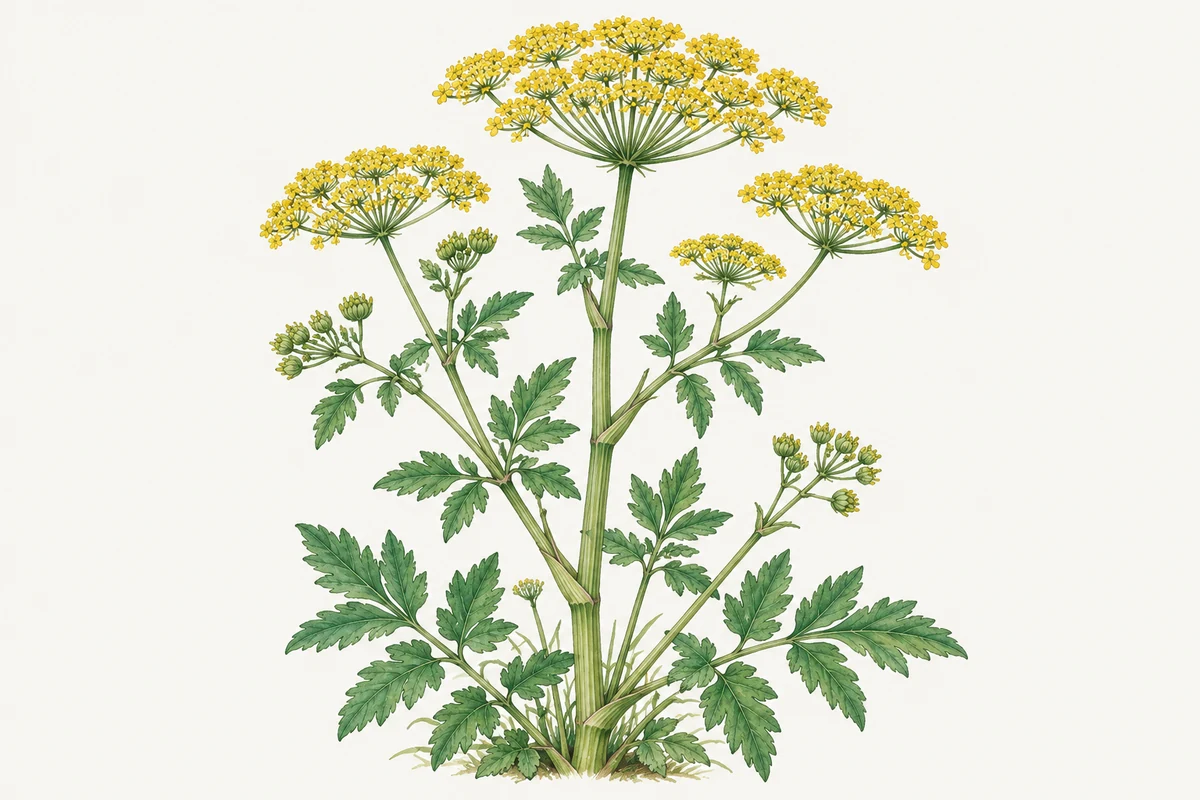
In short
Wild parsnip is identified by flat, umbrella-shaped clusters of yellowish-green flowers 10 to 20 cm across on a single stem up to 1.5 m (5 ft) tall. The stem is grooved, smooth with few hairs, and the compound leaves have sharply toothed, mitten-shaped leaflets in pairs. Its sap with sunlight can burn skin, so don't touch it.
- Yellowish-green umbrella flowers, a grooved stem with few hairs and mitten-shaped toothed leaflets point to wild parsnip (Government of Ontario).
- Sap with sunlight can cause intense burns, rashes or blisters: wear waterproof gloves, long sleeves, pants and eye protection near it.
- First-year plants are only a low rosette of leaves; the tall flowering stem comes in the second year, after which the plant dies.
- Giant hogweed, its dangerous relative, has white flower heads and a much thicker, purple-blotched, bristly stem.
Field marks at a glance
- Scientific name
- Pastinaca sativa
- Family
- Apiaceae (carrot family)
- Type
- Weed
- Height
- Up to 1.5 m tall (Government of Ontario); NY DEC gives up to 5 feet.
- Stem
- A single green stem 2 to 5 cm thick, smooth with few hairs (Ontario); NY DEC describes it as grooved and up to 1.5 inches thick, with no hairs.
- Leaves
- Compound, with leaflets in pairs; the leaflets are sharply toothed and shaped like a mitten.
- Flowers
- Yellowish-green, in flat, umbrella-shaped clusters 10 to 20 cm (about 4 to 8 in) across.
- Seeds
- Flat, round and brown, formed in the umbrella-shaped clusters after flowering.
- Life cycle
- Biennial: a low, spindly rosette of leaves the first year, then a tall flowering stalk in the second year, after which the plant dies.
- Where it grows
- Abandoned yards, meadows, open fields, roadsides and railway embankments. Native to Europe and Asia; reported in every Canadian province and territory except Nunavut (Ontario).
Wild parsnip (Pastinaca sativa), also called poison parsnip, is a yellow-flowered member of the carrot family from Europe and Asia that now lines roadsides and fields across Canada and the US. It matters because of its sap: the Government of Ontario says it contains chemicals that make skin react to sunlight, causing intense burns, rashes or blisters. Identify it from a distance, and protect your skin if you have to work near it.
How to identify wild parsnip without touching it
Use four checks, all from a step or two away. The figures come from the Government of Ontario's wild parsnip page and the New York State Department of Environmental Conservation's look-alike fact sheet.
1. The flowers. Small yellowish-green flowers form flat, umbrella-shaped clusters 10 to 20 cm (about 4 to 8 inches) across. Yellow is the key: the large look-alikes in the same family have white flowers.
2. The stem. A single green stem, 2 to 5 cm thick, grooved and smooth with few hairs. NY DEC gives up to 1.5 inches thick, with no hairs.
3. The leaves. Compound leaves with leaflets in pairs; each leaflet is sharply toothed and shaped like a mitten.
4. Height and stage. A flowering plant reaches up to 1.5 m (5 ft). In its first year, wild parsnip is only a low, spindly rosette of leaves; it flowers on a tall stalk in the second year and then dies. Ontario stresses learning both stages.
If you aren't sure what you are looking at, a photo taken from a distance in Plant Identifier gives you a name to compare against these four checks. The app shows no confidence score and no list of alternatives, and it can't stand in for an official confirmation, so use the checks above either way.
Why you shouldn't touch it: sap and sunlight
The Government of Ontario says the stem, leaves and flowers contain chemicals that increase skin sensitivity to sunlight and can cause severe dermatitis; like giant hogweed, wild parsnip produces sap that can cause intense burns, rashes or blisters. NY DEC's fact sheet is blunt: this plant can cause burns, do not touch.
If sap gets on your skin:
- Wash the area thoroughly with soap and water as soon as possible.
- Keep it covered and out of sunlight.
- See a doctor if a reaction develops.
In the US, Poison Control answers at 1-800-222-1222. Ontario also says it's very important to carefully wash any sap from clothing, equipment and pets. Keep children and pets away from it.
Wild parsnip vs giant hogweed and cow parsnip
The Government of Ontario lists giant hogweed, cow parsnip, angelica and Queen Anne's lace as plants that look similar. The first two are the confusions that matter most for safety:
| Plant | Height | Flower head | Stem |
|---|---|---|---|
| Wild parsnip | Up to 1.5 m | Yellowish-green, 10 to 20 cm | 2 to 5 cm, grooved, few hairs |
| Giant hogweed | 2.5 to 5 m | White, 30 to 90 cm | Hollow, 5 to 15 cm, purple blotches, coarse bristly hairs |
| Cow parsnip | 1 to 2.5 m | White, 10 to 30 cm | Hollow, about 5 cm at the base, soft fuzzy hairs |
Giant hogweed is the more dangerous relative; see our giant hogweed profile for how to recognize and report it. NY DEC says cow parsnip may also cause burns. Don't use wild parsnip or any of its look-alikes for food or remedies: NY DEC's look-alike fact sheet warns that all parts of poison hemlock, another carrot-family plant, are very poisonous and must not be ingested. For other roadside flowers, see the wildflower identification guide.
How to control and report wild parsnip
In Ontario, the province's advice is:
- Small patches (fewer than 100 plants) you may be able to manage yourself; larger infestations of thousands of plants will likely need a professional and repeated treatments over several years.
- Wear waterproof gloves, a long-sleeved shirt, pants and eye protection; a disposable spray suit gives the best protection. Take it off carefully, wash gloves with soap and water, and wash yourself immediately afterwards.
- Dig out as much of the taproot as you can with a sharp shovel, best in spring when the soil is moist, and check again every few weeks.
- Don't burn or compost cut or dug plants. Bag them in black plastic, leave the bags in the sun for a week or more, and ask your municipality whether they can go to landfill.
For herbicides, follow the label and local rules. Ontario also asks people to stay on trails, and to clean mud, seeds and plant parts from clothing, pets, vehicles and mowers before moving to new areas.
Elsewhere in Canada and the US, contact your provincial or state invasive species program and follow its instructions. For the general method on any unknown plant, see how to identify plants, and for another plant to keep off your skin, our guide to identifying poison ivy.
Look-alikes and how to tell them apart
Giant hogweed (Heracleum mantegazzianum)
Much bigger and white-flowered: the Government of Ontario gives 2.5 to 5 m tall, white flower clusters 30 to 90 cm across, and a hollow stem 5 to 15 cm thick with purple blotches and coarse, bristly hairs. Its sap is also dangerous.
Cow parsnip (Heracleum maximum)
A native plant with white, not yellow, flower clusters 10 to 30 cm across, hand-shaped leaves with fuzzy undersides and a hollow stem with soft, fuzzy hairs, 1 to 2.5 m tall (Ontario). NY DEC says it may also cause burns.
What a photo can't settle
- A first-year rosette has no flowers, so a photo of it is much harder to identify than a plant in bloom; avoid touching it while you check.
- Several carrot-family plants have similar umbrella flowers and some can also burn skin: treat any unknown umbel as hands-off until you know what it is.
Questions people ask
What happens if you touch wild parsnip?
The Government of Ontario says its sap contains chemicals that make skin react to sunlight, causing intense burns, rashes or blisters. Wash the skin with soap and water at once, keep it out of the sun, and see a doctor if it reacts.
How do I tell wild parsnip from giant hogweed?
Look at the flower color and the stem. Wild parsnip has yellowish-green flower clusters 10 to 20 cm across and a stem 2 to 5 cm thick with few hairs. Giant hogweed has white clusters up to 90 cm across and a stem 5 to 15 cm thick with purple blotches and coarse hairs.
How do I get rid of wild parsnip safely?
Ontario says small patches (fewer than 100 plants) can be dug out wearing waterproof gloves, long sleeves, pants and eye protection; larger ones likely need a professional. Don't burn or compost the plants. For herbicides, follow the label and local rules.
What does wild parsnip look like in its first year?
The Government of Ontario says it grows a low, spindly rosette of leaves in the first year and flowers on a tall stalk only in the second year. Learn both stages, because the rosette is easy to miss and its sap can still burn.
Sources
- Wild parsnip — Government of Ontario, Ministry of Natural Resources
- How to Identify Giant Hogweed from Common Lookalike Plants — New York State Department of Environmental Conservation
- Giant Hogweed — New York State Department of Environmental Conservation
Keep reading
- Weed profileGiant hogweed (Heracleum mantegazzianum): how to identify it
- Field guideHow to identify wildflowers in the field
- Safety guidePoison ivy identification: leaves, vines, berries and look-alikes
- Lawn and gardenHow to identify weeds in your lawn
- Weed profilePurple loosestrife (Lythrum salicaria): how to identify it