Weed profile
Purple loosestrife (Lythrum salicaria): how to identify it
A wetland invader from Europe and Asia with tall pink-purple flower spikes. Learn its square stem and leaves, then report it in the wild.
In short
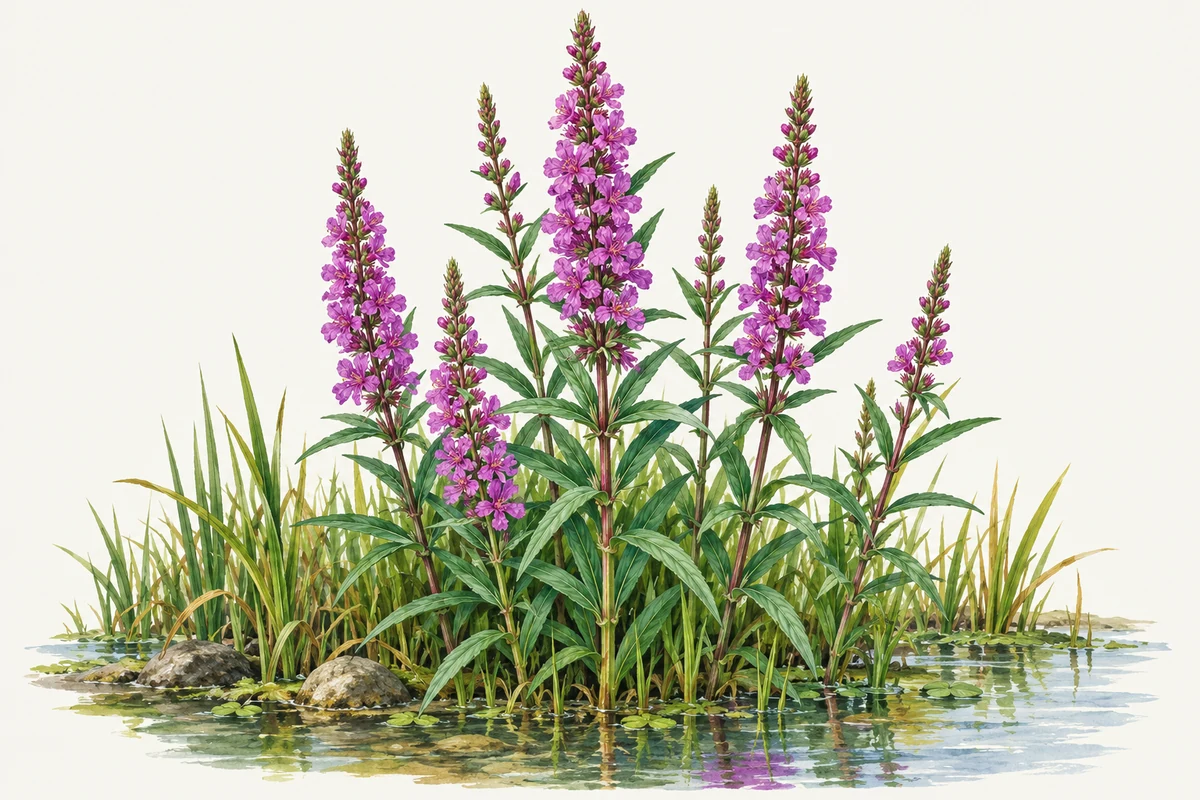
Purple loosestrife is identified by tall spikes of pink-purple flowers on square, woody stems up to 2.4 m (about 8 ft) high. Each flower has five to seven petals about 10 mm long, and the smooth-edged leaves, 3 to 10 cm long, grow opposite or in whorls. It forms dense stands in wetlands, ditches and roadsides from midsummer.
- Square stem, opposite or whorled smooth-edged leaves and spikes of five- to seven-petalled pink-purple flowers point to purple loosestrife (Ontario ISAP).
- One plant can carry up to 30 flowering stems and produce up to 2.7 million tiny seeds a year, spread by water, wind, wildlife and people.
- In Ontario, report wild plants to the Invading Species Hotline at 1-800-563-7711 or through EDDMapS.
- It is illegal to sell in North Carolina and many other states, says NC State Extension.
Field marks at a glance
- Scientific name
- Lythrum salicaria
- Family
- Lythraceae (loosestrife family)
- Type
- Weed
- Height
- Up to 2.4 m (7.9 ft) tall and 1.5 m (4.9 ft) wide (Ontario ISAP); NC State Extension gives 2 to 6 feet.
- Stem
- Woody and square in cross-section; one underground stem (rhizome) can send up 30 to 50 upright stems.
- Leaves
- Opposite or whorled, 3 to 10 cm (1.2 to 3.9 in) long, lance-shaped, stalkless and smooth-edged.
- Flowers
- Pink-purple flowers with five to seven petals about 10 mm (0.4 in) long, on long spikes at the top of the stems; NC State notes yellow centers.
- Flowering time
- Mid to late summer; NC State Extension gives early July to September.
- Seeds
- Tan capsules with many sand-sized seeds; up to 2.7 million seeds per plant each year (Ontario ISAP).
- Life cycle
- Perennial, with thick roots that send out runners and form an extensive underground network.
- Where it grows
- Wetlands, ditches, roadsides and disturbed wet ground. Native to Europe and Asia; spread across Canada and the US except Florida, Alaska and Hawaii (Ontario ISAP).
Purple loosestrife (Lythrum salicaria) is a wetland plant from Europe and Asia whose tall pink-purple flower spikes light up ditches and marshes in summer. It matters because it crowds out native plants: the Ontario Invading Species Awareness Program says its dense stands and thick root mats degrade habitat for birds, insects and other wildlife. Identify it in flower, then report it where your authority asks.
How to identify purple loosestrife
Use four checks. The figures come from Ontario's Invading Species Awareness Program (ISAP) and the NC State Extension Plant Toolbox.
1. The flower spikes. The flowers are pink-purple, each with five to seven petals about 10 mm (0.4 in) long, packed on long spikes at the top of the stems. NC State describes the spikes as about a foot tall, with yellow centers to the flowers, from early July to September.
2. The stem. Roll a stem between your fingers: it is square and woody. One underground stem can send up 30 to 50 upright stems, so a single plant forms a clump up to 2.4 m (7.9 ft) high and 1.5 m (4.9 ft) wide.
3. The leaves. Leaves are 3 to 10 cm (1.2 to 3.9 in) long, lance-shaped and stalkless, with smooth edges. They grow in opposite pairs or in whorls of three around the stem.
4. The place. Purple loosestrife likes wet ground in full sun: marshes, ditches, stream banks, roadsides and disturbed areas. A large purple stand in a wetland in late summer is the classic sight.
If you aren't sure what you are looking at, a photo in Plant Identifier gives you a name to compare against these four checks. The app shows no confidence score and no list of alternatives, and it can't stand in for an official confirmation, so use the traits above and the reporting steps below either way.
Purple loosestrife look-alikes
Ontario ISAP names several plants that can be mistaken for purple loosestrife: fireweed, blue vervain, blazing stars (Liatris), and two native relatives, winged loosestrife (Lythrum alatum) and swamp loosestrife (Decodon verticillatus). The safest approach is to confirm all of purple loosestrife's own traits together: square stem, smooth-edged leaves in pairs or whorls, and five- to seven-petalled pink-purple flowers on long spikes. If any is missing, don't remove the plant; the native loosestrifes in particular belong in wetlands. For other summer flowers, see the wildflower identification guide.
Why purple loosestrife is a problem
Ontario ISAP says each plant can grow as many as 30 flowering stems and produce up to 2.7 million seeds a year, and that the tiny seeds spread easily by water, wind, wildlife and people. Large stands can clog irrigation canals, degrade farmland and reduce the forage value of pastures. ISAP traces its arrival to the early 19th century, probably in soil used as ballast in European ships, and notes it is still used in flower gardens and occasionally sold in nurseries.
NC State Extension says it is against the law to sell purple loosestrife in North Carolina and many other states, and that named cultivars once thought non-invasive can cross and produce strains that spread rapidly. It is on North Carolina's noxious weed list.
The Government of Ontario adds that, since 1992, Canada and the US have released two European leaf-eating beetles, Galerucella calmariensis and G. pusilla, which can reduce populations by up to 90 percent and have greatly reduced purple loosestrife at many Ontario sites.
How to report and control purple loosestrife
In Ontario, if you find purple loosestrife or another invasive species in the wild, ISAP asks you to contact the Invading Species Hotline at 1-800-563-7711 or report the sighting on EDDMapS. A clear photo of the flower spike, the leaves and the stem helps; our guide to photographing a plant for identification shows how.
In your garden, ISAP's advice is:
- Remove it in June, July and early August, when it is in flower and easy to find.
- Dig small areas by hand.
- Cut the flower stalks before they go to seed, so the seeds can't produce new plants.
- Put the plants in plastic bags, seal them and put them in the garbage. Don't compost them or dump them in natural areas, because discarded flowers may still make seeds.
- Choose native or non-invasive plants from reputable garden retailers instead.
For herbicides, follow the label and local rules. Elsewhere in Canada and the US, contact your provincial or state invasive species program and follow its instructions. For lawn and garden weeds more generally, see how to identify weeds in your lawn, and for another invader of damp roadsides, our giant hogweed profile.
Look-alikes and how to tell them apart
Fireweed
Ontario ISAP lists fireweed as a plant mistaken for purple loosestrife. Check the stem and leaves: purple loosestrife has a square stem and leaves in opposite pairs or whorls, and its flowers have five to seven petals.
Blue vervain (Verbena hastata)
Named by Ontario ISAP as a look-alike. Purple loosestrife's flowers are pink-purple, about 10 mm per petal, packed along long spikes on stems that can reach 2.4 m; compare those traits before reporting.
Blazing stars (Liatris species)
Garden and prairie plants with purple spikes that Ontario ISAP lists as look-alikes. Purple loosestrife has separate five- to seven-petalled flowers and smooth-edged leaves 3 to 10 cm long, opposite or whorled.
Winged loosestrife and swamp loosestrife
Native relatives (Lythrum alatum and Decodon verticillatus) that Ontario ISAP warns can be confused with purple loosestrife. Because they are native, an expert check before any removal matters most here.
What a photo can't settle
- Out of flower, purple loosestrife is much harder to tell from other wetland plants: wait for the flower spikes, or check the square stem and the opposite or whorled leaves.
- Native winged loosestrife and swamp loosestrife can be confused with it; a photo alone may not separate them, so let your invasive species program confirm before removing plants in natural areas.
Questions people ask
How do I report purple loosestrife?
In Ontario, the Invading Species Awareness Program asks you to call the Invading Species Hotline at 1-800-563-7711 or report the sighting on EDDMapS. Elsewhere, contact your provincial or state invasive species program and follow its instructions.
Can I grow purple loosestrife in my garden?
NC State Extension says it is against the law to sell it in North Carolina and many other states, and that cultivars once thought non-invasive can cross and spread. Ontario ISAP advises buying native or non-invasive plants instead.
How do I get rid of purple loosestrife?
Ontario ISAP says the best time to remove it from a garden is June to early August, in flower; small areas can be dug by hand, and cutting flower stalks before seed stops new plants. Bag and seal plants for the garbage, never compost. For herbicides, follow the label and local rules.
When does purple loosestrife flower?
NC State Extension gives early July to September, with flowers in spikes about a foot tall. That is when the plant is easiest to spot, and when Ontario ISAP recommends removing it from gardens.
What are the beetles released against purple loosestrife?
Ontario ISAP says Canada and the US approved two European leaf-eating beetles, Galerucella calmariensis and G. pusilla, in 1992. They feed mainly on purple loosestrife and can reduce populations by up to 90 percent.
Sources
- Purple Loosestrife — Ontario's Invading Species Awareness Program (OFAH and Ontario Ministry of Natural Resources)
- Lythrum salicaria (purple loosestrife) — NC State Extension, North Carolina Extension Gardener Plant Toolbox
- Purple loosestrife — Government of Ontario, Ministry of Natural Resources