Weed profile
Nutsedge (Cyperus esculentus and C. rotundus): how to identify it
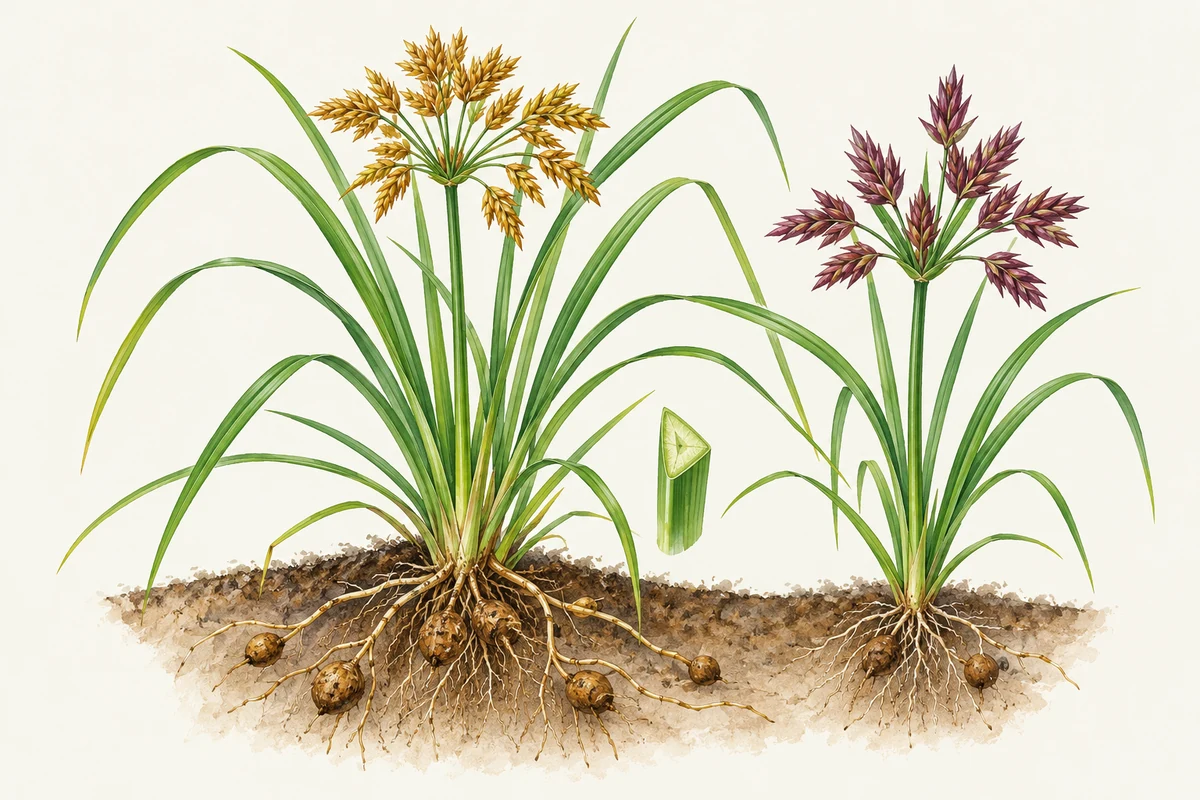
A grass-like sedge with a solid, triangular stem, glossy leaves in sets of three and a seed head ringed by long bracts, growing taller and paler than the lawn around it.
In short
Nutsedge is a perennial sedge, not a grass: roll the stem between your fingers and it feels solid and triangular, while grass stems are hollow and round. Its glossy, light green leaves grow in sets of three from the base. Yellow nutsedge has light brown flower heads and single round tubers; purple nutsedge has reddish heads and tubers in chains.
- Roll the stem: a solid, triangular stem means a sedge; grass stems are hollow and round or flattened.
- Count the leaves at the base: nutsedge leaves come in sets of three, grass leaves in sets of two.
- Yellow nutsedge has yellow to golden brown flower heads; purple nutsedge has reddish-purple to reddish-brown ones.
Field marks at a glance
- Scientific name
- Cyperus esculentus
- Family
- Cyperaceae (sedge family)
- Type
- Weed, perennial, deciduous
- Stem
- Solid and triangular in cross section, so it rolls with three edges between your fingers; grass stems are hollow and round to flattened (UC IPM).
- Leaves
- Light green, smooth, glossy and V-shaped, in sets of three at the base, with a channel along the midvein; yellow nutsedge blades reach about 1½ feet long and ⅓ inch wide (NC State).
- Flower head
- An umbrella-like cluster of flattened spikelets at the top of a single stem, with long leaf-like bracts at its base; the largest bract is usually longer than the head.
- Color of the head
- Yellow nutsedge: yellow to golden brown spikelets. Purple nutsedge: reddish-purple to reddish-brown spikelets.
- Underground parts
- Rhizomes 8 to 14 inches deep carry tubers ('nutlets'). Yellow nutsedge forms one round, smooth tuber at the end of each rhizome; purple nutsedge forms chains of tubers covered in red-brown scales.
- Height
- 6 inches to 2 feet for yellow nutsedge (NC State); in a lawn it grows faster and taller than the turf between mowings.
- Season
- Shoots sprout in spring from tubers once soil stays above 43°F (yellow) or 59°F (purple); leaves and stalks die back in fall.
- Where it grows
- Lawns, beds and gardens, especially waterlogged soil, poor drainage, frequent irrigation or leaky sprinklers; once established it tolerates normal watering and drought.
Nutsedge is a common lawn and garden weed, and one of the most often misnamed. It looks like grass, and many people call it nutgrass, but it is a sedge. The UC Statewide IPM Program names the two weedy species gardeners meet most: yellow nutsedge (Cyperus esculentus) and purple nutsedge (C. rotundus). Two quick checks, the stem and the leaves, tell you whether you have a sedge at all; the flower head and the tubers tell you which one.
How to identify nutsedge in three checks
1. Roll the stem. Find a stem that carries a flower head, or the thickest shoot in the tuft, and roll it between your thumb and finger. UC IPM says nutsedge stems are solid and triangular in cross section, while grass stems are hollow and round, or almost flat or oval. You will feel three edges as it turns. Cut it across with a fingernail and you will see a solid, three-sided core. Many gardeners remember this as "sedges have edges."
2. Count the leaves at the base. Look down at where the leaves leave the stem. Nutsedge leaves are arranged in sets of three, and grass leaves grow across from each other in sets of two. Nutsedge leaves are also thicker and stiffer than most lawn grasses, and glossier. The NC State Extension Plant Toolbox describes yellow nutsedge leaves as light green, smooth, glossy, V-shaped and narrow, up to 1½ feet long and ⅓ inch across, with a clear channel along the midvein and whitish green sheaths that can turn pale red near the base.
3. Watch the lawn after mowing. UC IPM says nutsedges grow faster than turfgrass, stand more upright and are lighter in color. Two or three days after you mow, nutsedge patches stick up as paler, stiffer tufts above the grass. From summer into fall, a single stem carries an umbrella-like head of flattened spikelets, with long, leaf-like bracts at its base (UC IPM counts three); NC State notes the largest bract is usually longer than the head.
If you are not sure where to start, one photo in Plant Identifier gives you a name to check. Include the base of a plant and a flower head if there is one. The app shows no confidence score and no list of alternatives, so finish with the stem and leaf checks above.
Yellow nutsedge vs purple nutsedge
Once you know you have nutsedge, the flower head and the tubers separate the two species.
| Feature | Yellow nutsedge | Purple nutsedge |
|---|---|---|
| Scientific name | Cyperus esculentus | Cyperus rotundus |
| Flower head color | Yellow to golden brown spikelets | Reddish-purple to reddish-brown spikelets |
| Seeds | Light brown | Dark brown or black |
| Tubers | One round, smooth, brown or black tuber at the end of each rhizome, up to 7/16 inch wide | Chains of several tubers on one rhizome, covered in red or red-brown scales |
| Spring sprouting | Soil above 43°F | Soil above 59°F |
| Origin (NC State) | Native weed of the southern US and tropical to subtropical regions | Tropical and subtropical Old World |
| US distribution (NC State) | Throughout the US except Wyoming and Montana | Southern and south-central US |
The table draws on UC IPM's Pest Note and on NC State's pages for yellow nutsedge and purple nutsedge.
To see the tubers, dig out one plant with a trowel, keeping a ball of soil, and wash the roots. UC IPM says the rhizomes run 8 to 14 inches deep and most tubers sit in the top 6 inches of soil. A single round tuber on the end of each rhizome points to yellow nutsedge; a string of scaly tubers points to purple nutsedge. NC State also notes the two respond differently to herbicides, which is why the species matters before you treat.
Nutsedge vs lawn grasses, kyllinga and flatsedge
Lawn grasses are the first look-alike. Grass leaves come in twos and grass stems are hollow and round or flattened. A tall grass seed head also has no ring of long bracts underneath it. If a tuft passes the triangle test and has leaves in threes, it is a sedge.
Green kyllinga (Kyllinga brevifolia) is a sedge too, so it also has a triangular stem. UC IPM calls it a major problem in California turf and says its flower heads look clearly different from those of nutsedge. Kyllinga spreads by rhizomes and seed but forms no tubers, so digging up a plant settles it.
Tall flatsedge (Cyperus eragrostis) grows in wet, soggy soil. UC IPM says that in a mowed lawn it forms tight clumps less than a foot across, with wider leaves and stems and short, thick rhizomes, and no tubers. Nutsedge patches, by contrast, can spread to 10 feet or more.
For other weeds in the same lawn, see the lawn weed identification guide and the page on creeping Charlie.
Where nutsedge grows and how it spreads
UC IPM says nutsedges thrive in waterlogged soil, and a patch often means drainage is poor, irrigation is too frequent or a sprinkler is leaking. Once established, they tolerate normal watering and even drought. NC State adds that the sedges prefer warm weather and full sun but grow in a wide range of sites.
Both species are perennials. Leaves and flowering stalks die back in fall, but the tubers and rhizomes survive in the soil and sprout the next spring. UC IPM says tubers can survive 1 to 3 years, and most new plants come from tubers rather than seed. Tubers sprout into new shoots that build patches over time.
Managing nutsedge in a lawn
UC IPM's advice starts with prevention and timing. Remove small plants before they have 5 to 6 leaves, because up to that stage they have not formed new tubers; in summer that means checking about every 2 to 3 weeks. Repeated removal drains the tuber's reserves, but UC IPM notes mature tubers can resprout more than 3 times, so keep removing new shoots. For small patches in turf, it suggests digging the patch out to at least 8 inches deep, refilling, then seeding or sodding, and watching the spot through spring and summer. Tilling mature plants spreads the tubers.
Fix the water first: UC IPM links nutsedge to wet soil, so repair leaking sprinklers and water less often where drainage is poor. If you use a herbicide, follow the label and local rules, and ask your local extension office which products suit your grass type, since yellow and purple nutsedge respond differently.
To remember where patches came back from year to year, the Plant Map in Plant Identifier keeps each located identification. For the general method on an unknown plant, see how to identify plants.
Look-alikes and how to tell them apart
Lawn grasses
Grass leaves grow in sets of two, across from each other, and grass stems are hollow and round or almost flat in cross section. Nutsedge leaves come in threes, are thicker and stiffer, and its stem is solid and triangular. In a lawn, nutsedge stands taller and lighter green a few days after mowing.
Green kyllinga (Kyllinga brevifolia)
Kyllinga is also a sedge with a triangular stem, so the roll test alone will not separate it. UC IPM says its flower heads look clearly different from nutsedge, and it spreads by rhizomes and seed but forms no tubers. Dig up a plant: tubers point to nutsedge.
Tall flatsedge (Cyperus eragrostis)
A larger, light green sedge of wet soil that grows in tight clumps less than 1 foot across, with wider leaves and stems, short thick rhizomes and no tubers. Nutsedge patches can spread to 10 feet or more.
What a photo can't settle
- A photo of mowed nutsedge without a flower head looks like any coarse grass; include the base of the plant so the leaves in threes show, and roll a stem yourself.
- Yellow and purple nutsedge are hard to separate without the flower head or the tubers, which no photo of the leaves shows; dig up one plant to check.
- Green kyllinga and other sedges share the triangular stem; a photo may not tell them apart from young nutsedge.
Questions people ask
Is nutsedge a grass?
No. Nutsedge is a sedge, in the family Cyperaceae. It is often called nutgrass, but UC IPM points out the differences: its stem is solid and triangular, not hollow and round, and its leaves grow in sets of three rather than two. The leaves are also thicker and stiffer than most lawn grasses.
How do I tell yellow nutsedge from purple nutsedge?
Look at the flower head and dig up a tuber. Yellow nutsedge has light brown to golden spikelets and one round, smooth tuber at the end of each rhizome. Purple nutsedge has reddish-purple spikelets and chains of tubers covered in red-brown scales. Yellow nutsedge is far more widespread in the US.
Why does nutsedge grow faster than my lawn?
UC IPM says nutsedges grow faster, more upright and lighter green than most turf, so a patch shows up as taller tufts a few days after mowing. They favor waterlogged soil, and their presence often points to poor drainage, overwatering or a leaking sprinkler.
Should I pull nutsedge by hand?
UC IPM says to remove small plants before they have 5 to 6 leaves, because before then they have not formed new tubers; in summer that means about every 2 to 3 weeks. Pulling a mature plant can leave tubers behind that resprout. For any herbicide, follow the label and local rules.
What is the triangular stem test?
Pick a flowering stem and roll it between your thumb and finger. A sedge stem is solid and has three edges, so it turns with a clicking, triangular feel. A grass stem is hollow and round or flattened and rolls smoothly. Remember it as: sedges have edges.
Sources
- Pest Notes: Nutsedge (Publication 7432) — UC Statewide IPM Program, University of California Agriculture and Natural Resources
- Cyperus esculentus (yellow nutsedge) — NC State Extension, North Carolina Extension Gardener Plant Toolbox
- Cyperus rotundus (purple nutsedge) — NC State Extension, North Carolina Extension Gardener Plant Toolbox
- Cyperus esculentus L. — GBIF Backbone Taxonomy
Keep reading
- Lawn and gardenHow to identify weeds in your lawn
- Weed profileCreeping Charlie (Glechoma hederacea): how to identify ground ivy
- Weed profileBindweed (Convolvulus arvensis, Calystegia sepium): how to identify it
- Field guideHow to identify a plant by its leaf
- Field guideHow to identify a plant, step by step