Weed profile
Bindweed (Convolvulus arvensis, Calystegia sepium): how to identify it
Twining stems that wind around other plants, arrow- or heart-shaped leaves, white to pink funnel flowers in summer, and pale roots that regrow from small pieces.
In short
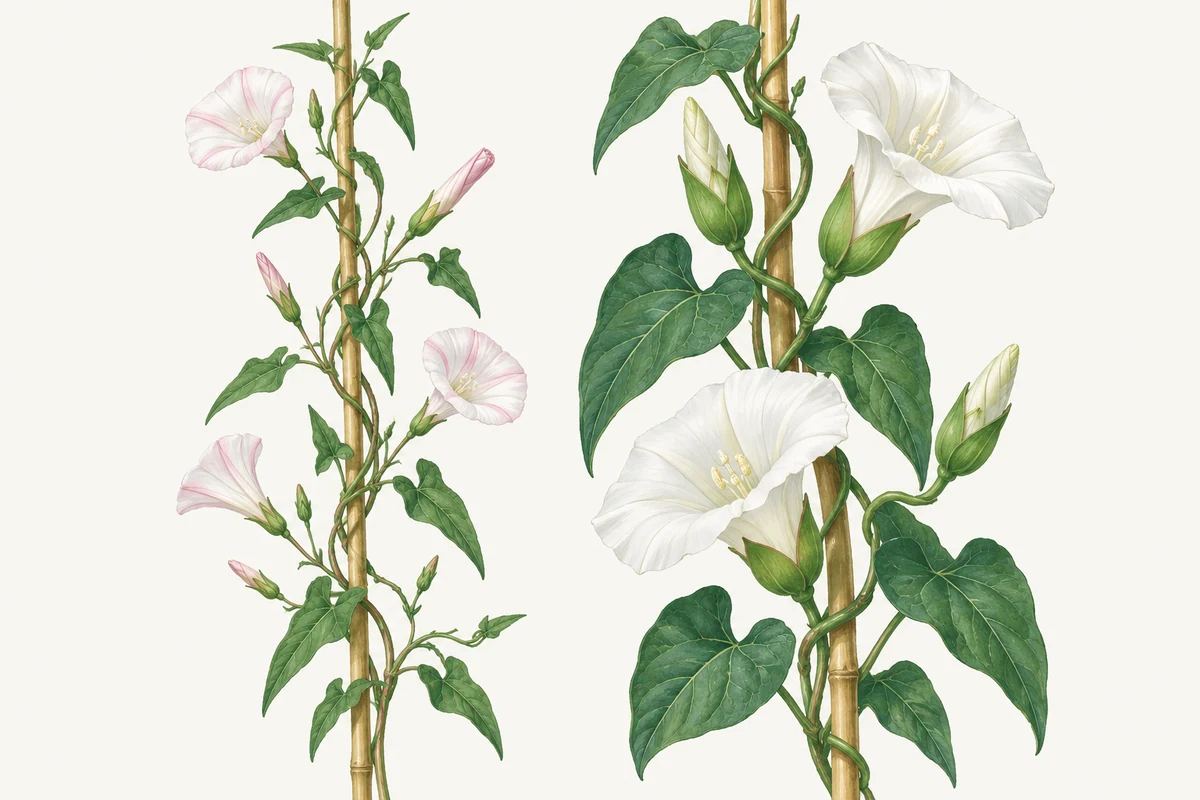
Bindweed is the name for two perennial twining vines of the morning glory family: field bindweed (Convolvulus arvensis) and hedge bindweed (Calystegia sepium). Both wind their stems around other plants, carry alternate arrow- to heart-shaped leaves and open white to pink funnel-shaped flowers in summer. Field bindweed is smaller, with flowers about ¾ inch wide; hedge bindweed's flowers reach 2 inches or more.
- Measure a flower: field bindweed's are about ¾ inch (2 cm) wide, hedge bindweed's about 2 inches (5 cm) or more.
- Look under the flower: hedge bindweed has two large green bracts hugging the base; field bindweed's small bracts sit well down the flower stalk.
- Ornamental annual morning glory has bigger, showier flowers that can be blue or purple, and a thicker, sometimes hairy stem.
Field marks at a glance
- Scientific name
- Convolvulus arvensis and Calystegia sepium
- Family
- Convolvulaceae (morning glory family)
- Type
- Weed, perennial, deciduous
- Stems
- Thin, smooth stems that trail along the ground or twine around other plants, fences and canes. Field bindweed's rarely pass 3 feet (1 m); hedge bindweed's reach about 10 feet (3 m).
- Leaves
- Alternate, untoothed. Field bindweed: arrowhead-shaped to oval, grey-green, 1 to 2½ inches (up to 6 cm) long. Hedge bindweed: triangular to heart-shaped with squared-off basal lobes, up to 5 inches (12 cm) long.
- Flowers
- Funnel- or trumpet-shaped, white to pink, often with paler stripes. Field bindweed about ¾ inch (2 cm) wide; hedge bindweed about 2 to 3 inches (5 to 7.5 cm) wide, white to pale pink with a yellow throat.
- Bracts
- Hedge bindweed has two large green bracts at the base of each flower that do not overlap once it opens. Field bindweed has small bracts about an inch down the flower stalk.
- Flowering time
- Summer: June to September in the UK (RHS). Hedge bindweed flowers last a single day and close around noon unless it is cloudy (NC State Extension).
- Roots
- Pale, fleshy roots and rhizomes; field bindweed's vertical roots can reach 20 feet deep (UC IPM). Pieces of root can grow into new plants.
- Seeds
- Small round capsules, about ¼ to ½ inch, holding 1 to 4 dark brown seeds. UC IPM says field bindweed seed can stay alive in soil for decades.
- Where it grows
- Gardens, hedges, borders, field edges, roadsides and disturbed ground. Both are UK natives (RHS) and native to Eurasia, introduced in North America (NC State Extension).
Bindweed is the common name for two twining perennial vines in the morning glory family: field bindweed (Convolvulus arvensis) and hedge bindweed (Calystegia sepium, formerly Convolvulus sepium). The RHS describes both as UK native wildflowers that are often unwelcome in gardens because of their spreading roots and twining stems. In North America both were introduced from Eurasia, and UC IPM calls field bindweed one of the most persistent weeds in landscapes and farms.
How to identify bindweed in four checks
1. The stems. Bindweed has thin, smooth stems that either trail across bare ground or wind their way up anything nearby: shrubs, canes, fences and other plants. The RHS gives about 3 feet (1 m) for field bindweed and 10 feet (3 m) for hedge bindweed.
2. The leaves. Leaves alternate along the stem, one at each node, with smooth edges. Field bindweed's are arrowhead-shaped to oval and grey-green, about 1 to 2 inches long; the UC IPM pest note adds that leaves at the base of a stem are larger than the young ones at the tip, and that size varies with water. Hedge bindweed's are bigger, triangular to heart-shaped, up to 5 inches long, with squared-off lobes at the base, according to NC State Extension.
3. The flowers. From June to September in the UK, both open funnel-shaped flowers. Field bindweed's are about ¾ inch (2 cm) wide, often pale pink, or pink with a white centre and stripes, or white. Hedge bindweed's are about 2 to 3 inches wide, usually white, sometimes pale pink, with a yellow throat; NC State says each flower lasts one day and closes around noon unless the sky is cloudy.
4. The base of the flower. Turn a flower over. Hedge bindweed has two large green bracts wrapped around the base of the flower, and they do not overlap once it opens. On field bindweed, NC State's field bindweed page places small green bracts about an inch below the flower, on the stalk.
If you'd like a second opinion, one photo of a flower with a few leaves in Plant Identifier gives you a name to check against these four points. The app shows no confidence score and no list of alternatives, so confirm the flower size and bracts yourself. The flower identifier can help with other white and pink flowers in the border.
Field bindweed vs hedge bindweed vs morning glory
| Feature | Field bindweed | Hedge bindweed | Annual morning glory |
|---|---|---|---|
| Stem length | Up to about 3 ft (1 m) | Up to about 10 ft (3 m) | Climbing vine, thicker, sometimes hairy stem |
| Leaves | Arrowhead to oval, grey-green, 1–2½ in | Triangular to heart-shaped, up to 5 in | Heart-shaped, 2 in or more long |
| Flower width | About ¾ in (2 cm) | About 2–3 in (5–7.5 cm) | About 2 in |
| Flower colour | Pale pink, pink and white, or white | White, sometimes pale pink | White to blue or purple |
| Bracts | Small, down the flower stalk | Two large bracts at the flower base | — |
| Life cycle | Perennial, regrows from roots | Perennial, regrows from roots | Annual |
The table draws on the RHS advice page, NC State's two Plant Toolbox pages and UC IPM's pest note.
Field and hedge bindweed are often confused with each other. Size settles most cases: hedge bindweed is larger in leaf and flower and climbs higher, and the two big bracts at the base of its flowers are the clearest single sign.
Ornamental morning glory (Ipomoea) is a garden annual with bigger, showier flowers that can be blue or purple. UC IPM says it has a thicker stem, sometimes hairy, and heart-shaped leaves about 1½ inches wide and 2 inches or more long, and that the two are easy to tell apart.
For other weeds in a lawn or border, see the lawn weed identification guide. Another common creeper in lawns is creeping Charlie, which roots along the ground rather than twining.
Why bindweed is hard to get rid of
The roots are the problem. UC IPM says field bindweed's vertical roots can reach 20 feet or more, though about 70% of the root mass sits in the top 2 feet of soil, and that fragments of root as short as 2 inches can form new plants. One plant can spread more than 10 feet in a season. Its seeds have a hard coat, and UC IPM reports seed found viable after 60 years in soil.
The RHS says both bindweeds regrow from small sections of root, that new plants or soil can bring root fragments into a garden, and that composting roots or chopping them when digging can spread them. Hedge bindweed seldom sets viable seed in the UK; field bindweed is more likely to.
Controlling bindweed in a garden
The RHS points out that you don't have to eradicate bindweed: left in a wildlife corner or a mature hedge, it feeds pollinators and moth caterpillars. Where it is not wanted, its advice is to stop plants setting seed, pull or cut off new growth persistently, fork out seedlings with the whole root, and fork out as much of the root system of established plants as you can, checking the root balls of border plants before replanting. Keep roots and stems out of home compost.
UC IPM adds that seedlings are easy to remove for only about 3 to 4 weeks after they germinate, before perennial buds form, and that control takes more than one season. If you use a herbicide, follow the label and local rules, and ask your local extension office or the RHS for advice suited to your garden.
For the general method on any unknown plant, see how to identify plants.
Look-alikes and how to tell them apart
Field bindweed vs hedge bindweed
Hedge bindweed is bigger in every part: leaves up to 5 inches, flowers 2 inches or more across, and two large bracts hugging the base of each flower. Field bindweed has leaves under 2½ inches, flowers about ¾ inch wide and only small bracts lower on the stalk.
Ornamental morning glory (Ipomoea)
UC IPM says annual morning glory has a larger, showier flower about 2 inches wide that can be white, blue or purple, a thicker, sometimes hairy stem, and heart-shaped leaves at least 2 inches long.
What a photo can't settle
- A photo of leaves alone can be hard to place: include a flower, ideally with its base showing, so the size and the bracts can be checked.
- Bindweed seedlings and shoots coming up from root pieces look different from mature vines; UC IPM notes that shoots from roots lack seed leaves, so photograph again once the vine has grown.
- A photo can't show how deep the roots run or where they came from; for a heavy infestation, a local extension office or the RHS advice service can help.
Questions people ask
What does bindweed look like?
A twining vine with thin stems that wrap around other plants, alternate arrow- or heart-shaped leaves and white to pink funnel-shaped flowers in summer. Field bindweed is small, with flowers about ¾ inch wide; hedge bindweed is larger, with flowers about 2 inches across.
How do I tell field bindweed from hedge bindweed?
Check the flower size and the base of the flower. Hedge bindweed's flowers are about 2 inches or more across and sit in two large green bracts. Field bindweed's are about ¾ inch across, with only small bracts further down the stalk, and its leaves are smaller and grey-green.
Is bindweed the same as morning glory?
They belong to the same family, and field bindweed is sometimes called perennial morning glory. But the garden morning glory is an Ipomoea: UC IPM says it has larger, showier flowers that can be blue or purple, thicker stems and bigger heart-shaped leaves.
Why does bindweed keep coming back?
Both species are perennials with deep, spreading roots, and the RHS says they can regrow from small sections of root. UC IPM says field bindweed roots can reach 20 feet down and that pieces as short as 2 inches can form new plants.
How do I get rid of bindweed?
The RHS suggests stopping it setting seed, pulling or cutting new growth again and again, and forking out as much root as possible. It also advises keeping roots and stems out of home compost. For any herbicide, follow the label and local rules.
Sources
- Field Bindweed (Pest Notes) — UC Statewide IPM Program, University of California Agriculture and Natural Resources
- Bindweed: identification and control — Royal Horticultural Society (RHS)
- Convolvulus arvensis (field bindweed) — NC State Extension, North Carolina Extension Gardener Plant Toolbox
- Calystegia sepium (hedge bindweed) — NC State Extension, North Carolina Extension Gardener Plant Toolbox
Keep reading
- Lawn and gardenHow to identify weeds in your lawn
- Field guideHow to identify wildflowers in the field
- Weed profileCreeping Charlie (Glechoma hederacea): how to identify ground ivy
- Vine profileEnglish ivy plant (Hedera helix): how to identify it
- Weed profileSpotted spurge (Euphorbia maculata): how to identify it