Vine profile
English ivy plant (Hedera helix): how to identify it
Evergreen lobed leaves on climbing stems held by tiny rootlets, unlobed leaves and autumn flowers on old growth. How to tell it from Boston ivy, Virginia creeper and creeping charlie, and what the ASPCA lists.
In short
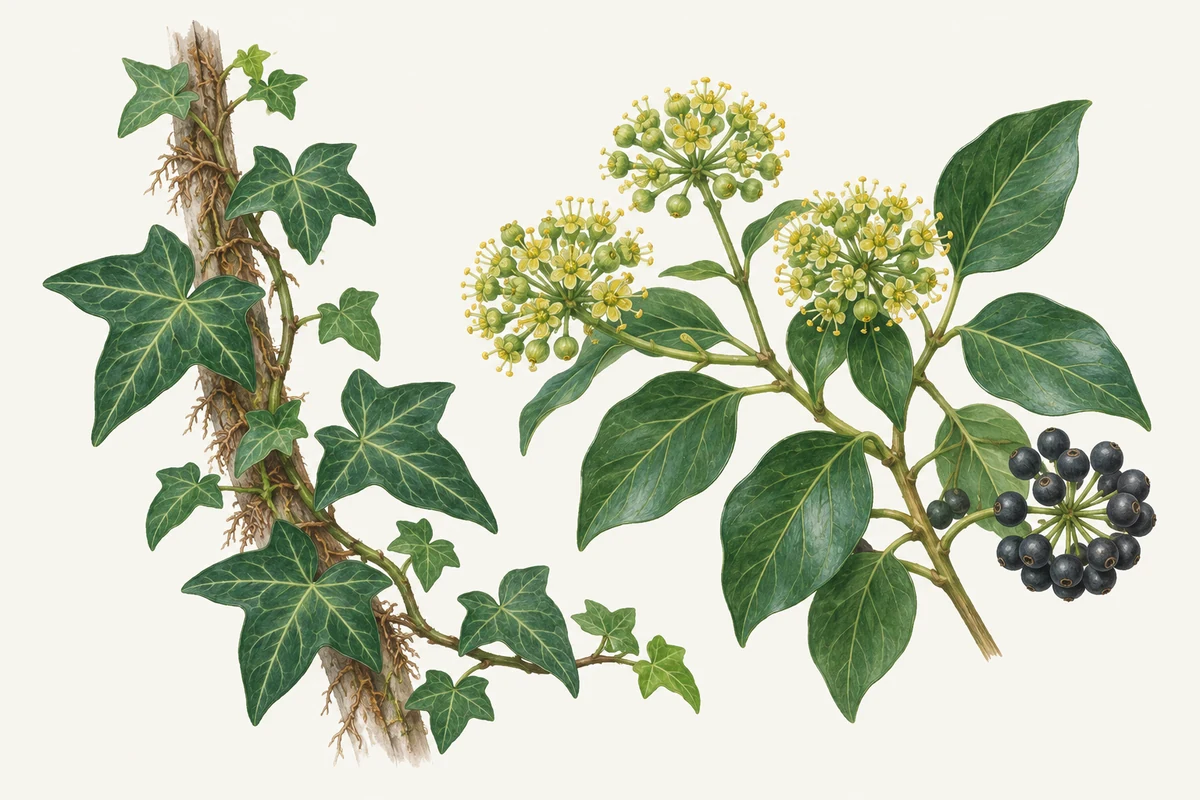
The English ivy plant (Hedera helix) is an evergreen woody vine from Europe that carpets shady ground, climbs walls and trees, and trails from pots as a houseplant. Recognize it by glossy leaves with 3 to 5 lobes on climbing stems, rows of tiny aerial rootlets instead of tendrils, and unlobed oval leaves with autumn flowers on old shoots. The ASPCA lists it as toxic to cats and dogs.
- Climbing, juvenile stems carry lobed leaves; old, flowering shoots carry unlobed leaves, autumn flowers and black winter berries.
- English ivy is evergreen and clings with rootlets; Boston ivy and Virginia creeper drop their leaves in fall and climb with tendrils ending in sticky discs.
- The ASPCA lists it as toxic to cats and dogs; NC State and USDA's invasive species center describe it as invasive in North America.
Field marks at a glance
- Scientific name
- Hedera helix
- Family
- Araliaceae (ginseng family)
- Type
- Climber, perennial, evergreen
- Juvenile leaves
- Dark green, glossy, with 3 to 5 palmate lobes and pale veins, alternate on creeping or climbing stems; houseplant cultivars vary in lobing and variegation.
- Adult leaves
- On old, upper, flowering shoots: unlobed, oval to diamond-shaped (ovate to rhombic). A single plant can carry both leaf forms.
- Climbing method
- Rows of short aerial rootlets along the stem grip bark, walls and fences. No tendrils, no suction discs.
- Flowers
- Small, greenish-yellow, five-parted flowers in rounded umbels, only on adult shoots, from about September to November.
- Berries
- Clusters of black, berry-like fruits that ripen through winter, roughly November to January in Britain, sometimes into spring.
- Habit
- Evergreen woody vine that carpets the ground and climbs trees and walls, 20 to 80 ft high on a support.
- Native range
- Europe, from Scandinavia east to Russia. Naturalized in North America since at least the 1870s through the nursery trade.
English ivy is the evergreen vine with glossy, lobed leaves that carpets shady ground, climbs trees and walls, and trails from hanging baskets as a houseplant. Its two leaf forms and its rootlets identify it; Boston ivy, Virginia creeper and creeping charlie share the name "ivy" but not the plant. The ASPCA lists it as toxic to cats and dogs.
How to identify English ivy: two leaf forms, rootlets, flowers and berries
1. Juvenile leaves. On creeping and climbing stems, NC State describes evergreen leaves with 3 to 5 palmate lobes, dark green and glossy above, with whitish-gray veins that fade with age. They are typically up to about 4 inches long. Houseplant cultivars range from deeply cut "needlepoint" types to heart-shaped and variegated leaves.
2. Adult leaves. Once ivy reaches the top of a support, it changes. The RHS explains that ivy has two distinct growth phases: after a plant is well established, normally around 10 years, growth switches to the adult phase, "the leaves change shape, becoming un-lobed," shoots turn shrubby, and the plant flowers. NC State describes adult leaves as ovate to rhombic. Seeing lobed leaves low on a trunk and plain oval leaves at the top of the same vine is one of the clearest ivy signs.
3. Rootlets. Turn over a climbing stem. Ivy holds on with short adventitious roots in rows along the stem; the Woodland Trust describes climbing stems with specialized hairs that stick to surfaces. There are no tendrils and no little suction pads.
4. Autumn flowers and winter berries. Only adult shoots flower. NC State describes small, greenish-yellow, five-parted flowers in umbels; the Woodland Trust gives the flowering period as September to November and says the black, nearly round fruits ripen from November to January. The RHS adds that berries can ripen over winter into spring or early summer. Flowers in autumn and berries in winter are unusual for a climber and a good field check.
One photo of a leaf and the stem in Plant Identifier gives a name when you find a vine you cannot place; the app shows no confidence score and no list of alternatives, so check the rootlets and the evergreen leaves yourself. The identify a plant by its leaves guide covers lobed and compound leaves in more detail.
What the ASPCA lists for cats and dogs
The ASPCA's English ivy entry lists Hedera helix, also called branching, glacier, needlepoint, sweetheart and California ivy, as toxic to dogs, cats and horses. It names triterpenoid saponins (hederagenin) as the toxic principle and gives the clinical signs as vomiting, abdominal pain, hypersalivation and diarrhea, adding that the "foliage is more toxic than berries."
The NC State Extension Plant Toolbox says the leaves and berries are toxic to humans and that contact with the sap can cause severe skin irritation. Poison Control describes allergic skin reactions in gardeners who trimmed English ivy and in children who played with it or climbed trees covered in it.
What to do:
- Cat or dog chewed ivy: call your vet or the ASPCA Animal Poison Control Center at (888) 426-4435 (the ASPCA says a consultation fee may apply).
- A person swallowed leaves or berries: call Poison Control at 1-800-222-1222 in the US, or NHS 111 in the UK; in an emergency, 911 or 999.
- Trimming ivy: the RHS advises long sleeves and gloves because ivy can be a skin irritant.
Plant Identifier's Toxicology tool gives AI-written notes for people, dogs and cats once the plant is named, but it does not replace the vet or poison-control call. The plants toxic to cats guide lists other common plants on the ASPCA's list.
English ivy vs Boston ivy, Virginia creeper and creeping charlie
| Feature | English ivy | Boston ivy | Virginia creeper | Creeping charlie |
|---|---|---|---|---|
| Family | Araliaceae | Vitaceae (grape) | Vitaceae (grape) | Lamiaceae (mint) |
| Leaves in winter | Evergreen | Dropped | Dropped | Low and evergreen |
| Leaf | 3 to 5 lobes; unlobed on adult shoots | Usually 3-lobed, toothed | 5 separate leaflets | Rounded, scalloped, paired |
| Climbs with | Aerial rootlets | Tendrils with sticky discs | Tendrils with sticky discs | Does not climb; roots at nodes |
| Fruit | Black, ripening in winter | Dull bluish-black | Blue | Tiny nutlets |
| Origin | Europe | China and Japan | Eastern North America | Eurasia |
Boston ivy. NC State's Parthenocissus tricuspidata page says it is "unrelated to English ivy": a deciduous grape-family vine from China and Japan that climbs by short, branched tendrils with sucker-like adhesive discs. Its mature leaves are broadly ovate, prominently three-lobed and coarsely toothed, and turn burgundy in fall before dropping. Juvenile leaves can have three separate leaflets.
Virginia creeper. NC State's Parthenocissus quinquefolia page describes a native, deciduous vine of eastern North America whose name means "five leaves," for its five palmate leaflets. It clings with adhesive discs at the tendril tips, turns red in fall and has blue fruit. Five leaflets on one stalk rule out English ivy at once. Vines with three leaflets are a different matter; see poison ivy identification.
Creeping charlie (ground ivy). A mint-family lawn weed with square stems, rounded toothed leaves and blue-violet spring flowers. It forms mats in lawns and shady beds but never climbs a tree. See creeping charlie.
Atlantic or Irish ivy. Hedera hibernica is the close look-alike. The Woodland Trust says both species are native in Britain and Ireland, with Atlantic ivy commoner in the west, and separates them by 3 to 5 lobes in common ivy versus 5 to 7 in Atlantic ivy, and by larger, glossier berries in common ivy. USDA groups English, Atlantic and Irish ivy together as invasive Hedera species.
Invasive status and a short care note
United States. NC State lists English ivy as an invasive species in North Carolina: it climbs trees and shrubs and can eventually kill them, smothers the forest floor so native seedlings cannot sprout, and once established is "nearly impossible to eradicate." NC State suggests growing it as a houseplant or in a patio container instead. The USDA National Invasive Species Information Center lists the species group as native to Europe, introduced through the nursery trade with naturalization records from the 1870s, and says it competes with native plants and spreads into tree canopies. It asks people to learn to tell the invasive ivies apart and report them to EDDMapS. Rules differ by state, so check your state agency before planting or removing large stands. If you treat it chemically, follow the label and local rules.
United Kingdom. Ivy is native in Britain and Ireland. The Woodland Trust says it supports wildlife: its autumn nectar feeds bees, hoverflies and wasps, and its winter berries feed thrushes, blackcaps and woodpigeons.
Indoors, briefly: the RHS says miniature and Pittsburgh cultivars adapt well to pots and make good houseplants, and variegated shoots that revert to plain green should be removed. Keep pots where cats cannot reach the trailing stems.
Look-alikes and how to tell them apart
Atlantic or Irish ivy (Hedera hibernica)
Very hard to separate from English ivy in the field. The Woodland Trust gives Atlantic ivy 5 to 7 leaf lobes against 3 to 5, and smaller, less glossy berries. Both are treated together as invasive ivies in the US.
Boston ivy (Parthenocissus tricuspidata)
Deciduous: leaves turn red in fall and drop. Mature leaves are three-lobed and coarsely toothed, and the vine climbs with branched tendrils tipped with sticky discs, not rootlets. It is in the grape family.
Virginia creeper (Parthenocissus quinquefolia)
Each leaf is made of five separate leaflets radiating from one point, and the leaves drop in fall after turning red. It climbs with tendrils ending in adhesive discs and bears blue fruits.
Creeping charlie, ground ivy (Glechoma hederacea)
A low, mint-family lawn weed with square stems, rounded scalloped leaves in opposite pairs and small blue-violet flowers in spring. It roots along the ground but never becomes a woody climber.
What a photo can't settle
- English ivy and Atlantic ivy (Hedera hibernica) are hard to separate even for botanists; a photo can name the genus Hedera but may not settle the species.
- Hundreds of cultivars differ in leaf shape and variegation, and some, like 'Arborescens', are fixed in the unlobed adult form; a picture of an unusual cultivar may not look like the wild plant.
- Whether ivy is regulated where you live depends on your state or country; a photo app cannot tell you the local rules, so check your state agency's list.
Questions people ask
Is English ivy poisonous to cats?
The ASPCA lists English ivy as toxic to cats, dogs and horses, naming triterpenoid saponins (hederagenin). Listed signs are vomiting, abdominal pain, hypersalivation and diarrhea, and the ASPCA notes the foliage is more toxic than the berries. If your cat chewed it, call your vet or the ASPCA Animal Poison Control Center at (888) 426-4435; a fee may apply.
Can English ivy irritate skin?
Yes, in some people. Poison Control says English ivy can cause an allergic skin reaction, reported in gardeners after trimming it and in children who played with it, with itching, rashes and weepy blisters. The RHS advises long sleeves and gloves when handling ivy. It is not related to poison ivy.
Is English ivy invasive in the US?
NC State lists it as an invasive species in North Carolina, saying it climbs and can kill trees and smothers native seedlings. USDA's National Invasive Species Information Center says it competes with native plants, spreads into tree canopies, and asks people to report invasive ivies to EDDMapS. Check your state's own list before planting.
Why does my ivy have two different leaf shapes?
Ivy has two growth phases. The RHS explains that young, climbing stems carry lobed leaves, and once a plant is well established, normally after about 10 years, growth turns adult: leaves become unlobed, shoots turn shrubby, and flowers appear in autumn followed by berries. Both forms can grow on the same plant.
How do I tell English ivy from Boston ivy?
Check in winter or look at how it climbs. English ivy is evergreen and holds on with rows of tiny rootlets. Boston ivy loses its leaves after turning red in fall and climbs with branched tendrils tipped with sticky discs. NC State notes the two are unrelated: Boston ivy belongs to the grape family.
Sources
- English Ivy — ASPCA Poison Control
- Hedera helix — NC State Extension Gardener Plant Toolbox
- English Ivy — USDA National Invasive Species Information Center
- Ivy: growing guide — Royal Horticultural Society
- Ivy (Hedera helix) — Woodland Trust
- Parthenocissus tricuspidata — NC State Extension Gardener Plant Toolbox
- Parthenocissus quinquefolia — NC State Extension Gardener Plant Toolbox
- Skin problems from outdoor plants — Poison Control (National Capital Poison Center)