Vine profile
Bougainvillea plant: how to identify it
Bright papery bracts in pink, purple, red, orange, white or yellow around tiny white flowers, on a thorny scrambling vine. How to tell great from lesser bougainvillea, and what to do if a pet chews it.
In short
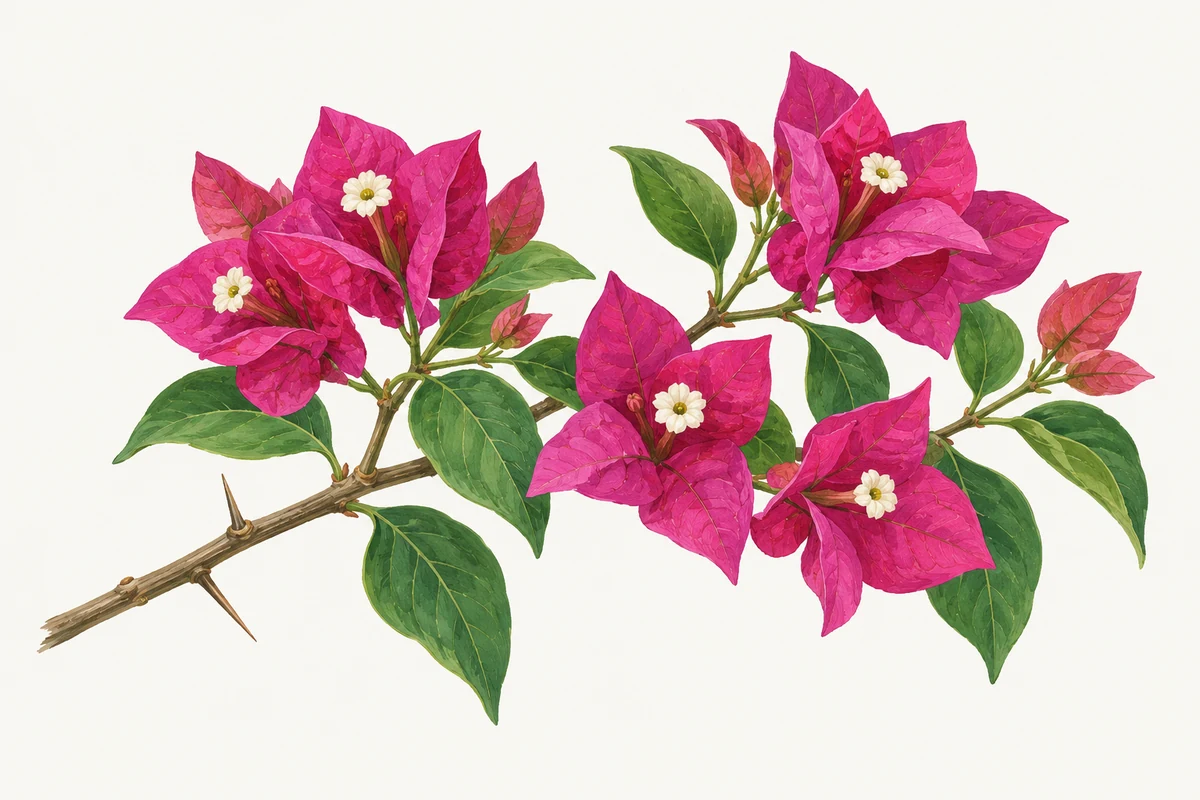
The bougainvillea plant is a thorny, scrambling woody vine from South America in the four-o'clock family, grown for papery color in pink, purple, red, orange, white or yellow. Recognize it by three tiny white tubular flowers sitting inside three to six bright bracts, simple pointed leaves, and long thin thorns at the leaf bases. The colorful parts are bracts, not petals.
- The color comes from papery bracts; the true flowers are tiny, white and tubular, in groups of three inside the bracts.
- Thorny, scrambling stems with simple, pointed leaves; it leans and hooks onto supports rather than clinging or twining tightly.
- Great bougainvillea has rounded floral tubes and longer bracts; lesser bougainvillea has five-angled tubes and shorter bracts.
Field marks at a glance
- Scientific name
- Bougainvillea spectabilis, Bougainvillea glabra and hybrids
- Family
- Nyctaginaceae (four-o'clock family)
- Type
- Climber, perennial, evergreen
- Bracts
- Three to six bright, papery bracts around each flower cluster, in pink, purple, red, orange, white or yellow. These are modified leaves, not petals.
- Flowers
- Tiny white tubular flowers in groups of three, sitting in the middle of the bracts.
- Leaves
- Simple, alternate, elliptical to heart-shaped with pointed tips and smooth edges; some cultivars are variegated.
- Thorns
- Long, thin thorns at the leaf bases (leaf axils); older stems turn woody.
- Climbing method
- Scrambles and hooks onto supports with curved thorns and loosely twining stems; usually tied to a fence, wall or pergola.
- Fruit
- A narrow, dry, five-ribbed achene; NC State describes the common garden plant as sterile and grown from cuttings.
- Native range
- South America. Frost-sensitive, so grown in pots or conservatories in cooler climates.
Bougainvillea is the thorny vine that covers walls, fences and pergolas in warm climates with sheets of papery pink, purple, red or orange. The color is not from petals but from bracts around tiny white flowers, and that is the fastest way to recognize it. Two species, great and lesser bougainvillea, and their many hybrids make up most garden plants.
How to identify a bougainvillea plant: bracts, flowers, leaves and thorns
1. Papery bracts. UF/IFAS's bougainvillea page explains that the "flowers" are modified leaves called bracts, long-lasting and bright, which outshine the tiny true flower much like a poinsettia. They come in fuchsia, red, white, yellow and orange, appear on and off for most of the year in Florida, and are especially plentiful in winter.
2. Tiny white flowers in threes. Look in the middle of a bract cluster. NC State's bougainvillea page describes small, tubular, generally white flowers in groups of three, each cluster surrounded by three to six brightly colored bracts.
3. Simple, pointed leaves. NC State describes thin, simple leaves, elliptical to heart-shaped, with pointed tips and smooth margins. Some cultivars have variegated leaves.
4. Thorns at the leaf bases. The stems carry long, thin thorns, often at the leaf axils, and turn woody with age. NC State lists thorns as the plant's main problem, and UF/IFAS advises heavy gloves for pruning.
5. Scrambling habit. Bougainvillea is a woody vine with a scrambling habit. It hooks onto other plants with curved thorns and loosely twining stems, and in gardens it is usually tied to a fence, wall or trellis.
One photo of the bracts and a leaf in Plant Identifier gives a name when you find a plant you cannot place; the app shows no confidence score and no list of alternatives, so check the tiny white flowers and the thorns yourself. The flower identifier covers other flowering plants.
Is bougainvillea poisonous to dogs and cats?
We did not find bougainvillea in the ASPCA's toxic and non-toxic plant database when this page was written. That absence is not a classification and not a guarantee: any plant material can upset a pet's stomach, and the thorns can injure mouths and paws. NC State's plant pages flag spines and thorns as the problem for every bougainvillea they list.
What to do:
- Cat or dog chewed bougainvillea: call your vet or the ASPCA Animal Poison Control Center at (888) 426-4435 (the ASPCA says a consultation fee may apply).
- A person swallowed part of the plant: call Poison Control at 1-800-222-1222 in the US, or NHS 111 in the UK; in an emergency, 911 or 999.
- Pruning: wear heavy gloves, as UF/IFAS advises, and keep thorny stems away from paths where pets and children play.
Plant Identifier's Toxicology tool gives AI-written notes for people, dogs and cats once the plant is named, but it does not replace the vet or poison-control call. The poisonous plants for dogs and plants toxic to cats guides list common plants on the ASPCA's list.
Great vs lesser bougainvillea, and the poinsettia
| Feature | Great bougainvillea | Lesser bougainvillea | Poinsettia |
|---|---|---|---|
| Scientific name | Bougainvillea spectabilis | Bougainvillea glabra | Euphorbia pulcherrima |
| Habit | Thorny scrambling vine | Thorny scrambling vine | Shrub, does not climb |
| Floral tube | Rounded | Five-angled | Not applicable |
| Bracts | Longer | Shorter | Large and leaf-like |
| Leaves and stems | Softly hairy beneath; hairy branches | Glossy, generally smooth | Broad leaves, no thorns |
Great bougainvillea. NC State's Bougainvillea spectabilis page describes a tropical shrubby vine with long, narrow thorns in the leaf axils, branches covered with long, soft hairs, and leaves softly hairy beneath. Its flowers sit in clusters of three, each with a purple, red, pink or orange bract beneath, and the floral tube is the same color as the bracts, with small white lobes.
Lesser bougainvillea. NC State's Bougainvillea glabra page describes an evergreen flowering vine with curved thorns and glossy, generally smooth leaves, green or variegated; the species name comes from the Latin for bald. NC State separates the two by the floral tube: distinctly five-angled with short bracts in lesser bougainvillea, rounded with longer bracts in great bougainvillea, "but they are otherwise very similar." Many garden plants are hybrids, so a name may stop at the genus.
Poinsettia. UF/IFAS compares bougainvillea's bracts to a poinsettia's, and both hide tiny true flowers inside colored bracts. A poinsettia is a holiday shrub with broad leafy bracts and no thorns, and it never scrambles up a wall. See the poinsettia page; for another warm-climate garden shrub often grown beside bougainvillea, see oleander.
A short care note
NC State says bougainvillea wants full sun and sandy or loamy, acidic, well-drained soil, and tolerates drought, heat and salt. It blooms on new growth, and in cooler climates it is grown in containers or a conservatory. UF/IFAS says it needs protection from frost and freeze, performs better when its soil is left a little dry, and should be pruned in late winter or early spring after flowering, or at the start of the rainy season; pruning in late summer or early fall can mean fewer flowers the following winter.
Look-alikes and how to tell them apart
Great bougainvillea (Bougainvillea spectabilis)
Rounded floral tubes and longer bracts. NC State notes branches covered with long, soft hairs and leaves that are softly hairy beneath.
Lesser bougainvillea (Bougainvillea glabra)
Distinctly five-angled floral tubes and shorter bracts; leaves are glossy and generally smooth. Otherwise very similar to great bougainvillea, and many garden plants are hybrids.
Poinsettia (Euphorbia pulcherrima)
Also colored by bracts around tiny flowers, but it is a non-climbing shrub with no thorns, larger leafy bracts and milky sap. See the poinsettia page.
What a photo can't settle
- Hundreds of bougainvillea cultivars and hybrids exist; a photo can name the genus but may not settle great versus lesser bougainvillea or the cultivar.
- The five-angled versus rounded floral tube is a close-up detail; a distant photo of a hedge of color may not show it.
- A plant out of bloom is a thorny vine with plain leaves; photograph the bracts and a leaf with its thorn for a better result.
Questions people ask
Are bougainvillea plants poisonous for dogs?
We did not find bougainvillea in the ASPCA's toxic and non-toxic plant database, and that absence is not a guarantee of anything. NC State flags its thorns as a hazard. If your dog chewed it or has a thorn injury, call your vet or the ASPCA Animal Poison Control Center at (888) 426-4435; a fee may apply.
Are the colorful parts of bougainvillea flowers?
No. UF/IFAS explains that the colorful "flowers" are modified leaves called bracts, much like a poinsettia's. NC State says the true flowers are small, white and tubular, three to a cluster, surrounded by three to six bracts.
Why won't my bougainvillea bloom?
UF/IFAS lists the usual reasons: too little direct sun, too much water, pruning too often, which removes new blooms, and too much nitrogen fertilizer, which favors leaves over flowers. NC State notes it blooms on new growth.
Can bougainvillea grow indoors?
In cooler climates, yes, with limits. NC State says it can be grown as an annual or a houseplant in containers and hanging baskets but is most often seen indoors in a conservatory. UF/IFAS says it needs full sun and protection from frost and freeze.
Sources
- Bougainvillea — NC State Extension Gardener Plant Toolbox
- Bougainvillea spectabilis — NC State Extension Gardener Plant Toolbox
- Bougainvillea glabra — NC State Extension Gardener Plant Toolbox
- Bougainvillea — UF/IFAS Gardening Solutions
Keep reading
- Houseplant profilePoinsettia plant (Euphorbia pulcherrima): how to identify it
- Plant profileOleander (Nerium oleander): how to identify it
- Pet safety guidePoisonous plants for dogs, and what to do if your dog ate one
- Vine profileClematis: how to identify a clematis vine
- Free toolFlower identifier by description