Vine profile
Clematis: how to identify a clematis vine
A climber in the buttercup family with petal-like sepals, leaf stalks that wrap around supports and silky seed heads. How to tell garden hybrids from montana, Armand and wild clematis.
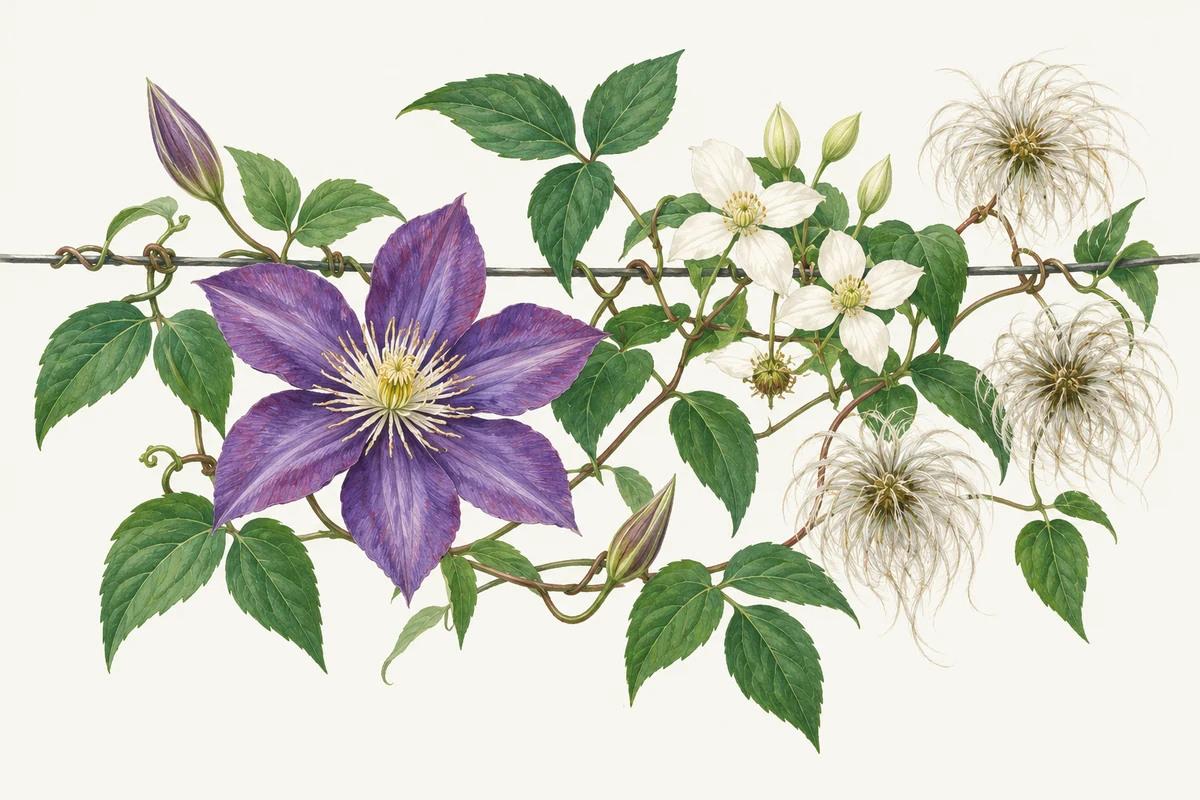
In short
Clematis is a genus of nearly 400 climbing and shrubby perennials in the buttercup family (Ranunculaceae). Recognize it by compound leaves, leaf stalks that bend around supports instead of tendrils, flowers with 4 to 8 colored petal-like sepals and many stamens, and fluffy seed heads of tailed achenes. Large-flowered hybrids, montana and wild virgin's bower are common. The ASPCA lists clematis as toxic to cats and dogs.
- Clematis climbs by leaf stalks that wrap around supports; it has no tendrils or rootlets, and its leaves are compound.
- The colored 'petals' are sepals, 4 to 8 per flower around many stamens; seed heads are clusters of dry fruits with silky, feathery tails.
- The ASPCA lists Clematis spp. as toxic to dogs, cats and horses; Japanese (sweet autumn) clematis is listed as invasive by the NC Invasive Plant Council.
Field marks at a glance
- Scientific name
- Clematis spp.
- Family
- Ranunculaceae (buttercup family)
- Type
- Climber, perennial, deciduous
- Flowers
- 4 to 8 colored petal-like sepals around many stamens; star, saucer, bell or cross shapes in blue, purple, pink, red, white or yellow.
- Flower size
- From about 1 inch in wild clematis to 4 to 10 inches across in large-flowered hybrids, according to NC State.
- Leaves
- Compound, usually opposite, divided into 3 to 5 or more leaflets; leathery and evergreen in Armand clematis.
- Climbing method
- Leaf stalks (petioles) bend and wrap around supports like tendrils; there are no true tendrils and no rootlets.
- Seed heads
- Clusters of small dry fruits (achenes), each with a silky, feathery tail, often showy into fall or winter.
- Stems
- Thin, fragile stems that become woody in climbing species; old stems of some species have shredding bark.
- Habit
- Climbers of 1 to 18 ft depending on species and support, per NC State; montana reaches 16 to 40 ft. Some species are non-climbing border perennials.
- Native range
- Temperate regions of the Northern Hemisphere and beyond; virgin's bower is native to central and eastern Canada and the US.
Clematis is the climber behind the big star-shaped flowers on mailbox posts and trellises, and also behind the foaming white curtains that cover fences in late summer. It is a genus in the buttercup family with nearly 400 species and many more hybrids, from compact border perennials to vines that reach 40 feet. The ASPCA lists clematis as toxic to cats and dogs.
How to identify clematis: leaves, climbing stalks, flowers and seed heads
1. Leaf stalks that wrap around supports. This is the trait to check first. NC State's Armand clematis page describes a vine that "climbs by twining petioles", and the Japanese clematis page says the long leaf stalks bend around neighboring objects and that true tendrils are not present. A climber with a coiled leaf stalk around a wire or twig, and nothing else holding it, is very likely a clematis.
2. Compound leaves. Each leaf is divided into leaflets: three in Armand clematis, three to five in the sweet autumn and virgin's bower types, five in old man's beard. In most species the leaves sit in opposite pairs on the stem.
3. Petal-like sepals and many stamens. The NC State clematis page describes flowers with 4 to 8 petal-like parts in many colors and many stamens. The colored parts are sepals: NC State lists no petals for Armand clematis, and Washington State says old man's beard flowers have none. Shapes run from flat stars and saucers to bells and nodding urns.
4. Feathery seed heads. After bloom, clematis carries clusters of small dry fruits, each with a silky, plumed tail. On wild species the heads look like gray-white fluff, which is where the name old man's beard comes from.
One photo of a flower, a leaf with its stalk, or a seed head in Plant Identifier gives a name when you find a vine you cannot place; the app shows no confidence score and no list of alternatives, so check the leaf stalks and leaflets yourself. The flower identifier covers other garden flowers, and the wisteria page covers the other big flowering climber of pergolas.
What the ASPCA lists for cats and dogs
The ASPCA's clematis entry lists Clematis spp., also called virgin's bower and leatherflower, in the family Ranunculaceae, as toxic to dogs, cats and horses. It names an irritant glycoside, protoanemonin, as the toxic principle and gives the clinical signs as salivation, vomiting and diarrhea.
NC State's clematis pages tag the plants as a problem for dogs, cats, horses and children, name the leaves and sap, and say clematis can cause severe mouth pain and ulcers if eaten. They add that contact can cause skin redness and burning for some people and recommend gardening gloves.
What to do:
- Cat or dog chewed clematis: call your vet or the ASPCA Animal Poison Control Center at (888) 426-4435 (the ASPCA says a consultation fee may apply).
- A person swallowed leaves or other parts: call Poison Control at 1-800-222-1222 in the US, or NHS 111 in the UK; in an emergency, 911 or 999.
Plant Identifier's Toxicology tool gives AI-written notes for people, dogs and cats once the plant is named, but it does not replace the vet or poison-control call. The plants toxic to cats and poisonous plants for dogs guides list other common plants on the ASPCA's list.
Garden clematis: large-flowered hybrids, montana and Armand clematis
| Feature | Large-flowered hybrids | Montana | Armand clematis |
|---|---|---|---|
| Scientific name | Clematis × hybrida, × jackmanii and others | Clematis montana | Clematis armandii |
| Leaves | Divided, slightly heart-shaped leaflets | Deciduous, compound, ovate leaflets | Evergreen, 3 long leathery drooping leaflets |
| Flowers | 4 to 10 in, single, semi-double or double | 3 to 4 in, star- or saucer-shaped, vanilla scent | 2 to 2.5 in, white or pink-tinted stars in clusters |
| Bloom time | Late spring to early summer, often again in late summer | Late spring to early summer | Late winter to spring |
| Size | Weak climbers, often container size | 16 to 40 ft high | 15 to 30 ft high |
| Pruning group | Type 2 | Type 1 | Type 1 |
Large-flowered hybrids. NC State's hybrid clematis page says there are hundreds of hybrids in blue, pink, red, white, purple, yellow, cream and bicolors, and that one plant may produce more than 100 star- or saucer-shaped blossoms of 4 to 10 inches in a season. These are the clematis most people picture. NC State calls them weak climbers.
Montana. NC State's mountain clematis page describes a woody twining vine from the Himalayas to Taiwan and China that can climb 16 to 40 feet. Its star-shaped flowers in white, pink and purple cascade down the vine in late spring and early summer, with a vanilla fragrance. Look for masses of four-sepaled flowers smothering a wall or tree.
Armand clematis. This is the evergreen one. NC State's quick ID hints are long, leathery, drooping leaflets, large clusters of star-shaped, vanilla-scented flowers in late winter, and opposite, ternately compound leaves. New leaves emerge bronze before turning glossy dark green.
Wild clematis: virgin's bower, sweet autumn clematis and old man's beard
Virgin's bower (Clematis virginiana). NC State's virgin's bower page describes a native woody vine of central and eastern Canada and the central and eastern US that grows 15 to 20 feet. Fragrant white flowers about 1 1/4 inches across, with four narrow sepals, cover the plant from July to September in clusters from the leaf axils. Leaves have 3 to 5 toothed leaflets with hairs along the veins underneath. Male and female flowers grow on separate plants, and only female plants carry the brown, feathery seed heads.
Sweet autumn or Japanese clematis (Clematis terniflora). NC State says this vine is native to Japan, Korea and central and southern China, can rapidly reach 15 to 30 feet, and has escaped cultivation to invade forest edges, rights-of-way and stream banks. Its fragrant white flowers open from August to October in branching clusters of 3 to 12 at the stem tips. Mature leaflets are glossy, leathery and smooth-edged. NC State says it is listed as invasive by the NC Invasive Plant Council and does not recommend it for any garden.
Old man's beard or traveler's joy (Clematis vitalba). The Washington State Noxious Weed Control Board describes a deciduous climbing vine native to Europe, Asia and northern Africa, with woody stems up to about 65 feet long. It carries 3 to 22 cream to white flowers per cluster, leaves divided into 5 leaflets, and seeds with feathery tails about 1.4 inches long that stay on the plant all winter. The board lists it as a Class C noxious weed in Washington and says it can blanket shrubs and trees and cause trees to collapse.
Rules and removal. Invasive status depends on where you live. Check your state, provincial or national agency before planting a vigorous species or removing a large vine, and if you treat it chemically, follow the label and local rules.
Look-alikes and how to tell them apart
Japanese or sweet autumn clematis (Clematis terniflora)
Masses of small white, four-sepaled flowers in late summer to fall, in clusters at the stem tips. Leaves have 3 to 5 glossy, leathery leaflets with smooth edges on mature plants.
Virgin's bower (Clematis virginiana)
Native look-alike of sweet autumn clematis. Its white flowers come from the leaf axils from July to September, and its 3 to 5 leaflets are toothed, with hairs along the veins underneath.
Old man's beard or traveler's joy (Clematis vitalba)
European wild clematis with 3 to 22 cream flowers per cluster and leaves divided into 5 leaflets. Its feathery seed clusters stay on the vine all winter.
Armand clematis (Clematis armandii)
Evergreen, with three long, leathery, drooping leaflets per leaf and clusters of fragrant white star-shaped flowers in late winter to spring.
Wisteria (Wisteria spp.)
Also a woody climber, but its pea-shaped flowers hang in long chains and its leaves carry many paired leaflets. Wisteria twines with its whole stem, not its leaf stalks.
What a photo can't settle
- There are hundreds of clematis cultivars and hybrids; a photo can name the genus or a broad group, but rarely a cultivar such as 'Jackmanii' or 'Nelly Moser'.
- Sweet autumn clematis and native virgin's bower look alike from a distance; leaflet edges and flower position, checked up close, settle it better than one photo.
- Whether a clematis is regulated where you live depends on your state, province or country; a photo app cannot tell you the local rules.
Questions people ask
Is clematis poisonous to cats and dogs?
The ASPCA lists clematis (Clematis spp.) as toxic to dogs, cats and horses, naming the irritant glycoside protoanemonin. Listed signs are salivation, vomiting and diarrhea. If your pet chewed clematis, call your vet or the ASPCA Animal Poison Control Center at (888) 426-4435; a fee may apply.
How do I tell sweet autumn clematis from virgin's bower?
Look at the leaflets and where the flowers grow. NC State describes sweet autumn clematis with smooth-edged, glossy leaflets on mature plants and flowers at the stem tips. Virgin's bower has toothed leaflets with hairs along the veins underneath and flower clusters from the leaf axils.
Can clematis irritate my skin?
It can for some people. NC State's clematis page says contact can cause skin redness and a burning sensation, names the sap and leaves, and recommends gardening gloves when you handle the plant.
Which clematis is invasive?
NC State says Japanese (sweet autumn) clematis is listed as invasive by the NC Invasive Plant Council and is considered invasive in some eastern states. Washington State lists old man's beard as a Class C noxious weed. Rules differ by state, province and country, so check your local agency's list.
Sources
- Clematis — ASPCA Poison Control
- Clematis — NC State Extension Gardener Plant Toolbox
- Clematis x hybrida — NC State Extension Gardener Plant Toolbox
- Clematis montana — NC State Extension Gardener Plant Toolbox
- Clematis armandii — NC State Extension Gardener Plant Toolbox
- Clematis terniflora — NC State Extension Gardener Plant Toolbox
- Clematis virginiana — NC State Extension Gardener Plant Toolbox
- Old man's beard — Washington State Noxious Weed Control Board
Keep reading
- Vine profileWhat flower is wisteria? How to identify a wisteria vine
- Vine profileEnglish ivy plant (Hedera helix): how to identify it
- Vine profileBougainvillea plant: how to identify it
- Pet safety guidePoisonous plants for dogs, and what to do if your dog ate one
- Free toolFlower identifier by description