Vine profile
What flower is wisteria? How to identify a wisteria vine
Hanging chains of purple, pink or white pea-shaped flowers on a twining woody vine. How to tell Chinese, Japanese and American wisteria apart, and what the ASPCA lists.
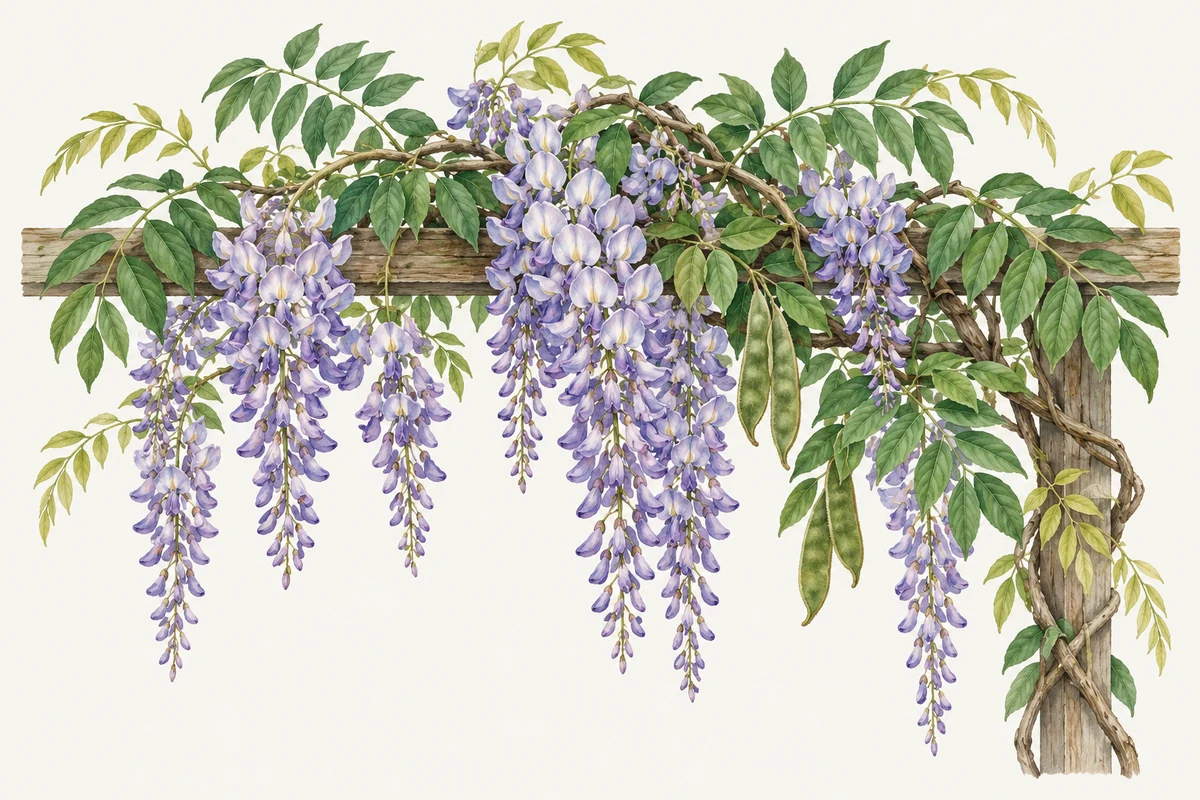
In short
Wisteria is the flower of a woody climbing vine in the bean family (Fabaceae), grown for long, drooping chains of fragrant, pea-shaped flowers in purple, blue, pink or white in spring. Recognize it by twining woody stems, pinnately compound leaves with many leaflets and velvety bean-like pods. Chinese, Japanese and native American wisteria are the common species. The ASPCA lists wisteria as toxic to cats and dogs.
- Wisteria flowers hang in pendulous chains (racemes) of pea-shaped blooms; the vine has pinnately compound leaves and twining woody stems.
- Chinese wisteria twines counterclockwise and blooms before its leaves; Japanese wisteria twines clockwise with longer chains as the leaves emerge; American wisteria has short chains after leaf-out.
- The ASPCA lists wisteria as toxic to cats, dogs and horses; NC State lists the Chinese and Japanese species as invasive in North Carolina.
Field marks at a glance
- Scientific name
- Wisteria sinensis, Wisteria floribunda, Wisteria frutescens
- Family
- Fabaceae (bean family)
- Type
- Climber, perennial, deciduous
- Flowers
- Fragrant, pea-shaped flowers in drooping chains (racemes), blue-violet, lilac, pink or white, in spring.
- Leaves
- Alternate, pinnately compound: 7 to 13 leaflets in Chinese wisteria, 15 to 19 in Japanese wisteria, 9 to 15 in American wisteria.
- Climbing method
- Twining woody stems, with no tendrils or rootlets. Chinese and American wisteria twine counterclockwise, Japanese wisteria clockwise.
- Pods
- Velvety, bean-like seed pods hanging after bloom in the Asian species; American wisteria has narrow, smooth pods up to 5 inches.
- Stems
- Brown-gray woody stems that become twisted, trunk-like and massive over the years on old Asian wisterias.
- Habit
- Deciduous woody vine, 10 to 25 ft or more on a support for the Asian species; American wisteria can reach 40 ft.
- Native range
- Chinese wisteria from China, Japanese wisteria from Japan; American wisteria from Virginia to Illinois, south to Florida and Texas.
Wisteria is the climber behind the hanging chains of purple, blue, pink or white flowers that drape pergolas and house fronts in spring. It is a woody vine in the bean family, and three species are common in gardens: Chinese, Japanese and the native American wisteria. The ASPCA lists wisteria as toxic to cats and dogs.
How to identify wisteria: flowers, leaves, stems and pods
1. Hanging chains of pea-shaped flowers. The flowers are the giveaway. NC State's Chinese wisteria page describes 6- to 12-inch racemes of mildly fragrant, blue-violet, pea-shaped flowers. The RHS growing guide describes "cascades of fragrant mauve or white flowers in late spring", sometimes followed by occasional flowers in summer.
2. Pinnately compound leaves. Each leaf is a central stalk lined with paired leaflets and one at the tip. NC State gives 7 to 13 leaflets for Chinese wisteria, 15 to 19 for Japanese wisteria and 9 to 15 lance-shaped, shiny leaflets for American wisteria. Counting leaflets is a useful check when the vine is not in bloom.
3. Twining woody stems. Wisteria climbs by wrapping its stems around a support. It has no tendrils and no rootlets. Over the years, the stems of the Asian species become twisted, trunk-like and massive.
4. Velvety pods. After bloom, Chinese and Japanese wisteria hang bean-like, velvety seed pods that can last into fall or winter. American wisteria has narrow, smooth pods up to about 5 inches that ripen in late summer and split in fall.
One photo of the flower chain or a leaf in Plant Identifier gives a name when you find a vine you cannot place; the app shows no confidence score and no list of alternatives, so check the twining direction and the leaflets yourself. The flower identifier and the identify a plant by its leaves guide cover more flowers and compound leaves.
What the ASPCA lists for cats and dogs
The ASPCA's wisteria entry lists Wisteria spp., in the family Fabaceae, as toxic to dogs, cats and horses. It names lectin and wisterin glycoside as the toxic principles and gives the clinical signs as vomiting (sometimes with blood), diarrhea and depression.
NC State's plant pages tag all three wisterias as a problem for dogs, cats and horses, and the Japanese wisteria page says the seeds are poisonous. Pods and seeds within reach of children and pets are the part to watch.
What to do:
- Cat or dog chewed wisteria: call your vet or the ASPCA Animal Poison Control Center at (888) 426-4435 (the ASPCA says a consultation fee may apply).
- A person swallowed seeds, pods or other parts: call Poison Control at 1-800-222-1222 in the US, or NHS 111 in the UK; in an emergency, 911 or 999.
Plant Identifier's Toxicology tool gives AI-written notes for people, dogs and cats once the plant is named, but it does not replace the vet or poison-control call. The plants toxic to cats and poisonous plants for dogs guides list other common plants on the ASPCA's list.
Chinese vs Japanese vs American wisteria
| Feature | Chinese wisteria | Japanese wisteria | American wisteria |
|---|---|---|---|
| Scientific name | Wisteria sinensis | Wisteria floribunda | Wisteria frutescens |
| Twines | Counterclockwise | Clockwise | Counterclockwise |
| Flower chains | 6 to 12 in, open almost at once | 12 to 18 in, open from base to tip | Up to about 6 in |
| Bloom timing | Before the leaves fully emerge | As the leaves emerge | After the leaves emerge |
| Leaflets per leaf | 7 to 13 | 15 to 19 | 9 to 15 |
| Pods | Velvety | Velvety, 2.5 to 6 in | Smooth, up to 5 in |
| Origin | China | Japan | Southeastern and central US |
Chinese wisteria. NC State describes a deciduous woody vine native to China that grows 10 to 20 feet high, twines counterclockwise and blooms almost all at once in spring, before its leaves fully emerge. The RHS says the shorter chains are best displayed against a wall.
Japanese wisteria. NC State says it twines clockwise, has bright green leaves with 15 to 19 leaflets, and carries 12- to 18-inch chains of very fragrant pink to purple flowers that open from the base of the cluster to the tip as the leaves emerge. The RHS says it has the longest flower sprays of all the species, best seen hanging from a pergola or arch.
American wisteria. NC State's American wisteria page describes a native vine found from Virginia to Illinois, south to Florida and Texas, in moist thickets, swampy woods and stream banks. Its lilac-purple or blue flower chains, up to about 6 inches, bloom in April and May after the leaves emerge. NC State calls it less aggressive than Chinese wisteria and less damaging to buildings than either Asian species.
The two Asian species also cross in gardens, so a vine can show a mix of traits. If the twining direction and the leaflet count disagree, the name may stop at "wisteria".
Invasive status and a short care note
United States. NC State lists both Chinese and Japanese wisteria as invasive species in North Carolina. It says Chinese wisteria has rapid growth and forms very dense thickets, and that Japanese wisteria is aggressive because of its rampant growth and rooting surface runners, with stems that root wherever they touch the ground. NC State suggests native alternatives, including American wisteria. Rules differ by state, so check your state agency before planting or removing large vines. If you treat it chemically, follow the label and local rules.
Flowering, briefly. The RHS says wisteria needs regular pruning and training to keep it in check and flowering well, and that most plants begin flowering within three to four years of planting. NC State adds that plants dislike being transplanted, so choose the site carefully.
Look-alikes and how to tell them apart
Japanese wisteria (Wisteria floribunda)
Twines clockwise, and its pink to purple flower chains are long, 12 to 18 inches, opening from the base to the tip as the leaves emerge. Leaves carry 15 to 19 leaflets.
Chinese wisteria (Wisteria sinensis)
Twines counterclockwise. Blue-violet chains of 6 to 12 inches open almost all at once, before the leaves fully emerge. Leaves have 7 to 13 leaflets.
American wisteria (Wisteria frutescens)
Native to the southeastern US. Short chains, up to about 6 inches, open after the leaves emerge, and its pods are smooth rather than velvety. Leaves carry 9 to 15 lance-shaped leaflets.
Silky wisteria (Wisteria brachybotrys)
Garden species with downy leaves and short flower chains of 4 to 6 inches, according to the RHS.
What a photo can't settle
- Chinese and Japanese wisteria hybridize in gardens, and the cross can mix their traits; a photo may name the genus Wisteria without settling the species.
- Out of bloom, a wisteria is a twining vine with compound leaves, like several other bean-family climbers; a photo of flowers or pods gives a far better result than leaves alone.
- Whether wisteria is regulated where you live depends on your state or country; a photo app cannot tell you the local rules.
Questions people ask
Is wisteria poisonous to cats and dogs?
The ASPCA lists wisteria (Wisteria spp.) as toxic to dogs, cats and horses, naming lectin and wisterin glycoside. Listed signs are vomiting, sometimes with blood, diarrhea and depression. If your pet chewed wisteria, call your vet or the ASPCA Animal Poison Control Center at (888) 426-4435; a fee may apply.
How do I tell Chinese from Japanese wisteria?
Watch the stems and the flowers. The RHS and NC State say Japanese wisteria twines clockwise and flowers as its leaves open, with longer chains. Chinese wisteria twines counterclockwise and flowers before the leaves appear, with shorter chains that open almost at once. Garden hybrids can blur these traits.
Is wisteria invasive?
NC State lists both Chinese and Japanese wisteria as invasive in North Carolina, saying they grow rapidly and form dense thickets, and suggests native alternatives such as American wisteria. Rules differ by state and country, so check your local agency's list.
Why is my wisteria not flowering?
Usually patience or pruning. The RHS says most wisterias begin flowering within three to four years of planting. NC State lists frost damage to buds, too much shade, young or seed-grown plants, improper pruning and too much fertilizer as common reasons a wisteria fails to bloom.
Sources
- Wisteria — ASPCA Poison Control
- Wisteria sinensis — NC State Extension Gardener Plant Toolbox
- Wisteria floribunda — NC State Extension Gardener Plant Toolbox
- Wisteria frutescens — NC State Extension Gardener Plant Toolbox
- Wisteria: growing guide — Royal Horticultural Society