Plant profile
Poison oak (Toxicodendron diversilobum and T. pubescens): how to identify it
Two North American shrubs with leaves of three and the same rash-causing oil, urushiol. Learn the marks from a step away, and leave the plant alone.
In short
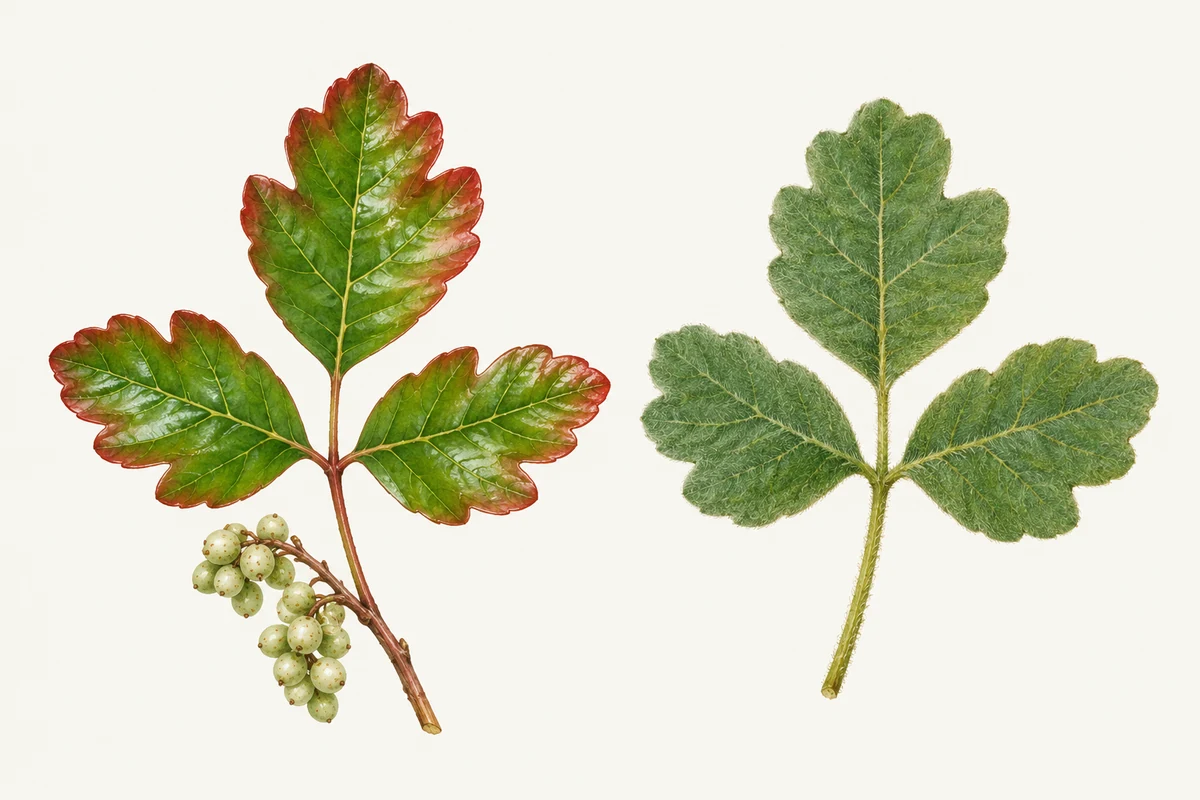
Poison oak is identified by leaves of three: each leaf has three toothed or lobed leaflets, the middle one on a longer stalk, set alternately on stems with no thorns. Western poison oak grows as a 1- to 6-foot shrub or a climbing vine; Atlantic poison oak is a low shrub with fuzzy leaflets crowded at the stem tips. Every part carries urushiol, so look but don't touch.
- Three leaflets, the middle one on a longer stalk, alternate leaves and no thorns: check all four together (UC IPM).
- Western poison oak (T. diversilobum) grows from British Columbia to Baja California; Atlantic poison oak (T. pubescens) in the central and eastern United States.
- True oak leaves grow singly, not in threes; blackberries have prickles, poison oak has none.
- Never burn it: UC IPM and Poison Control say the smoke can cause severe breathing problems.
Field marks at a glance
- Scientific name
- Toxicodendron diversilobum
- Family
- Anacardiaceae (cashew or sumac family)
- Type
- Shrub, perennial, deciduous
- Species
- Two species share the name: western or Pacific poison oak (Toxicodendron diversilobum) and Atlantic or eastern poison oak (T. pubescens), per Poison Control and UC IPM.
- Leaves
- Three leaflets per leaf, the stalk of the middle leaflet longer than the other two; rarely five, seven or nine leaflets in western poison oak (UC IPM). Leaves alternate along the stem.
- Leaflets
- Western: 1 to 4 inches long, toothed or somewhat lobed, glossy to dull, sometimes hairy underneath (UC IPM). Atlantic: oak-like, lobed or toothed, finely hairy on both sides (NC State).
- Growth form
- Western: a dense shrub usually 1 to 6 feet tall in sun, or a vine climbing 75 feet or more in shade (UC IPM). Atlantic: an upright low shrub, usually 2 to 4 feet, up to 10 feet (NC State).
- Stems
- No thorns or spines (UC IPM). Atlantic poison oak stems are finely hairy with smooth, light brown bark, and leaves crowd toward the stem tips (NC State).
- Flowers and fruit
- Small white-green flowers where leaves join the stem; western fruit is whitish-green, round and hairless (UC IPM). Atlantic fruit is greenish-white to tan and finely hairy (NC State).
- Seasons
- Deciduous. New spring leaves are green or light red, summer foliage is often glossy green, and fall leaves turn orange and red; winter stems are bare (UC IPM).
- Where it grows
- Western: British Columbia to Baja California, in woodlands, brush, parks and gardens up to about 5,000 feet (UC IPM). Atlantic: dry, sandy forests and thickets of the central and eastern US (NC State).
Poison oak is two North American shrubs, not one: western poison oak (Toxicodendron diversilobum) on the Pacific side and Atlantic poison oak (T. pubescens) in the central and eastern United States. Neither is a true oak. Both carry urushiol, the same oil that makes poison ivy and poison sumac cause a rash, so the aim of this page is to help you recognize poison oak from a step away and leave it alone. For poison ivy itself, see the poison ivy identification guide.
How to identify poison oak: four checks
Use these together; any one alone fits other plants. The marks come from the University of California's poison oak Pest Note (western poison oak) and NC State Extension's Atlantic poison oak profile.
1. Leaves of three, middle one stalked. Each leaf normally has three leaflets, and the stalk of the central leaflet is longer than those of the other two. UC IPM notes that western poison oak occasionally has five or seven leaflets, and in rare cases nine, so "leaves of three" is a general truth, not a rule.
2. Leaves alternate. The leaves grow to the left, then to the right along the stem, never in matching pairs.
3. Oak-like leaflets. Western leaflets are 1 to 4 inches long with toothed or somewhat lobed edges, glossy to dull, thin to leathery, sometimes hairy underneath; that variety gave the species its name, diversilobum. Atlantic leaflets are lobed or toothed and finely hairy on both sides, which is what pubescens means.
4. No thorns. UC IPM points out that poison oak has no thorns or spines on its leaves or stems, which helps rule out brambles.
Western vs Atlantic poison oak. In full sun, western poison oak forms a dense, leafy shrub usually 1 to 6 feet high; in shade it climbs as a vine up to 75 feet or more, holding on with aerial roots (UC IPM). Atlantic poison oak is an erect, low shrub, usually 2 to 4 feet, up to 10 feet, with finely hairy stems, smooth light brown bark and leaves crowded toward the stem tips (NC State). Alabama Extension adds that Atlantic poison oak's upright stems reach about 3 feet on dry pine and scrub oak sites.
Seasons change the look. UC IPM says new spring leaves are green or sometimes light red, summer foliage is often glossy green, and fall leaves turn orange and red. Small white-green flowers grow where the leaves meet the stem, followed in late summer by round, whitish-green, hairless fruit on western plants; NC State describes Atlantic fruit as greenish-white to tan and finely hairy. In winter the plant is bare stems, which UC IPM calls extremely hard to identify.
If you are unsure, one photo in Plant Identifier gives you a name to check against these four marks. Take it from where you stand; the app shows no confidence score and no list of alternatives, so confirm with the checks above before you go near the plant.
Poison oak vs true oak, blackberry and poison ivy
| Plant | Leaf | Stem | Quick test |
|---|---|---|---|
| Poison oak | Three leaflets (rarely 5 to 9), middle one on a longer stalk | No thorns or spines | Count leaflets per stalk |
| True oak seedling | One single leaf per stalk (UC IPM) | Woody twig | One blade, not three |
| Blackberry, raspberry | Compound, toothed | Prickly canes | Look for prickles |
| Poison ivy | Three leaflets, more pointed teeth (Alabama Extension) | Often a hairy climbing vine | Habit and teeth |
| Skunkbush sumac | Three leaflets, middle one without a stalk | No thorns | Hairy fruit (UC IPM) |
The trap with true oak is that a poison oak leaflet can look like a small oak leaf. Look at where the blade joins the twig: a true oak leaf grows singly, while poison oak's grow in sets. The trap with poison ivy is that it is just as hazardous; telling them apart matters less than recognizing both. In the East, Alabama Extension says poison oak's leaflet teeth are more rounded and its leaves often less shiny than poison ivy's.
Why you shouldn't touch it: urushiol
These lines are as the health and extension sources state them. They are not medical advice.
- Every part, every season. The American Academy of Dermatology says these plants are poisonous year-round and that touching any part, including the roots, can cause a rash, even during the winter. NC State says all parts of Atlantic poison oak are poisonous, even when dormant.
- Never burn it. UC IPM says that when poison oak is burned, the oils can disperse via smoke particles, and breathing that smoke can cause severe respiratory irritation. Poison Control says the dead leaves and stems should never be used as kindling, because inhaling the smoke can cause very severe breathing problems.
- It lingers on things. UC IPM says urushiol can persist on tools, clothing, pets and vehicles and stay able to cause a reaction for months or even years. Damage to the plant releases the oil, so weed eating, clearing brush, pruning or trampling are the risky jobs.
- Who reacts. UC IPM estimates that 50% to 75% of adults are sensitive to urushiol. Poison Control says the rash often starts 1 to 2 days after contact, sometimes up to a week, and typically lasts 1 to 2 weeks.
If you touched poison oak: first steps and when to get help
First steps. Poison Control says to rinse your skin with lukewarm, soapy water as soon as possible, then wash, separately, all the clothes you were wearing, along with any tools, backpacks and pets that may have been exposed. UC IPM explains why speed matters: the skin absorbs urushiol quickly, and after 30 minutes the oil has been absorbed. It also says to wash hands and under the fingernails, which spread the oil to other parts of the body, especially the face.
See a doctor, according to Poison Control, if the rash covers a large area or if you can't control the itching. In the US, Poison Control answers at 1-800-222-1222, online or by phone, 24 hours a day.
Pets. UC IPM says a dog's or cat's coat usually protects it from the oil, but the oil on its fur can spread to you; the AAD suggests bathing a pet you suspect has been near these plants, wearing rubber gloves.
Where poison oak grows in the US and Canada
Poison Control sums up the split: poison oak is mainly a plant of the Western states, poison ivy and poison sumac of the Midwest and East. UC IPM gives western poison oak's range as British Columbia to the Baja California peninsula, mainly the western parts of Washington and Oregon, and nearly all of California, where it grows from sea level to about 5,000 feet in coastlands, oak woodlands, rangelands, conifer forests, stream sides, brushlands, parks and gardens. UC IPM calls it the only Toxicodendron species in California.
NC State describes Atlantic poison oak as native to the central and eastern United States, common on North Carolina's coastal plain, and growing in dry, sandy forests and thickets, where it spreads by rhizomes into large colonies.
For a wider view of plants that irritate skin, see plants that cause skin rashes. To keep track of a patch you want to avoid on a trail or in a yard, Plant Identifier's Plant Map records where each located identification was made. If poison oak has to go, ask your county extension office first, wear long sleeves, gloves and long pants, wash everything afterwards, and don't burn it.
Look-alikes and how to tell them apart
True oak seedlings (Quercus)
Count the blades on one leaf stalk. UC IPM says true oak leaves grow singly, not in groups; poison oak always carries its leaflets in sets, usually three, with the middle one on a longer stalk.
Blackberry and other brambles (Rubus)
Look at the stems from a step away. Brambles carry prickles on their canes; UC IPM says poison oak has no thorns or spines on its leaves or stems.
Poison ivy (Toxicodendron radicans)
Alabama Extension says poison ivy's leaflet teeth are more pointed, and its vines look hairy from aerial roots; Atlantic poison oak is an upright shrub to about 3 feet with rounded teeth. Both carry urushiol, so treat either as hands-off.
Skunkbush sumac (Rhus trilobata)
A western shrub that UC IPM says resembles poison oak but does not cause dermatitis: its fruit is hairy and its middle leaflet has no stalk. Western poison oak fruit is hairless and its middle leaflet is stalked.
What a photo can't settle
- Western poison oak's leaves vary from glossy to dull, toothed to lobed and smooth to hairy (UC IPM), so a single photo can be misread: check the leaflet count, the middle stalk and the stem together.
- In winter the plant is bare stems; a photo of leafless twigs can't confirm poison oak, and the stems still carry urushiol.
- No identification, by app or by eye, tells you what caused a rash; a doctor decides that.
Questions people ask
Is poison oak the same as poison ivy?
No. They are different species in the same genus, Toxicodendron, and both carry urushiol. Poison ivy is Toxicodendron radicans; poison oak is T. diversilobum on the Pacific side and T. pubescens in the East (Poison Control). Atlantic poison oak is an upright shrub with rounded leaflet teeth; poison ivy often climbs with hairy vines.
Can you get a rash from poison oak in winter?
Yes. The AAD says these plants are poisonous year-round and that touching any part, including the roots, can cause a rash, even in winter. UC IPM adds that bare winter stems are easy to touch by accident and release oil if damaged.
Does poison oak grow in Canada?
Western poison oak does: UC IPM gives its range as British Columbia to the Baja California peninsula. NC State describes Atlantic poison oak as native to the central and eastern United States.
What should I do if I touched poison oak?
Poison Control says to rinse your skin with lukewarm, soapy water as soon as possible, then wash your clothes, tools and any pets that were exposed. See a doctor if the rash covers a large area or you can't control the itching. In the US, call Poison Control at 1-800-222-1222.
Is poison oak a real oak?
No. UC IPM says poison oak is not a true oak; it belongs to the cashew or sumac family. Its leaflets can look like small oak leaves, but true oak leaves grow singly, while poison oak's grow in sets, usually of three.
Sources
- Poison Oak (Pest Notes) — University of California Statewide IPM Program (UC IPM)
- Toxicodendron pubescens (Atlantic Poison Oak) — NC State Extension, North Carolina Extension Gardener Plant Toolbox
- Touch-Me-Nots: Poison Ivy, Poison Oak, and Poison Sumac — Alabama Cooperative Extension System
- Poison ivy, poison oak, and poison sumac — Poison Control, National Capital Poison Center
- Poison ivy, oak, and sumac: Who gets a rash, and is it contagious? — American Academy of Dermatology
Keep reading
- Safety guidePoison ivy identification: leaves, vines, berries and look-alikes
- Safety guidePlants that cause skin rashes, and how to tell which one
- Weed profileGiant hogweed (Heracleum mantegazzianum): how to identify it
- Weed profileWild parsnip (Pastinaca sativa): how to identify it
- Field guideHow to identify a plant, step by step