Plant profile
Gardenia (Gardenia jasminoides): how to identify it
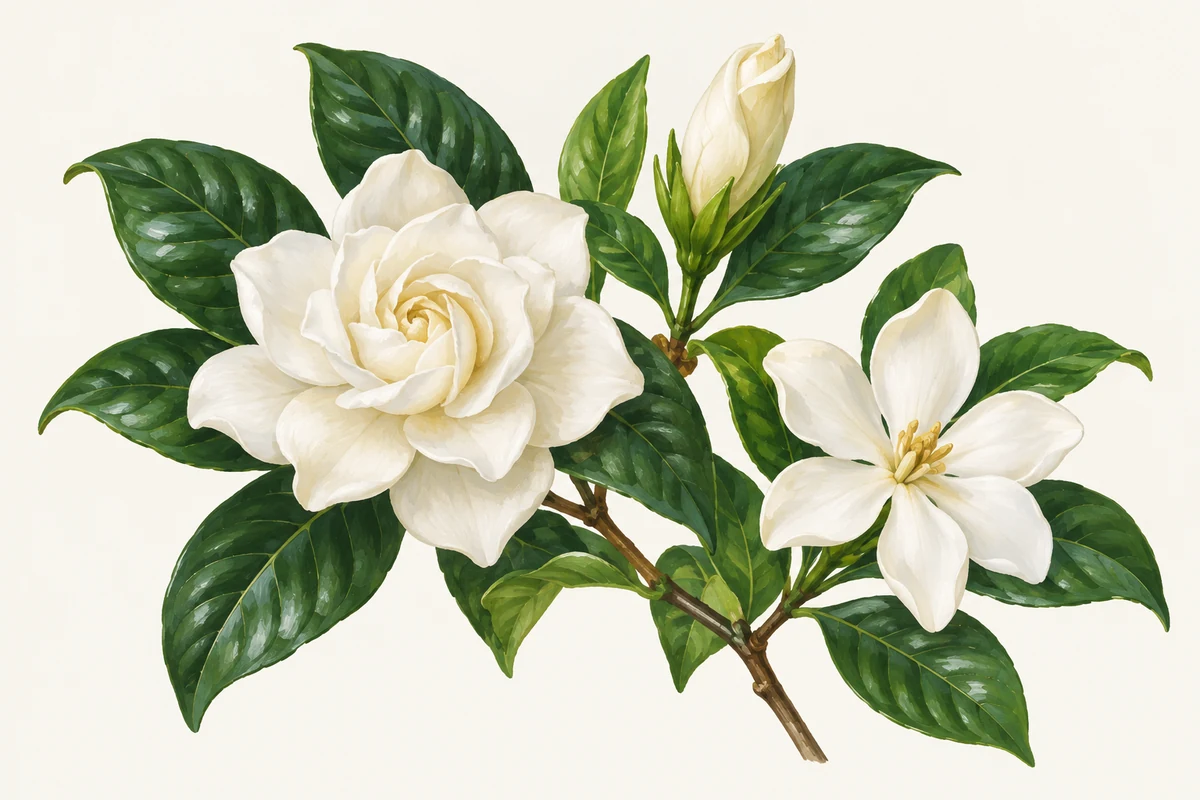
Glossy dark green leaves with deeply pressed-in veins, set in pairs or whorls, waxy white flowers that turn yellow as they age, pinwheel-twisted buds and a strong sweet scent.
In short
Gardenia (Gardenia jasminoides), also called Cape jasmine, is an evergreen shrub with glossy, dark green leaves, mostly 2 to 4 inches long, set opposite or in whorls, with deeply impressed veins. Its waxy, very fragrant flowers are 2 to 3 inches across, white to cream and aging to yellow, opening from spiral buds in spring and summer. The ASPCA lists it as toxic to dogs, cats and horses.
- Look at the buds and the veins: pinwheel-twisted buds and glossy leaves with sunken veins are NC State's quick ID marks for gardenia.
- A camellia has alternate, toothed leaves and cup-shaped flowers in late winter to early spring; a gardenia has smooth-edged leaves in pairs or whorls and scented waxy flowers in spring and summer.
- The ASPCA lists gardenia as toxic to dogs, cats and horses, with mild vomiting, diarrhea and hives as the signs it names.
Field marks at a glance
- Scientific name
- Gardenia jasminoides
- Family
- Rubiaceae (coffee family)
- Type
- Shrub, perennial, evergreen
- Leaves
- Opposite or whorled, simple, lanceolate to ovate, smooth-edged. NC State's description gives 2 to 4 inches long; its attribute table gives 3 to 6 inches long and 1 to 3 inches wide.
- Leaf surface
- Glossy, leathery and dark emerald green above, lighter and duller below, with prominent veins pressed into the surface (rugose). The leaves cluster in whorls at the branch tips.
- Buds
- Pinwheel or spiral-looking: the petals are twisted around each other before they open. NC State gives this as a quick ID hint.
- Flowers
- Waxy, 2 to 3 inches across, single or double depending on the cultivar, very fragrant. White to cream, aging to yellow; UF/IFAS adds pale yellow forms with purple mottling.
- Bloom season
- Spring and summer (NC State). Flowers form on new growth, which is why pruning after the bloom matters.
- Fruit
- An orange berry 1 to 3 inches long and under an inch wide, in summer and fall. NC State calls them hips and notes they attract birds.
- Size and form
- Dense, rounded, multi-stemmed shrub, 4 to 8 feet tall and wide (NC State); UF/IFAS gives 2 to 15 feet depending on the cultivar. 'Radicans' is a groundcover of 6 to 18 inches.
- Where it grows
- Native to southern China, Taiwan, Japan and Vietnam. Planted outdoors in USDA zones 7b to 11b and sold as a florist plant for pots elsewhere.
- Other names
- Cape jasmine, Cape jessamine. Previously known as Gardenia augusta and Gardenia florida, names still seen on old labels.
Gardenia (Gardenia jasminoides) is the shrub people usually notice by scent before they see it: a heavy, sweet fragrance from waxy white flowers on a glossy evergreen bush. It is grown in gardens across the US South and sold everywhere as a florist plant in pots, so it turns up both outdoors and on windowsills. Check the leaves first, then the buds and flowers, then any fruit.
What to check first: leaves, buds, flowers
1. The leaves. The NC State Extension Plant Toolbox describes gardenia leaves as opposite or whorled, glossy and dark emerald green above, lighter and duller below, with smooth edges and prominent veins pressed into the surface. That creased, quilted look (NC State's word is rugose) is the leaf mark to learn. The leaves crowd into whorls at the branch tips. NC State's description gives them as 2 to 4 inches long, while its attribute table gives 3 to 6 inches long and 1 to 3 inches wide, so expect a range.
2. The buds. NC State's first quick ID hint is that the buds look like a pinwheel or a spiral: the petals are wrapped and twisted around each other before they open. On a plant that is just coming into bloom, the buds alone are a strong clue.
3. The flowers. Open flowers are waxy, 2 to 3 inches across and very fragrant, white to cream and aging to yellow, so a single plant often carries white and yellowed flowers at the same time. They can be single or double depending on the cultivar. UF/IFAS Gardening Solutions adds that colors range from pale yellow with purple mottling to creamy white, that every gardenia flower has a wax-like look, and that the sweet scent is probably the most distinguishing characteristic. NC State gives spring and summer as bloom time.
4. The fruit. After flowering, gardenia can set an orange berry 1 to 3 inches long and under an inch wide, in summer and fall. NC State notes the fruit attracts birds. Not every pot plant fruits, so its absence proves nothing.
Plant Identifier can name an unknown shrub from one photo of a flower, a leafy branch or the whole plant. The app's answer comes without a confidence score or alternatives, so check it against the sunken veins and the paired or whorled leaves before you rely on it.
Gardenia toxicity: what the sources say
Searches for gardenia and pets are common, so here is exactly how each source lists it.
- ASPCA. The ASPCA Animal Poison Control Center lists gardenia (also Cape jasmine) as toxic to dogs, cats and horses. Toxic principles: genioposide and gardenoside. Clinical signs: mild vomiting and/or diarrhea, hives.
- NC State Extension. NC State flags gardenia as a problem for cats, dogs and horses and as poisonous to humans with a poison severity of low, listing the same symptoms and toxic principles. It notes that it does not cause contact dermatitis.
A "low" severity rating is NC State's classification, not a reason to wait. If someone may have eaten any part of a gardenia, call Poison Control at 1-800-222-1222 (poison.org) right away. If a pet may have, call your veterinarian or the ASPCA Animal Poison Control Center at (888) 426-4435 (a consultation fee may apply). Other plants on the ASPCA lists are gathered in plants toxic to cats and poisonous plants for dogs.
Plant Identifier's Toxicology tool gives AI-written notes on toxic parts and symptoms. Treat them as background, never as a reason to wait before calling.
Gardenia vs camellia, star jasmine and mountain laurel
Three plants get mixed up with gardenia: camellia for its glossy leaves and white double flowers, star jasmine for its scent and its shared "jasmine" name, and mountain laurel, which NC State lists as a plant gardenia is often confused with. Leaf arrangement and the leaf edge settle most cases.
| Feature | Gardenia | Camellia (C. japonica) | Star jasmine | Mountain laurel |
|---|---|---|---|---|
| Growth form | Shrub | Shrub or small tree | Climbing vine | Shrub |
| Leaf arrangement | Opposite or whorled | Alternate | Opposite | Mostly alternate |
| Leaf edge and veins | Smooth edge, sunken veins | Finely toothed | Smooth edge | Smooth edge, under 1 in wide |
| Flowers | Waxy, 2–3 in, white aging yellow | 3–5 in, cup-shaped, many colors | Under 1 in, five twisted lobes | 1 in, five-sided cups, 10 anther pockets |
| Bloom | Spring–summer | Late winter–early spring | Spring | Late April–July |
| Fruit | Orange berry 1–3 in | Woody capsule under 1 in | Pair of long slender pods | Tiny 5-valved capsules |
Sources: NC State Extension pages for camellia, star jasmine and mountain laurel.
Star jasmine has one more field test: NC State notes that bruised twigs and leaf stalks show white milky latex. NC State also lists star jasmine and mountain laurel as poisonous, so a mix-up doesn't make any of these plants harmless. For the general method of narrowing down an unknown shrub, see how to identify plants.
Where you'll see gardenia
NC State gives gardenia's origin as southern China, Taiwan, Japan and Vietnam, along stream banks, and names it after Alexander Garden, a Scottish naturalist. In the US it is planted outdoors in USDA zones 7b to 11b; UF/IFAS says that in Florida varieties of Gardenia jasminoides are used almost exclusively, out of more than 200 gardenia species. Farther north, in Canada and the UK, it is mostly the pot plant sold by florists. NC State notes it is often offered as a florist plant that can also go outside in a container or the landscape.
A short care note, and yellow leaves
Neither source calls gardenia easy: UF/IFAS says gardenias may not be low-maintenance, and NC State rates maintenance as high. Both put soil first. UF/IFAS gives a soil pH of 5.0 to 6.5 and suggests another plant or a container where soil is above 7.0; NC State says soil near a concrete walk or foundation may be too alkaline for good growth. Those are the first things to look at when leaves turn yellow, before reaching for anything else; the general causes are covered in yellow leaves on plants, and a soil test from your county Extension office settles the pH question.
NC State suggests bright indirect light or partial shade, shelter from cold wind, and no fertilizing in fall, which pushes frost-tender growth. Its roots are shallow and dislike disturbance. UF/IFAS says to prune only after flowering and before October, since flowers form on new growth, and names mealybugs, aphids, scales and whiteflies as the common pests; NC State notes whiteflies on stressed plants. For any pest treatment, follow the label and local rules.
Look-alikes and how to tell them apart
Camellia (Camellia japonica)
Camellia leaves are alternate (one per node) with finely toothed edges and no sunken veins. Its flowers are 3 to 5 inches, cup-shaped, in white, pink, red or variegated, and open in late winter to early spring. The fruit is a woody capsule under an inch long.
Star jasmine (Trachelospermum jasminoides)
Star jasmine is a climbing vine, not a shrub. Its creamy, fragrant flowers are under an inch across with five twisted pinwheel lobes, and bruised twigs and leaf stalks bleed white milky sap. The fruit is a pair of long, slender pods.
Mountain laurel (Kalmia latifolia)
NC State lists mountain laurel as a plant gardenia is often confused with. Its leaves are narrower (under an inch wide), mostly alternate and without impressed veins. The flowers are 1-inch, five-sided cups in rose to white with purple marks and 10 anther pockets, carried in large clusters.
What a photo can't settle
- Out of flower, a young potted gardenia can look like many glossy evergreen shrubs in a photo. Look for leaves in pairs or whorls, the sunken veins and any spiral buds before trusting a name.
- Cultivars vary a lot in size and flower form, from 6-inch groundcovers to 15-foot shrubs and from single to fully double flowers. Size alone won't confirm or rule out gardenia.
- A photo app, ours included, can name the plant but can't say how much of it a child or pet has eaten or how serious it is. That is a call for Poison Control or a vet, not an app.
Questions people ask
What does a gardenia look like?
A dense, rounded evergreen shrub, often 4 to 8 feet tall, with glossy dark green leaves in pairs or whorls and deeply sunken veins. In spring and summer it carries waxy white flowers 2 to 3 inches across that turn creamy yellow as they age, opening from twisted, spiral buds.
Is gardenia poisonous to cats and dogs?
The ASPCA lists gardenia as toxic to dogs, cats and horses, naming genioposide and gardenoside as the toxic principles and mild vomiting, diarrhea and hives as the signs. If a pet may have chewed any part, call your vet or the ASPCA Animal Poison Control Center at (888) 426-4435. For a person, call Poison Control at 1-800-222-1222.
Why does my gardenia have yellow leaves?
Its sources point first at the soil. NC State says soil near a concrete walk or foundation may be too alkaline for good growth, and UF/IFAS gives a soil pH of 5.0 to 6.5 for gardenias. A soil test from your county Extension office tells you where yours stands.
How do I tell a gardenia from a camellia?
Check the leaf edge and arrangement. Gardenia leaves are smooth-edged, in pairs or whorls, with sunken veins; camellia leaves sit one per node and have finely toothed edges. Camellias flower in late winter to early spring, gardenias in spring and summer, and gardenia buds are twisted like a pinwheel.
Sources
- Gardenia jasminoides — NC State Extension, North Carolina Extension Gardener Plant Toolbox
- Gardenias — UF/IFAS Gardening Solutions, University of Florida
- Toxic and Non-toxic Plants: Gardenia — ASPCA Animal Poison Control Center
- Poison Control — National Capital Poison Center
- Camellia japonica — NC State Extension, North Carolina Extension Gardener Plant Toolbox
- Trachelospermum jasminoides — NC State Extension, North Carolina Extension Gardener Plant Toolbox
- Kalmia latifolia — NC State Extension, North Carolina Extension Gardener Plant Toolbox
Keep reading
- Garden shrub profileLantana (Lantana camara): how to identify it
- Pet safety guidePoisonous plants for dogs, and what to do if your dog ate one
- Plant healthYellow leaves on plants, and what each pattern means
- Free toolFlower identifier by description
- Plant profileHydrangea: how to identify it and tell the types apart