Plant profile
Hydrangea: how to identify it and tell the types apart
Opposite, toothed leaves and big heads of four-parted florets mark every garden hydrangea. The shape of the head and of the leaf tells you which of the five common kinds you have.
In short
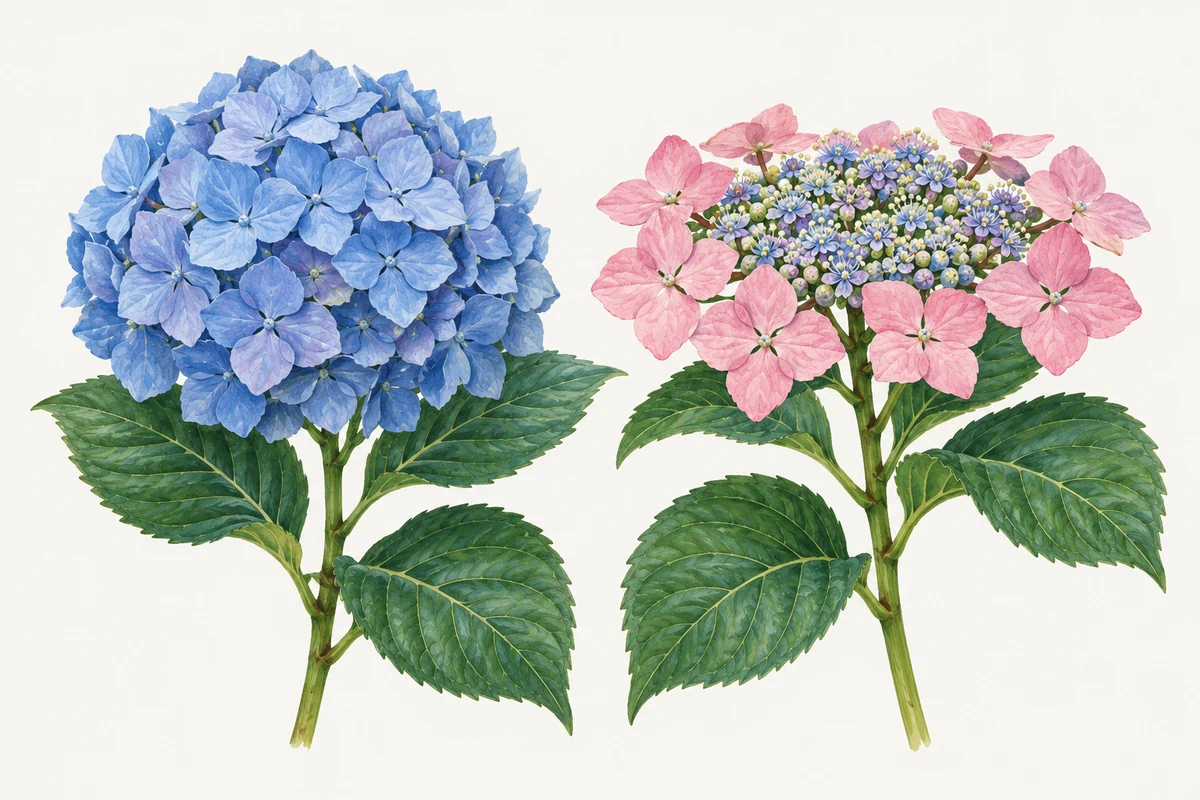
What flower is a hydrangea? A hydrangea is a shrub, or in one case a climbing vine, whose "flower" is a head of many small florets, the showy ones sterile and enlarged. All garden hydrangeas have opposite, toothed leaves. Round mopheads or flat lacecaps with 4- to 8-inch leaves mean bigleaf hydrangea; cone-shaped heads mean panicle or oakleaf hydrangea; a flowering vine on a wall means climbing hydrangea.
- Flower head shape sorts the five: ball or flat (bigleaf, smooth, climbing) versus cone (panicle, oakleaf).
- Oak-shaped, lobed leaves can only be oakleaf hydrangea; a woody vine clinging with aerial rootlets can only be climbing hydrangea.
- Only bigleaf-type hydrangeas change color with soil: blue in acid soil, mauve near neutral, pink in alkaline soil (RHS).
Field marks at a glance
- Scientific name
- Hydrangea macrophylla
- Family
- Hydrangeaceae (hydrangea family)
- Type
- Shrub, perennial, deciduous
- Leaves
- Opposite, simple, coarsely toothed; obovate to broadly ovate with a short pointed tip, 4 to 8 inches long and 3 to 6 inches wide, lustrous medium to dark green, on a stout stalk about 1 inch long.
- Flower heads
- Either mophead (a ball of showy sterile florets) or lacecap (a flat center of tiny fertile flowers ringed by larger showy ones). Each showy floret is 4- or 5-parted.
- Flower color
- Blue, pink, purple or white. On blue- and pink-flowered cultivars the color follows soil pH; white, red and green cultivars stay their color.
- Bloom time
- Late spring and summer, mostly on the previous year's stems (old wood). Reblooming cultivars flower again later in summer on new growth.
- Size and form
- Rounded, multi-stemmed shrub, generally 3 to 6 feet tall and wide, with coarse texture. Stems rise from the ground and rarely branch.
- Bark and stems
- Tan stems with large leaf scars. Faded flower heads can stay on the plant well into winter (RHS).
- Origin
- Native to Japan, China, Korea and Southeast Asia. Grown in USDA zones 6 to 11 (NC State Extension).
- Other names
- Mophead or lacecap hydrangea, hortensia, and in shops simply "hydrangea". The ASPCA files its hydrangea entry under smooth hydrangea, also called hortensia.
"Hydrangea" usually means bigleaf hydrangea (Hydrangea macrophylla), the blue-or-pink mophead of shady gardens and florists' pots. But at least four other kinds are common in gardens, and they differ in ways that matter: when to prune, how big they get, and whether the color changes. Two marks sort them out: the shape of the flower head, then the shape of the leaf.
What to check first: flower head shape, then the leaf
Every garden hydrangea has opposite leaves (two per node) with toothed edges, and flower heads built from many small florets. The large, showy florets are sterile; the tiny ones are fertile. The RHS growing guide groups them by head shape, and that is the fastest first check.
1. The flower head.
- Round ball (mophead): bigleaf hydrangea or a ball-flowered smooth hydrangea.
- Flat plate with a ring of big florets (lacecap): lacecap bigleaf hydrangea (or its close relative H. serrata), wild-type smooth hydrangea, or climbing hydrangea.
- Upright cone: panicle hydrangea or oakleaf hydrangea.
2. The leaf. Once the head narrows it to two or three, the leaf finishes the job.
| Hydrangea | Flower head | Leaf | Size and habit |
|---|---|---|---|
| Bigleaf (H. macrophylla) | Mophead or lacecap; blue, pink, purple or white | 4–8 in, glossy, coarsely toothed, broadly oval | Shrub 3–6 ft |
| Panicle (H. paniculata) | Cone, 6–8 in, creamy white fading pink and tan | 3–6 in, oval, toothed, sometimes 3 per node near tips | Shrub or small tree 8–15 ft, up to 25 |
| Smooth (H. arborescens) | Flat, 2–8 in, or a white ball in several cultivars | 2–6 in, broad, rounded, sharply toothed | Shrub 3–5 ft |
| Oakleaf (H. quercifolia) | Cone, 4–12 in, white fading pink then tan | 3–8 in, 3–7 oak-like lobes, felty below | Shrub 4–8 ft |
| Climbing (H. petiolaris) | Flat, 6–8 in, ring of large white florets | 2½–5 in, glossy, heart-shaped base | Vine to 60 ft |
Sources: NC State Extension Plant Toolbox pages for bigleaf, panicle, smooth, oakleaf and climbing hydrangea.
If you have a photo of the head and one leaf, Plant Identifier can suggest which hydrangea it is; the app returns a single answer with no confidence score, so check it against the table. For flowers that may not be hydrangeas at all, the flower identifier starts from color and shape.
Mophead vs lacecap bigleaf hydrangea
Mophead and lacecap are two forms of the same species, not two species. NC State Extension describes bigleaf hydrangea cultivars as producing either ball-shaped clusters ("mop-heads") or flat clusters of small flowers surrounded by a ring of more prominent flowers ("lacecaps"). In a mophead nearly every floret is the large, sterile kind; in a lacecap the large ones form only the outer ring.
Whichever the form, the plant underneath is the same: a rounded, multi-stemmed shrub, generally 3 to 6 feet tall and wide, with glossy, coarsely toothed leaves 4 to 8 inches long on stout stalks. Bigleaf hydrangea blooms in late spring and summer on the previous year's stems, which is why the RHS warns that heavy pruning means lost flowers; some cultivars, sold as rebloomers, flower again on new growth later in summer.
How to tell the other hydrangea species apart
Panicle hydrangea (H. paniculata) is the big one: NC State gives 8 to 15 feet, up to 25, calls it a shrub or small tree and one of the hardiest hydrangeas in winter, and notes it is more tolerant of full sun than other species. Its heads are cones of creamy white flowers, 6 to 8 inches long, that fade toward pink and tan in fall. Its leaves are smaller than bigleaf's and, as NC State's quick ID hints note, sometimes whorled near the branch tips.
Smooth hydrangea (H. arborescens) is native to woods and streambanks of the eastern United States and is the most common native hydrangea in North Carolina. Wild plants have flat heads of tiny white fertile flowers with only a few large florets at the edge; several named cultivars have sterile flowers in ball-shaped heads. Its leaves are broad, egg-shaped to rounded and sharply toothed, 2 to 6 inches long, and the bark peels in thin layers.
Oakleaf hydrangea (H. quercifolia) is the easiest: its leaves have 3 to 7 lobes like an oak leaf, 3 to 8 inches long and felty underneath, and they turn wine, orange or mahogany in fall. Its flowers come in upright cones, 4 to 12 inches long, white fading to pink and then tan. Older stems peel to reveal cinnamon-brown bark, a winter mark. It is native to the southeastern United States.
Climbing hydrangea (H. petiolaris, which the RHS lists as Hydrangea anomala subsp. petiolaris) is a woody vine. NC State describes it clinging by aerial rootlets and reaching 60 feet on walls, arbors and other structures, with flat, fragrant heads 6 to 8 inches wide: a ring of large white sterile florets around creamy fertile ones, in early summer. Its leaves are glossy, 2½ to 5 inches long, with heart-shaped bases on long stalks, and the bark peels reddish-brown.
Why hydrangea flowers change color with soil
This is the question most people bring to a hydrangea, and the sources agree on the answer.
- The mechanism. The RHS explains that on mophead and lacecap bigleaf hydrangeas (and H. serrata and H. involucrata), soil pH controls how much aluminium is available to the plant. Flowers are blue in acid soil (high available aluminium), mauve in lightly acid to neutral soil and pink in alkaline soil. The RHS adds that blue cultivars stay blue at around pH 4.5 to 5.
- What doesn't change. The RHS notes that white, red and green-flowered cultivars stay white or green whatever the soil. NC State says smooth hydrangea's color is not affected by soil pH. Panicle and oakleaf hydrangeas are white-flowered species whose heads age to pink and tan, which is not a soil effect.
- Changing it. NC State says aluminum sulfate can be added to acidify the soil (bluer) and lime to make it more alkaline (pinker). The RHS says the "blueing compounds" sold for this contain aluminium sulphate, that you should always follow the manufacturer's instructions, and that on very alkaline or chalky soil they won't work, so growing in containers of ericaceous compost is the alternative.
- Aging is different. By late summer, the RHS notes, blue and pink heads fade to mixes of green and pink-red, and white heads often turn pink. A fading head says nothing about the soil.
So color is a clue to the soil, not to the species: two bigleaf hydrangeas of the same cultivar can flower blue and pink a few streets apart.
Hydrangeas and pets
The ASPCA Animal Poison Control Center lists hydrangea as toxic to dogs, cats and horses. The entry is filed under smooth hydrangea (Hydrangea arborescens), with hortensia among its other names; the toxic principle is a cyanogenic glycoside, and the listed signs are vomiting, depression and diarrhea, with the ASPCA noting that cyanide intoxication is rare. The RHS says all parts may cause mild stomach upset if eaten, and that contact with the foliage may aggravate skin allergies, so it recommends gloves.
If a pet has eaten part of a hydrangea, call your veterinarian or the ASPCA Animal Poison Control Center at (888) 426-4435 (a consultation fee may apply). If a person has, call Poison Control at 1-800-222-1222 (poison.org). The same ASPCA lists cover other garden shrubs in poisonous plants for dogs and plants toxic to cats.
A short care note
The RHS recommends moist, well-drained soil and light shade, with sun tolerated if the soil doesn't dry out; NC State adds protection from afternoon sun for bigleaf hydrangea. Pruning follows the flowering wood: bigleaf hydrangeas flower on last year's stems, so the RHS advises light pruning in mid-spring, cutting back to the first or second strong pair of buds below the old head, while panicle and smooth hydrangeas, which flower on new growth, can be cut back in early spring. Oakleaf hydrangea also flowers on old wood and needs little pruning. If leaves develop spots or mildew, Plant Identifier's Diagnose tool gives a first read from a photo.
Look-alikes and how to tell them apart
Panicle hydrangea (Hydrangea paniculata)
Check the flower head: panicle hydrangea carries cone-shaped, pyramidal heads of creamy white flowers 6 to 8 inches long that fade to pink and tan, never round blue mopheads. Its leaves are smaller, 3 to 6 inches, and sometimes in whorls of three near the branch tips. It grows 8 to 15 feet or more.
Smooth hydrangea (Hydrangea arborescens)
Smooth hydrangea has white flower heads, flat with a few large florets at the edge or, in several cultivars, round balls, and its color does not change with soil. Its leaves are broad egg-shaped to rounded and sharply toothed, 2 to 6 inches long. It is native to the eastern United States.
Oakleaf hydrangea (Hydrangea quercifolia)
Look at the leaf: oakleaf hydrangea's leaves have 3 to 7 lobes like an oak's, 3 to 8 inches long, felty and whitish-brown beneath, turning wine, orange or mahogany in fall. Its flowers come in upright white cones, 4 to 12 inches long, and older stems peel to cinnamon-brown bark.
Climbing hydrangea (Hydrangea petiolaris)
Climbing hydrangea is a woody vine that clings to walls and other structures with aerial rootlets and can reach 60 feet. Its flat, lacecap-like heads, 6 to 8 inches wide, are white and fragrant, and its glossy leaves have heart-shaped bases on stalks up to 4 inches long.
What a photo can't settle
- Bigleaf hydrangea has many cultivars, and the RHS groups Hydrangea serrata with it for lacecap heads and soil-driven color; a photo can name the species group but rarely the cultivar.
- Flower color is not an identification mark on its own: the same bigleaf plant can be blue in one garden and pink in another, and all heads fade to green and pink-red with age.
- Climbing hydrangea goes by two names: NC State Extension uses Hydrangea petiolaris and the RHS Hydrangea anomala subsp. petiolaris. A name check won't settle which a nursery label means.
Questions people ask
What is the difference between a mophead and a lacecap hydrangea?
Both are usually bigleaf hydrangea (Hydrangea macrophylla). A mophead's head is a dense ball made almost entirely of large, showy sterile florets. A lacecap's head is flat: a center of tiny fertile flowers surrounded by a ring of larger showy ones. NC State Extension describes both forms.
Why did my hydrangea change from blue to pink?
On bigleaf hydrangeas, soil pH controls how much aluminium is available to the plant. The RHS says flowers are blue in acid soil, mauve in lightly acid to neutral soil and pink in alkaline soil, so the same cultivar can flower in different colors in different soils.
Which hydrangeas don't change color?
Smooth hydrangeas keep their color whatever the soil (NC State Extension), and the RHS notes that white, red and green-flowered bigleaf cultivars stay white or green. Fading in late summer, to green and pink-red, is aging, not a soil effect.
Is hydrangea poisonous to dogs and cats?
The ASPCA lists hydrangea as toxic to dogs, cats and horses, naming a cyanogenic glycoside and signs of vomiting, depression and diarrhea. If a pet has eaten part of a hydrangea, call your vet or the ASPCA Animal Poison Control Center at (888) 426-4435. For a person, call Poison Control at 1-800-222-1222.
Sources
- Hydrangea macrophylla — NC State Extension, North Carolina Extension Gardener Plant Toolbox
- How to grow shrubby hydrangeas — Royal Horticultural Society (RHS)
- Hydrangea paniculata — NC State Extension, North Carolina Extension Gardener Plant Toolbox
- Hydrangea arborescens — NC State Extension, North Carolina Extension Gardener Plant Toolbox
- Hydrangea quercifolia — NC State Extension, North Carolina Extension Gardener Plant Toolbox
- Hydrangea petiolaris — NC State Extension, North Carolina Extension Gardener Plant Toolbox
- Toxic and Non-toxic Plants: Hydrangea — ASPCA Animal Poison Control Center
- Poison Control — National Capital Poison Center