Plant profile
Azalea: how to identify it, and how to tell it from a rhododendron
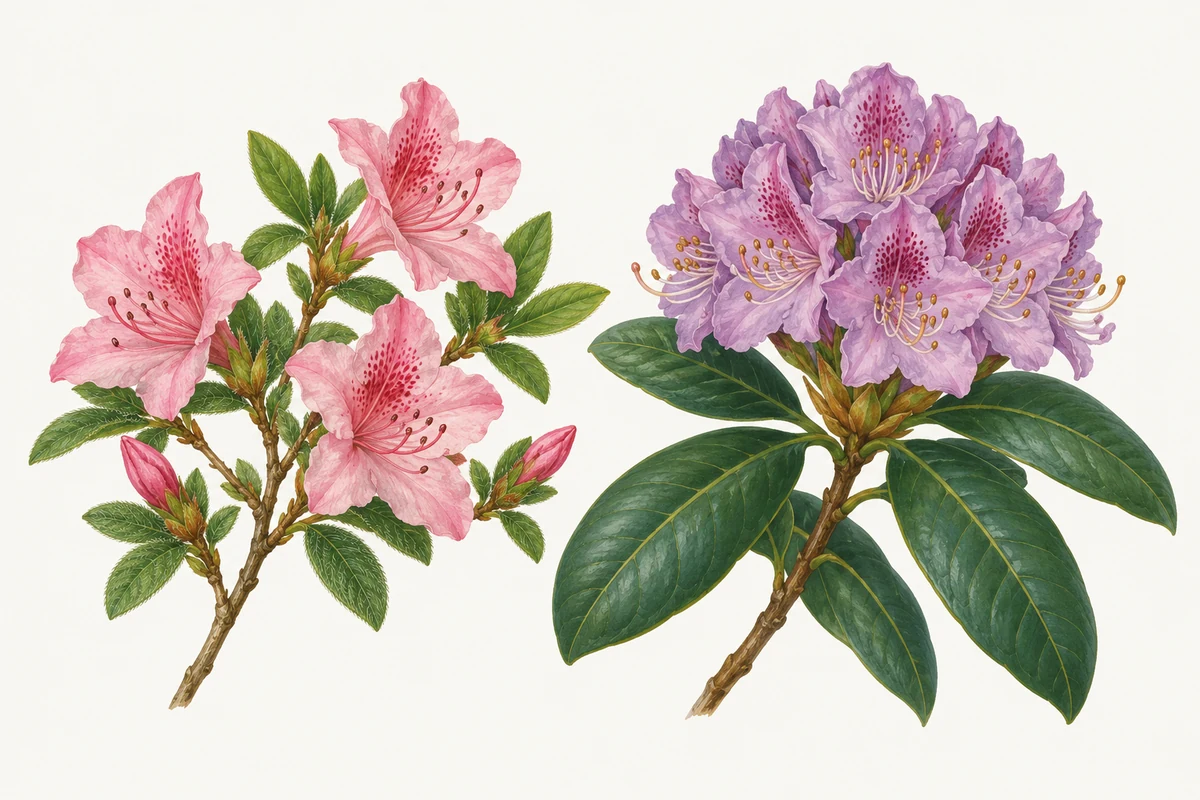
Funnel-shaped flowers that cover the shrub in spring, small, thin, often hairy leaves bunched at the branch tips. All azaleas are rhododendrons, but they look different on the shrub.
In short
An azalea is a Rhododendron shrub with funnel-shaped or tubular flowers, usually one to a few per stem tip, so the whole bush looks covered in bloom in spring. Its leaves are small, thin, smooth-edged and often hairy, clustered at the branch tips; many are deciduous. Rhododendrons have bell-shaped flowers in big end clusters and thick, leathery, glossy leaves. The ASPCA lists azaleas as toxic to dogs, cats and horses.
- Flower shape and leaf texture settle azalea vs rhododendron: funnel flowers and small, thin, hairy leaves for azalea; bell flowers in big clusters and thick, glossy leaves for rhododendron.
- NC State's 5 vs 10 stamens rule is a rough guide only: World Flora Online describes Rhododendron simsii, an azalea, with 10 stamens.
- The ASPCA lists azaleas (Rhododendron spp.) as toxic to dogs, cats and horses, with vomiting, diarrhea, weakness and cardiac failure among the signs.
Field marks at a glance
- Scientific name
- Rhododendron spp.
- Family
- Ericaceae (heath or blueberry family)
- Type
- Shrub, perennial, deciduous
- Flowers
- Tubular or funnel-shaped, 5-lobed, 1 to 3 inches across, in white, cream, pink, red, lavender, purple, orange or yellow. One or a few flowers per stem tip, on many stems, so the shrub looks blanketed in bloom.
- Bloom season
- Spring; NC State gives April as the typical azalea bloom, earlier than most rhododendrons. Some, such as Southern Indian azalea, can rebloom in fall.
- Leaves
- Alternate, small, thin, elliptic to obovate, smooth-edged and often hairy, crowded at the branch tips. NC State's Southern Indian azalea has reddish-brown hairs on twigs and leaf veins.
- Leaf habit
- Most azaleas are deciduous, NC State says, but many are evergreen; the evergreen azaleas in Florida landscapes are mostly hybrids of Asian origin (UF/IFAS).
- Stamens
- NC State's rule of thumb is 5 stamens for azaleas and 10 for rhododendrons, but World Flora Online describes Rhododendron simsii with 10. Use it as a hint, not a test.
- Fruit
- Small, dry red-brown capsules about half an inch long in terminal clusters in fall, releasing fine seeds (NC State, genus page).
- Size and form
- Rounded, multi-stemmed shrub. NC State gives 6 to 10 feet for azaleas and rhododendrons; UF/IFAS gives 3 to 5 feet for Kurume hybrids, about 10 feet for 'George Tabor', and 2 to 3 feet for dwarfs.
- Where it grows
- Rhododendrons, azaleas included, are native to North America, Europe and Asia (NC State). Garden azaleas grow best in acidic, moist, well-drained soil in dappled shade.
- Scent
- UF/IFAS says non-native azaleas have no fragrance, while native American azaleas, with smaller and more delicate flowers, are very fragrant.
Azaleas are the shrubs that turn whole front yards pink, red and white each spring across the US South, and the potted ones sold in bloom by florists in Canada and the UK. Botanically every azalea is a Rhododendron, which is why "azalea vs rhododendron" is the first question most people have. Check the flowers first, then the leaves, then the season.
What to check first: flower shape, leaves, bloom time
The NC State Extension Plant Toolbox quotes the American Rhododendron Society: all azaleas are rhododendrons, but not all rhododendrons are azaleas. It then gives garden marks that separate the two.
1. Flower shape and how they're carried. Azalea flowers are tubular or funnel-shaped, with 5 lobes, one flower (or a few) per stem tip; because the shrub has many stems, it looks covered in bloom. Rhododendron flowers are bell-shaped and come in big clusters at the branch ends. Azaleas come in white, cream, pink, red, lavender, purple, orange and yellow; rhododendrons in white, pink, purple and red, rarely yellow.
2. The leaves. Azalea leaves are small, thin, elliptic to obovate, smooth-edged and often thickly hairy, crowded at the branch tips. Rhododendron leaves are thick, leathery and glossy, laurel-like, with undersides that may be scaly or dotted. Run a leaf between your fingers: thin and soft points to azalea, stiff and leathery to rhododendron.
3. Bloom time. NC State gives April for azaleas and later in spring for rhododendrons. Some azaleas rebloom: NC State's Southern Indian azalea flowers in mid to late spring and occasionally again in fall.
4. Stamens, with a caution. NC State's rule is 5 stamens for azaleas, 10 for rhododendrons. It's a handy hint, but not a test: World Flora Online describes Rhododendron simsii, an azalea with broadly funnel-shaped red, rose or white flowers flecked dark red on the upper lobes, as having 10 stamens.
Plant Identifier can name a flowering shrub from one photo of a flower cluster or the whole plant. The app's answer comes without a confidence score or alternatives, so check it against the flower shape and the leaf texture, especially between azalea and rhododendron.
Azalea toxicity: what the sources say
- ASPCA. The ASPCA Animal Poison Control Center lists azalea (Rhododendron spp., also called rosebay and rhododendron) as toxic to dogs, cats and horses. Toxic principle: grayanotoxin. Clinical signs: vomiting (not in horses), diarrhea, weakness, cardiac failure.
- NC State Extension. NC State lists azaleas and rhododendrons as poisonous, names grayanotoxins as the toxic principle, and lists bark, flowers, fruits, leaves, roots, sap and seeds among the poisonous parts. It rates the severity low and notes they do not cause contact dermatitis.
A severity rating is a classification, not a reason to wait. If someone may have eaten any part of an azalea, call Poison Control at 1-800-222-1222 (poison.org) right away. If a pet may have, call your veterinarian or the ASPCA Animal Poison Control Center at (888) 426-4435 (a consultation fee may apply). Other plants on the ASPCA lists are gathered in poisonous plants for dogs and plants toxic to cats.
Plant Identifier's Toxicology tool gives AI-written notes on toxic parts and symptoms. Treat them as background, never as a reason to wait before calling.
Azalea vs rhododendron, mountain laurel and oleander
| Feature | Azalea | Rhododendron (R. maximum) | Mountain laurel | Oleander |
|---|---|---|---|---|
| Flower shape | Funnel or tube, 5 lobes | Bell-shaped, often spotted | Five-sided cup, 10 anther pockets | Funnel with fringed center |
| How flowers are carried | One to a few per stem tip | Big end clusters | Large end clusters | Clusters at branch tips |
| Leaves | Small, thin, often hairy, at tips | 4–8 in, thick, leathery | 2–5 in, glossy, leathery | 4–7 in, narrow, in whorls of 3–4 |
| Leaf habit | Deciduous or evergreen | Evergreen | Evergreen | Evergreen |
| Fruit | Small dry capsules | Oblong capsule | Tiny 5-valved capsules | Paired pods 5–7 in |
Sources: NC State Extension pages for rosebay rhododendron and mountain laurel; oleander details are on our oleander page.
The name "rosebay" adds confusion: the ASPCA gives it as another name for azalea, NC State uses it for Rhododendron maximum, and NC State also gives it as a common name of oleander. All of these are listed as poisonous by NC State, so mixing them up doesn't make any of them harmless.
Where you'll see azaleas, and the main groups
NC State says rhododendrons, azaleas included, are native to North America, Europe and Asia, with some species native to North Carolina. UF/IFAS Gardening Solutions sorts the garden azaleas into groups you can learn to spot:
- Southern Indica hybrids, vigorous evergreens such as 'George Tabor' (soft pink, about 10 feet tall and 8 feet wide), 'Formosa' (rose-purple) and 'Mrs. G. G. Gerbing' (white).
- Kurume hybrids, 3 to 5 feet, with smaller but plentiful pink, red, purple or white flowers.
- Satsuki hybrids, about 5 or 6 feet after 10 to 15 years, often with patterned petals.
- Native azaleas, mostly deciduous, with smaller, fragrant flowers from pink to peach to yellow.
World Flora Online lists Rhododendron simsii as an accepted species and gives Azalea indica as a synonym; its Flora of China description is a shrub 2 to 5 meters tall with flowers in April and May. NC State notes that some azaleas are offered as florist plants, which is how many people in Canada and the UK first meet one.
A short care note
NC State says azaleas and rhododendrons prefer moist, well-drained, acidic soil in dappled shade with protection from afternoon sun, which can scorch the leaves. They don't tolerate dense clay, their roots may rot if drainage is poor, and NC State suggests planting the root ball high and avoiding overwatering and over-fertilizing. Prune, if at all, after flowering. Its listed problems include lace bugs, mites, scale and Phytophthora root rot, which causes leaf loss, dieback and wilting; for any treatment, follow the label and local rules.
Look-alikes and how to tell them apart
Rhododendron (e.g. rosebay rhododendron, Rhododendron maximum)
Rhododendron leaves are thick, leathery, glossy and larger (rosebay rhododendron's run 4 to 8 inches), sometimes scaly or dotted underneath. The flowers are bell-shaped, in big rounded clusters at the branch ends, and usually open later in spring than azaleas.
Mountain laurel (Kalmia latifolia)
Mountain laurel has glossy, leathery evergreen leaves 2 to 5 inches long and flowers in large terminal clusters. Each flower is a small five-sided cup about an inch across, rose to white with purple-red marks inside and 10 anthers tucked into pockets, unlike an azalea's open funnel.
Oleander (Nerium oleander)
Oleander leaves are long and narrow (4 to 7 inches, under an inch wide) in whorls of 3 or 4, not small leaves crowded at the tips. Its flowers have a fringed center and are followed by long paired pods. Oleander, rhododendron and azalea are all called rosebay in some sources.
What a photo can't settle
- Azaleas and rhododendrons are one genus with thousands of hybrids, and some hybrids sit between the two. The flower-shape and leaf-texture tests work on most garden plants, not every one.
- Out of flower, a small evergreen azalea is hard to name from a photo. Look for small hairy leaves crowded at the tips and last year's dry seed capsules.
- A photo app, ours included, can name the plant but can't say how much of it a child or pet has eaten or how serious it is. That is a call for Poison Control or a vet, not an app.
Questions people ask
What is the difference between an azalea and a rhododendron?
All azaleas are rhododendrons, but not all rhododendrons are azaleas. In the garden, azaleas have funnel-shaped flowers one to a few per stem and small, thin, often hairy leaves; rhododendrons have bell-shaped flowers in big end clusters and thick, leathery, glossy leaves, and usually bloom a little later in spring.
Are azaleas poisonous to dogs and cats?
The ASPCA lists azaleas (Rhododendron spp.) as toxic to dogs, cats and horses, naming grayanotoxin as the toxic principle and vomiting, diarrhea, weakness and cardiac failure as signs. If a pet may have chewed any part, call your vet or the ASPCA Animal Poison Control Center at (888) 426-4435. For a person, call Poison Control at 1-800-222-1222.
Are azaleas evergreen?
Some are, some aren't. NC State says most azaleas are deciduous but many are evergreen. UF/IFAS says the evergreen azaleas in Florida gardens are mostly Asian-origin hybrids, such as the Southern Indica, Kurume and Satsuki groups, while most native American azaleas lose their leaves in winter.
Do azaleas smell?
Usually not the ones in garden centers. UF/IFAS says non-native azaleas have no fragrance, while native azaleas, with smaller, more delicate flowers in pink, peach and yellow, are very fragrant. A strongly scented azalea in the woods of the eastern US is likely a native species.
Sources
- Rhododendron — NC State Extension, North Carolina Extension Gardener Plant Toolbox
- Rhododendron indicum (Southern Indian Azalea) — NC State Extension, North Carolina Extension Gardener Plant Toolbox
- Rhododendron simsii Planch. — World Flora Online
- Azaleas — UF/IFAS Gardening Solutions, University of Florida
- Toxic and Non-toxic Plants: Azalea — ASPCA Animal Poison Control Center
- Poison Control — National Capital Poison Center
- Rhododendron maximum — NC State Extension, North Carolina Extension Gardener Plant Toolbox
- Kalmia latifolia — NC State Extension, North Carolina Extension Gardener Plant Toolbox
Keep reading
- Plant profileOleander (Nerium oleander): how to identify it
- Pet safety guidePoisonous plants for dogs, and what to do if your dog ate one
- Plant profileCamellia (Camellia japonica and C. sasanqua): how to identify it
- Free toolFlower identifier by description
- Plant profileHydrangea: how to identify it and tell the types apart