Invasive plants ID
How to identify invasive plants
Seven plants people most often report in the UK, Canada and the US, the features that give each one away, what the official agencies ask you to do, and how to photograph a plant so an expert can confirm it.
In short
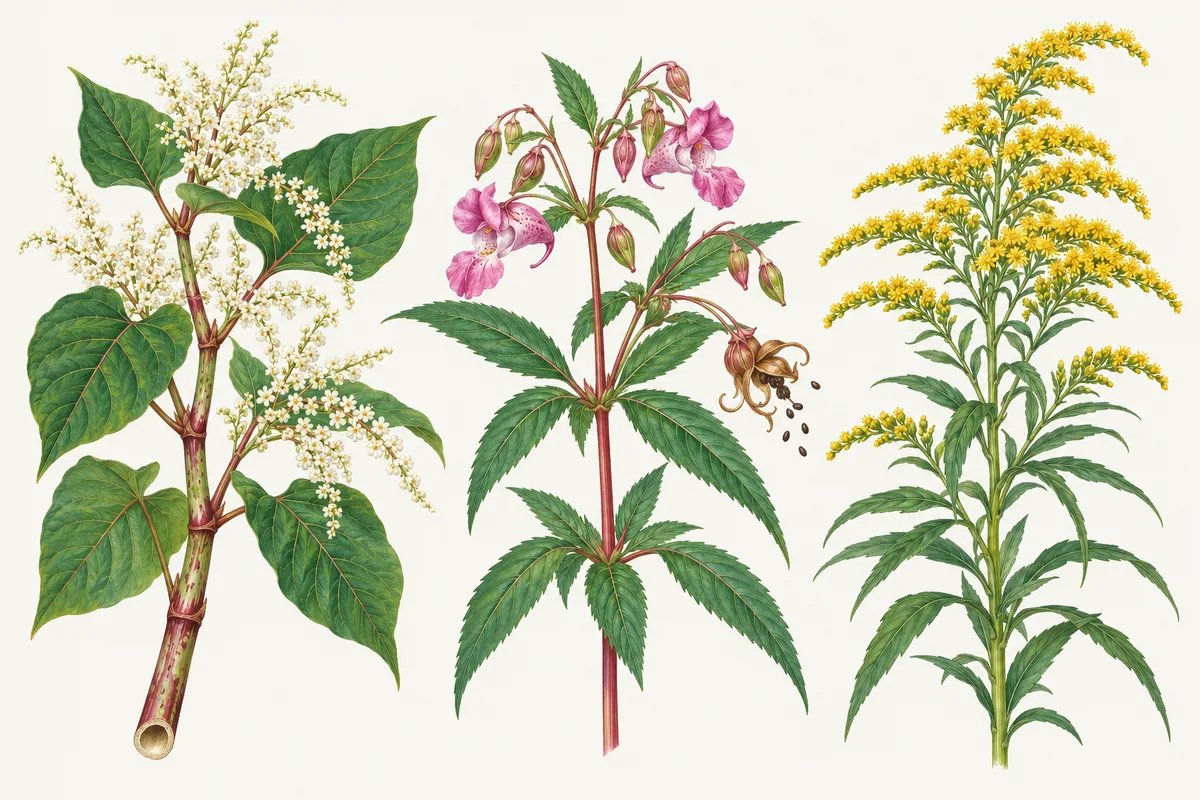
To identify invasive plants, start with the stem and the way the plant grows, then check flower and leaf. Japanese knotweed has hollow, bamboo-like stems speckled reddish-purple with leaves in a zig-zag. Himalayan balsam has hollow reddish stems and pink helmet flowers. Giant hogweed has purple-blotched, bristly stems and white flower heads up to a metre wide. Keep your skin off hogweed and wild parsnip sap.
- Stems settle most cases: hollow and speckled (knotweed), hollow and reddish (balsam), purple-blotched and bristly (giant hogweed), square and woody (purple loosestrife).
- Giant hogweed and wild parsnip sap can burn skin in sunlight. Photograph them from a distance and never touch them bare-handed.
- In England and Wales you don't have to remove knotweed from your land, but GOV.UK says you can be prosecuted for causing it to spread into the wild.
- Every agency asks for the same report: clear photos of several parts of the plant, the exact location and the size of the patch.
An invasive plant is a non-native plant that spreads fast and pushes out what grows around it. Most people who search for one have a specific worry: a bamboo-like clump by the fence, a giant white-flowered plant by a creek, pink flowers taking over a riverbank. This guide covers the seven plants people in the UK, Canada and the US most often ask about, the features that separate each from its look-alikes, and what the agencies want you to do next. Two of them, giant hogweed and wild parsnip, have sap that can burn skin in sunlight, so look before you touch.
Invasive plant identification chart
| Plant | Stem | Leaves | Flowers | Grows in |
|---|---|---|---|---|
| Japanese knotweed (Reynoutria japonica) | Hollow, bamboo-like, reddish-purple speckles, clear nodes, about 2 m | Spade-shaped, flat base, about 14 cm, zig-zag along the stem | Small creamy-white clusters, late summer to early autumn | Roadsides, railway banks, waste ground, riverbanks |
| Giant hogweed (Heracleum mantegazzianum) | Hollow, 5 to 15 cm thick, purple blotches, coarse bristly hairs | Sharply toothed, up to 1.5 m long | White umbrella heads 30 to 90 cm across | Ditches, roadsides, stream banks |
| Himalayan balsam (Impatiens glandulifera) | Hollow, often reddish, about 2 m | Lance-shaped, finely serrated | Pink to purple, sometimes white, June to November; exploding seed pods | Riverbanks and wet ground |
| Purple loosestrife (Lythrum salicaria) | Woody and square, 30 to 50 stems from one rhizome, up to 2.4 m | Opposite or whorled, 3 to 10 cm, smooth edges | Pink-purple, five to seven petals, on long spikes | Wetlands, ditches, roadsides |
| Wild parsnip (Pastinaca sativa) | Single green stem, 2 to 5 cm thick, smooth with few hairs | Compound, toothed mitten-shaped leaflets in pairs | Yellowish-green umbrella heads 10 to 20 cm across | Roadsides, meadows, old fields, rail embankments |
| English ivy (Hedera helix) | Woody vine with clinging roots | Thick, glossy, evergreen | Greenish-white clusters in early fall on mature, non-climbing stems, then blue-black berries | Woods, urban edges, tree trunks |
| Common ragweed (Ambrosia artemisiifolia) | Hairy | Deeply lobed, fern-like | Small, non-showy, in spike-like clusters; heavy late-summer pollen | Fields, verges, disturbed soil |
Sources: RHS on Japanese knotweed and Himalayan balsam; Ontario's pages on giant hogweed and wild parsnip; Ontario's Invading Species Awareness Program on purple loosestrife; NC State Extension on English ivy and common ragweed.
"Invasive" depends on where you stand. English ivy comes from Europe, where it is part of the native flora, but NC State Extension lists it as invasive in North Carolina and widespread in North American cities and disturbed forests. Common ragweed is native to most of North America, where NC State Extension calls it a noxious weed and the culprit behind much late-summer hay fever, and it has naturalized in many other parts of the world.
The seven plants, one by one
Japanese knotweed. The RHS describes reddish-purple shoots from pink buds in spring that become hollow, bamboo-like stems with reddish-purple speckling and conspicuous nodes. Leaves are spade-shaped with flattish bases and sit in a zig-zag along the stem. In winter, the stems die back to dry brown canes. Underground, the rhizomes look like tree roots, but are orange under the dark brown skin. GOV.UK notes that a new plant can grow from a piece of rhizome as small as 1 cm. More detail on the Japanese knotweed page.
Giant hogweed. Ontario's giant hogweed page gives the scale: up to 5.5 metres in ideal conditions and a flower head almost a metre wide. The stems carry reddish-purple flecks and stiff hairs filled with sap. Its look-alikes are smaller: cow parsnip, angelica, valerian, lovage and Queen Anne's lace. The plant flowers once, then dies, and seeds stay viable in the soil for up to 15 years. The sap causes severe burns when skin is then exposed to sunlight. See the full giant hogweed profile before you go near one.
Himalayan balsam. A tall annual of riverbanks. The RHS page lists hollow stems with reddish tints about 2 m tall, lance-shaped leaves with finely serrated edges and scented pink to purple flowers from June to November. The seed pods explode when touched and can throw seed up to 7 m. The roots rarely go deeper than 15 cm, so the plant pulls up easily, and in autumn it leaves straw-coloured dead stems. See Himalayan balsam.
Purple loosestrife. Ontario's Invading Species Awareness Program describes purple loosestrife as woody, square stems, many from one rhizome, with spikes of pink-purple flowers and smooth-edged leaves set opposite or in whorls. Each plant can make up to 2.7 million seeds a year. Its look-alikes include fireweed, blue vervain, blazing stars and two native loosestrifes, so check the square stem and the five to seven petals. More on the purple loosestrife page.
Wild parsnip. In its first year it is only a low rosette; in the second it flowers on a tall stalk and dies. The Ontario wild parsnip page describes a single smooth green stem, mitten-shaped toothed leaflets in pairs and yellowish-green umbrella flower heads. Yellow flowers set it apart from the white heads of giant hogweed, cow parsnip and Queen Anne's lace. The sap can make skin react to sunlight, causing burns, rashes or blisters. See wild parsnip.
English ivy in North America. NC State Extension's English ivy profile describes two stages: a climbing stage with thick, glossy leaves on non-flowering stems that cling with small roots, and a shrubby adult stage that flowers in early fall and sets blue-black berries. It climbs trees and can kill them, and on the ground it smothers seedlings. Look-alikes include climbing fig and other ivies; see the English ivy page for leaf tests.
Common ragweed. A summer annual, usually 1 to 3 feet tall, with deeply lobed, fern-like leaves and inconspicuous flowers in spike-like clusters at the top. The male flowers release heavy pollen from late summer to fall. The common ragweed page covers giant ragweed and mugwort, which are easy to confuse with it.
What the agencies ask you to do
England and Wales. GOV.UK's knotweed guidance says the landowner, not the Environment Agency, is responsible for knotweed. You must stop it spreading off your property; you don't legally have to remove it unless it's causing a nuisance, but you can be prosecuted for causing it to spread into the wild. It advises against treating knotweed yourself without the right skills. Giant hogweed and Himalayan balsam are among 36 listed species of special concern: plants already on your land are not an offence, but you must not grow, sell or transport them, or intentionally let them spread. To record a sighting, the NNSS points to iRecord and asks for a photograph to help with identification. Scotland, Wales and Northern Ireland have their own guidance, linked from the GOV.UK page.
Canada. Reporting runs through provincial programs. In Ontario, the Invading Species Awareness Program asks you to call the Invading Species Hotline at 1-800-563-7711 or report on EDDMapS. Ontario recommends hiring a professional to remove giant hogweed, and says that small patches of wild parsnip (fewer than 100 plants) can be dug out with full protective clothing. The Invasive Species Council of British Columbia asks you to report a plant that looks "out of place" through its Report Invasives app or website form, and to include photos. For purple loosestrife, Ontario's advice is to bag the plants, seal the bags and put them in the garbage, not the compost.
United States. Invasive plant reporting is run by each state. New York's Department of Environmental Conservation is a good model: if you think you've found giant hogweed, photograph the entire plant, stem, leaves and flowers or seed from a safe distance. Then note how many plants there are, how big the patch is and where it is, with GPS coordinates if you can. Report it by email, on the DEC Invasive Plant Information Line (845-256-3111), through iMapInvasives or via your local PRISM. Other states have similar lines through their natural resources department or extension service.
If you decide to use a herbicide, follow the label and local rules. GOV.UK adds that in England, anyone spraying knotweed near water may need Environment Agency agreement, and that protected sites need Natural England's permission.
How to photograph a suspected invasive plant
Every agency above asks for the same evidence, and it's the same set of photos that makes an identification reliable:
- The whole plant and its setting. Stand back far enough to show the height and the patch, with something for scale.
- The stem, close up. Speckles, blotches, hairs, hollow or square: for knotweed, hogweed, balsam and loosestrife, the stem is the single most useful photo.
- A leaf, top and underside, and how leaves attach. Zig-zag, opposite, whorled or in pairs of leaflets.
- Flowers or seed heads, if there are any. Fill the frame.
- The location. Keep location on in your camera, or note the road, landmark or GPS coordinates.
For giant hogweed and wild parsnip, use the zoom and stay out of the patch. NY DEC warns that the reaction can begin as soon as 15 minutes after sap touches skin. Its advice after contact: wash the area thoroughly with soap and water as soon as possible, keep it covered and out of sunlight for 48 hours, and see a doctor if you have a reaction. The photography guide covers light and focus in more detail.
Plant Identifier names a plant from one photo and gives its scientific name, which you can compare with the chart above before you report anything. The app shows no confidence score and no list of alternative species, so check the stem and flower tests yourself, and let the agency confirm. If the answer surprises you, the follow-up chat under the result lets you ask how that plant differs from the native look-alike you suspected. For weeds in a lawn rather than a riverbank, see how to identify weeds in your lawn.
What a photo can't settle
- A photo can't settle a legal or property question. For knotweed on land you're buying or building on, GOV.UK points to specialist companies and trade bodies.
- Seedlings, first-year rosettes and winter stems are hard to name from a picture: wild parsnip, hogweed and their native look-alikes are all carrot-family plants with similar young leaves.
- No identification, by app or by eye, tells you which herbicide is right or legal where you live. Follow the label and local rules; near water in England you may need Environment Agency agreement first.
Questions people ask
How do I tell Japanese knotweed from bamboo?
Knotweed stems are hollow with clear nodes like bamboo, but the RHS describes reddish-purple speckles, spade-shaped leaves with flat bases in a zig-zag along the stem, and creamy-white flower clusters in late summer. The stems die back to brown canes in winter; bamboo stays green.
Is it illegal to have Japanese knotweed in my garden?
Not in England. GOV.UK says you don't legally have to remove it unless it causes a nuisance, but you must stop it spreading off your property and can be prosecuted for causing it to spread into the wild. Soil containing it may be classed as controlled waste.
How can I tell giant hogweed from cow parsnip?
Size and stem. Ontario lists giant hogweed at 2.5 to 5 metres, with flower clusters 30 to 90 cm across and a hollow stem with purple blotches and coarse, bristly hairs. Native cow parsnip reaches 1 to 2.5 metres, with a mostly green stem and soft, fuzzy hairs.
Where do I report an invasive plant?
In Great Britain, record it through iRecord with a photo (NNSS). In Ontario, call the Invading Species Hotline at 1-800-563-7711 or use EDDMapS; in British Columbia, use the Report Invasives app. In New York, email photos and the location to DEC. Elsewhere, ask your state or provincial invasive species council.
Sources
- How to stop Japanese knotweed from spreading — GOV.UK (Environment Agency, Defra and Natural England)
- Invasive non-native (alien) plant species: rules in England and Wales — GOV.UK (Defra)
- Recording — GB Non-native Species Secretariat (NNSS)
- Himalayan balsam — Royal Horticultural Society (RHS)
- Purple Loosestrife — Ontario's Invading Species Awareness Program (OFAH and Ontario Ministry of Natural Resources)
- Wild parsnip — Government of Ontario
- Giant Hogweed — New York State Department of Environmental Conservation
- Hedera helix (English ivy) — NC State Extension Gardener Plant Toolbox
Keep reading
- Weed profileGiant hogweed (Heracleum mantegazzianum): how to identify it
- Vine profileEnglish ivy plant (Hedera helix): how to identify it
- Weed profileCommon ragweed (Ambrosia artemisiifolia): how to identify it
- Photo checklistHow to photograph a plant for identification
- Lawn and gardenHow to identify weeds in your lawn