Weed profile
Himalayan balsam (Impatiens glandulifera): how to identify it
A tall pink-flowered annual of river banks, also called policeman's helmet, whose seed pods burst when touched. Learn the signs, then follow your agency's guidance.
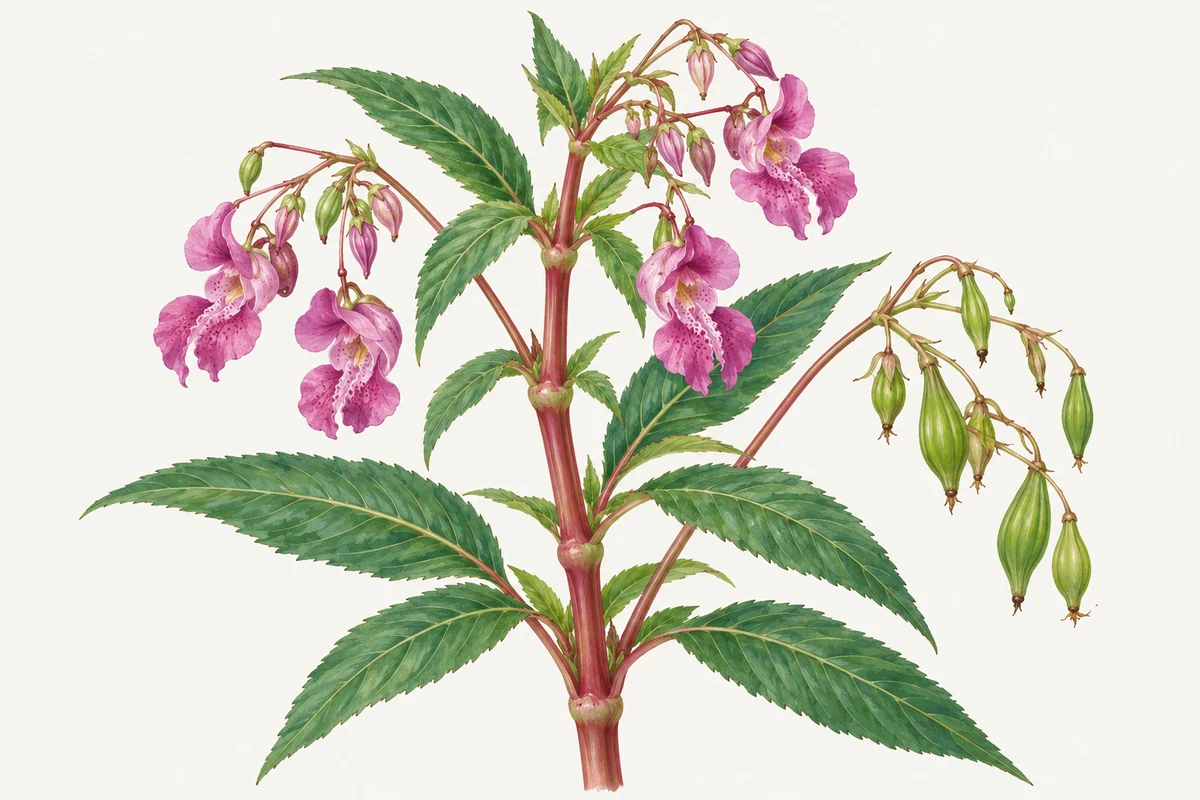
In short
Himalayan balsam is identified by its height and flowers: a smooth annual about 2 m (6.5 ft) tall with hollow, reddish-tinted stems, lance-shaped leaves with finely toothed edges, often three to a node, and scented pink, purple or white flowers shaped like a policeman's helmet from June to November. Its ripe seed pods burst when touched.
- Hollow reddish stems up to head height, toothed leaves often in threes, and pink helmet-shaped flowers: that combination points to Himalayan balsam.
- Ripe pods explode at a touch and can throw seed up to 7 m (23 ft), according to the RHS; seed can stay viable for two years.
- Native jewelweed is a related look-alike with yellow-orange flowers (Ontario's Invading Species Awareness Program).
- In England you must not cause it to grow in the wild; in Ontario, report wild sightings to 1-800-563-7711 or EDDMapS.
Field marks at a glance
- Scientific name
- Impatiens glandulifera
- Family
- Balsaminaceae (balsam family)
- Type
- Weed
- Height
- About 2 m (6.5 ft) by summer (RHS); the Washington State Noxious Weed Control Board gives 3 to 10 feet.
- Stems
- Sturdy, hollow, smooth and hairless, often with reddish or purplish tints (RHS, Washington NWCB).
- Leaves
- Lance-shaped to oval, about 6 inches long with sharply or finely toothed edges, usually three to a node (Washington NWCB); seedlings start with broad, almost square seed leaves (RHS).
- Flowers
- Scented, in shades of pink and purple and occasionally white, shaped like a British policeman's helmet; borne from June to November (RHS).
- Seed pods
- Elongated capsules 1.5 to 3.5 cm long holding up to 16 seeds, about 3 mm wide; ripe pods explode when touched (RHS, Ontario's Invading Species Awareness Program).
- Life cycle
- An annual: seed germinates in early spring and the whole plant dies in autumn or early winter, leaving dead, straw-coloured stems on the ground (RHS).
- Roots
- A small, shallow root system, rarely deeper than 15 cm (6 in), despite the plant's height (RHS).
- Where it grows
- River banks, streamsides, wetlands and other damp, partly shaded places. Native to the western Himalayas; reported in eight Canadian provinces, naturalized in the US and widespread in the UK.
Himalayan balsam (Impatiens glandulifera), also called policeman's helmet or Indian balsam, is a tall annual from the western Himalayas with pink, helmet-shaped flowers. It was brought to Britain, Europe and North America as a garden ornamental in the 1800s and now lines river banks, where dense stands crowd out other plants. This page covers how to recognize it, what it gets confused with, and what the official agencies ask you to do.
How to identify Himalayan balsam
The RHS Himalayan balsam page and the Washington State Noxious Weed Control Board describe the plant in detail. Use these checks together.
1. Height and stem. In summer the plant stands about 2 m (6.5 ft) tall, sometimes taller: Washington gives 3 to 10 feet. The stems are sturdy, hollow, smooth and hairless, often with reddish or purplish tints.
2. The leaves. Leaves are lance-shaped to oval, about 6 inches long, with finely or sharply toothed edges. Washington notes they usually come three to a node, which helps separate balsam from plants with single alternate leaves.
3. The flowers. From June to November, scented flowers in shades of pink and purple, occasionally white, hang from the upper stems. Their shape resembles a British policeman's helmet, which gave the plant its other common name.
4. The seed pods. Flowers are followed by elongated pods holding up to 16 rounded seeds about 3 mm wide. When ripe, the pods explode at a touch: the RHS says they can throw seed up to 7 m (23 ft).
5. The season. Seed germinates in early spring with broad, almost square seed leaves. The whole plant dies in autumn or early winter, leaving dead, straw-coloured stems on the ground, and the RHS notes its roots rarely go deeper than 15 cm (6 in).
A photo of the flowers and a leaf node in Plant Identifier gives you a name to compare against these checks; the app shows one result and no confidence score, so check the traits yourself. Our guide to photographing a plant for identification explains which parts to capture.
Himalayan balsam vs jewelweed and other look-alikes
Ontario's Invading Species Awareness Program says Himalayan balsam looks similar to native jewelweed (Impatiens capensis), a related species with yellow-orange flowers. Flower colour is the quickest check: balsam's flowers are pink, purple or white.
The Washington board adds that other native and non-native Impatiens species grow in the state and that the plants are best identified when in flower. Along rivers, balsam often grows near Japanese knotweed; knotweed has speckled, bamboo-like canes, spade-shaped leaves set one at a time and creamy-white flower sprays. For other summer flowers, see the wildflower identification guide.
Why it is a problem
The RHS says rapid growth early in the season leads to dense, tall stands that outcompete native plants, and that its shallow roots and annual habit do little to hold river banks together, which leads to erosion. The Ontario Invasive Plant Council adds that it produces a lot of nectar and can draw pollinators away from native plants.
It spreads by seed. Ontario's awareness program gives about 800 seeds per plant. The RHS says seed travels much farther by floating down watercourses, can stay viable for two years, and is also moved by people, through gardeners sharing seed or by moving soil that contains it.
What the official agencies say to do
In England, GOV.UK guidance from the Environment Agency and Defra lists Himalayan balsam among the most commonly found invasive non-native plants and says:
- You must not plant in the wild, or cause to grow in the wild, invasive non-native plants. This can include moving contaminated soil or plant cuttings.
- If you find invasive non-native plants on your land, you must stop them from spreading and causing a nuisance or damage to other land or property.
- Soil or plant material contaminated with them may be classified as controlled waste, and you cannot compost most non-native plants.
- In most cases, you'll need to hire a specialist contractor.
For any weedkiller, follow the label and local rules; GOV.UK says spraying in or near water needs agreement from the Environment Agency. The RHS adds that the plant is listed on Schedule 9 of the Wildlife and Countryside Act 1981.
In Ontario, the Invading Species Awareness Program asks you to report Himalayan balsam found in the wild to the Invading Species Hotline at 1-800-563-7711 or through EDDMapS, not to put invasive plants in the compost pile, and to stay on trails and keep pets on a leash to avoid spreading seed. It says the plant has been reported in eight provinces, including British Columbia, Manitoba, Quebec and the Atlantic provinces; follow your own province's invasive species council there.
In Washington State, policeman's helmet is a Class B noxious weed and is on the state quarantine list, which prohibits transporting, buying, selling or distributing plants, plant parts or seed of quarantined species. The board says to contact your county noxious weed coordinator for help with identification and control. In other states, contact your state department of agriculture or invasive species program.
Where it grows
Himalayan balsam favours damp, partly shaded ground: river banks, streamsides, wetlands, moist woods and roadside thickets. The RHS says it was introduced to the UK in 1839 and is now widespread and common. In North America, Ontario's program says it has been reported in eight Canadian provinces and is naturalized in the United States. If you log where you found a stand, Plant Identifier's Plant Map keeps each located identification on your phone. For a general method on any unknown plant, see how to identify plants, and for another invasive of river banks, see giant hogweed.
Look-alikes and how to tell them apart
Jewelweed (Impatiens capensis)
Ontario's Invading Species Awareness Program says this native relative looks similar but has yellow-orange flowers. Himalayan balsam's flowers are pink, purple or white.
Other Impatiens species
The Washington State Noxious Weed Control Board notes other native and non-native Impatiens grow in the state and that plants are best identified in flower; your county noxious weed coordinator can help.
Japanese knotweed (Reynoutria japonica)
Both form tall stands of hollow stems by water, but knotweed has speckled, bamboo-like canes with spade-shaped leaves set one at a time in a zig-zag, and creamy-white flower sprays. Balsam has toothed leaves in groups and pink helmet-shaped flowers.
What a photo can't settle
- Young plants before flowering are harder to name from a photo; the Washington State Noxious Weed Control Board says Impatiens are best identified in flower.
- Garden balsams and other Impatiens can share the flower shape; check height, leaf arrangement and colour together, and ask your local weed authority if unsure.
- Plant Identifier gives one name per photo with no confidence score, so use a match as a starting point and check the traits above.
Questions people ask
Is it illegal to have Himalayan balsam in your garden in the UK?
The RHS says it is not an offence if it is already growing in your garden and you are not keeping it or causing it to spread, but you must not introduce it or cause it to spread. GOV.UK says you must not plant or cause invasive non-native plants to grow in the wild.
Why do Himalayan balsam seed pods explode?
Ripe pods are triggered by touch and throw their seed away from the plant: up to 7 m (23 ft) according to the RHS, and about 5 m according to Ontario's Invading Species Awareness Program. Seed also floats downstream, which is how it spreads along rivers.
How do I tell Himalayan balsam from jewelweed?
Look at the flower colour. Ontario's Invading Species Awareness Program says native jewelweed (Impatiens capensis) has yellow-orange flowers, while Himalayan balsam's are pink, purple or occasionally white and shaped like a policeman's helmet.
Where do I report Himalayan balsam?
In Ontario, call the Invading Species Hotline at 1-800-563-7711 or report on EDDMapS. In Washington State, it is a Class B noxious weed: contact your county noxious weed coordinator. In England, GOV.UK says you must stop invasive plants on your land from spreading.
Can I compost Himalayan balsam?
The RHS says not to put it in home compost or council green waste. Ontario's program says to discard invasive plants in the regular garbage, not the compost pile. GOV.UK says most non-native invasive plants survive composting.
Sources
- Himalayan balsam — Royal Horticultural Society (RHS)
- How to stop invasive non-native plants from spreading — GOV.UK (Environment Agency and Defra)
- Himalayan Balsam — Ontario's Invading Species Awareness Program (OFAH/MNR)
- Himalayan Balsam — Ontario Invasive Plant Council
- Policeman's helmet (Impatiens glandulifera) — Washington State Noxious Weed Control Board
- Impatiens glandulifera Royle (species match) — GBIF