Weed profile
Japanese knotweed (Reynoutria japonica): how to identify it
An invasive plant from eastern Asia with hollow, speckled, bamboo-like canes. Learn the signs in every season, then follow your official agency's guidance.
In short
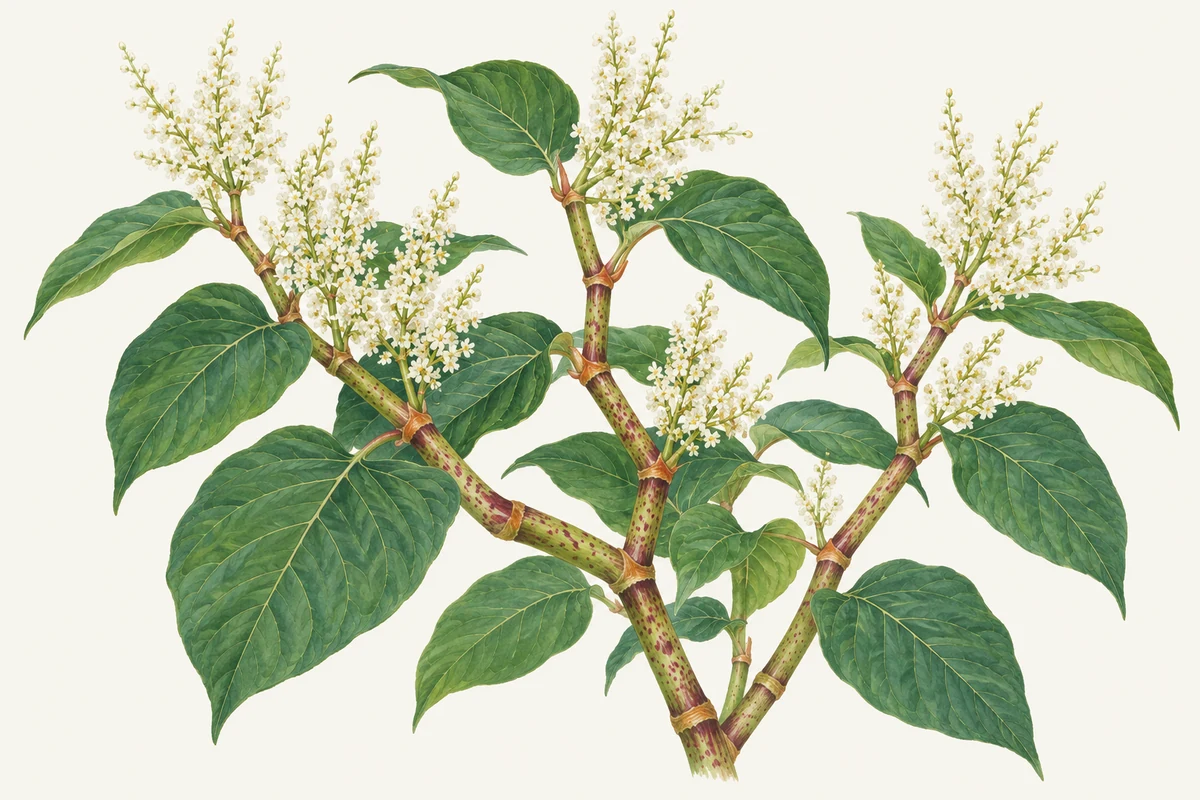
Japanese knotweed is identified by its hollow, bamboo-like stems with reddish-purple speckles and raised nodes, and by spade-shaped leaves with a flat base, about 14 cm (5.5 in) long, arranged in a zig-zag along the stem. Stems usually reach about 2 m (6.5 ft) by late summer, when small creamy-white flower clusters appear. In winter, dead brown canes remain.
- Look for three things together: speckled hollow canes with nodes, flat-based spade-shaped leaves, and a zig-zag leaf pattern (RHS).
- It dies back in winter, so a garden can look clear for months; dry brown canes on the ground are the clue.
- A new plant can grow from a piece of rhizome as small as 1 cm, so digging and moving soil spreads it (GOV.UK).
- In England you must stop it spreading off your land; GOV.UK says not to treat it yourself without the right skills.
Field marks at a glance
- Scientific name
- Reynoutria japonica
- Family
- Polygonaceae (knotweed family)
- Type
- Weed
- Height
- Stems usually grow about 2 m (6.5 ft) tall by late summer (RHS); NC State gives 10 to 13 feet, and Ontario's awareness program 1 to 3 m.
- Stems
- Hollow and bamboo-like, with reddish-purple speckles and conspicuous nodes; they often arch over at the top by late summer (RHS).
- Leaves
- Spade-shaped, green, with a flattish base and pointed tip, usually about 14 cm (5.5 in) long, arranged in a zig-zag pattern along the stem (RHS).
- Flowers
- Clusters of small creamy-white flowers toward the stem tips in late summer and early autumn (RHS); NC State describes erect panicles 3 to 6 inches long.
- Spring shoots
- Rounded pink buds at ground level, then reddish-purple shoots that grow fast into canes (RHS).
- Winter
- Stems die back, leaving dry brown canes on the ground or, in sheltered spots, still standing (RHS).
- Underground
- Rhizomes that can go 1 m (3 ft) or more deep; thick and woody, with orange colouring under a dark brown outer layer (RHS).
- Where it grows
- Roadsides, waste ground, railway embankments and along rivers and streams (GOV.UK). Native to eastern Asia; established in the UK, the US and Canada from Ontario to Newfoundland and in British Columbia.
Japanese knotweed (Reynoutria japonica, also sold in the past as Fallopia japonica) is a tall perennial from eastern Asia that was brought to Britain and North America as a garden plant in the 1800s. It is now one of the best-known invasive plants in the UK, the US and Canada because it spreads from tiny pieces of underground stem and pushes through cracks in paving. This page covers how to recognize it in each season, what it gets confused with, and what the official agencies ask you to do.
How to identify Japanese knotweed
The RHS Japanese knotweed page describes the plant through the year. Use these checks together; no single one is enough.
1. The canes. The stems are hollow and bamboo-like, with reddish-purple speckles and conspicuous nodes (joints). They usually grow to about 2 m (6.5 ft) by late summer and often arch over at the top. NC State Extension gives 10 to 13 feet for plants in North Carolina, so height varies a lot.
2. The leaves. Leaves are spade-shaped, with a flattish base and a pointed tip, usually about 14 cm (5.5 in) long. They sit one at a time, alternating from side to side, which gives the stem a zig-zag look.
3. The flowers. In late summer and early autumn, clusters of small creamy-white flowers form toward the stem tips.
4. The season. In spring, rounded pink buds appear at ground level and grow into reddish-purple shoots. In winter, the stems die back and leave dry brown canes on the ground. The RHS notes this matters if you are selling a house: knotweed can be invisible above ground for months.
5. Underground. If soil has been dug, the rhizomes are thick and woody, a bit like tree roots, with orange colouring under a dark brown outer layer.
A clear photo of a leaf and a stem section in Plant Identifier gives you a name to compare against these checks. The app shows one result with no confidence score, so look for the traits yourself. Our guide to photographing a plant for identification covers getting a sharp leaf and stem shot.
Japanese knotweed vs bamboo and other look-alikes
Ontario's Invading Species Awareness Program says knotweed is often mistaken for bamboo but is easily distinguished by its broad leaves. Bamboo leaves are narrow and grass-like; knotweed leaves are wide spade shapes with a flat base.
The RHS lists other plants commonly confused with it: Russian vine (Fallopia baldschuanica), Himalayan honeysuckle (Leycesteria formosa), fish mint (Houttuynia cordata) and small-headed knotweed (Persicaria microcephala). Several annual persicarias are weeds too, but not as invasive. GOV.UK adds that Japanese knotweed is one of four invasive knotweeds in the UK, alongside dwarf, giant and Bohemian (hybrid) knotweed. For smaller weeds in grass, see how to identify weeds in your lawn.
Why it is a problem
The RHS says rapid spring and summer growth forms dense stands that crowd out other plants, that shoots exploit joints and cracks in paving, tarmac and asphalt, and that stands on river banks can add to erosion and flooding risk. Ontario's program adds that its root system has been known to break through asphalt and concrete, and that pieces of root can float downstream to start new populations.
It spreads mainly by its rhizomes. GOV.UK says a new plant can grow from pieces of rhizome as small as 1 cm. The RHS adds that almost all Japanese knotweed in the UK is female, so it does not spread by seed there, and that rhizomes can stay dormant in the soil for many years.
What the official agencies say to do
In England, GOV.UK guidance from the Environment Agency, Defra and Natural England says:
- You must stop Japanese knotweed on your land from spreading off your property.
- You do not legally have to remove it unless it is causing a nuisance, but you can be prosecuted for causing it to spread into the wild.
- Do not treat knotweed yourself unless you have the appropriate skills and experience; you can find companies that specialise in treating it.
- It usually takes at least 3 years to treat, and dormant rhizome will regrow if disturbed or if the soil is moved.
- Soil or plant material containing it may be classified as controlled waste, with set rules for burying, burning and taking it off site.
For any weedkiller, follow the label and local rules; GOV.UK notes extra permissions apply near water and on protected sites. Scotland, Wales and Northern Ireland have their own guidance, linked from the GOV.UK page. The RHS adds that sellers in England and Wales must state on the TA6 property form whether knotweed is present.
In Ontario, the Ontario Invasive Plant Council says Japanese, giant, Bohemian and Himalayan knotweed are restricted species under the Invasive Species Act (2015), so it is illegal to import, deposit, release, grow, buy, sell, lease or trade them. The Invading Species Awareness Program asks you to report sightings in the wild to the Invading Species Hotline at 1-800-563-7711 or through EDDMapS, and not to put knotweed in a backyard composter. Other provinces have their own invasive species councils; follow theirs.
In the US, NC State Extension notes the plant is listed as invasive by the NC Invasive Plant Council and says not to plant it. In other states, contact your state department of agriculture or invasive species program and follow its instructions.
Where it grows
GOV.UK lists roadsides, waste ground, railway embankments, spoil tips and the banks of rivers and streams. The RHS says it was introduced to the UK in the 19th century as an ornamental and is now widespread. In Canada, Ontario's program says it is established from Ontario to Newfoundland and is also found in British Columbia, mostly in gardens, along roadsides and near old building sites. If you note where you saw a stand, Plant Identifier's Plant Map keeps each located identification on your phone. For a general method on any unknown plant, see how to identify plants, and for another invasive you should not touch, see giant hogweed.
Look-alikes and how to tell them apart
Bamboo
Ontario's Invading Species Awareness Program says knotweed is often mistaken for bamboo but is easily told apart by its broad, flat-based leaves. Bamboo has narrow, grass-like leaves.
Giant and Bohemian knotweed
GOV.UK lists four invasive knotweeds in the UK: Japanese, dwarf, giant and Bohemian (hybrid). They are close relatives and are handled the same way under the rules; a professional survey is the way to separate them.
Russian vine (Fallopia baldschuanica)
The RHS lists it as commonly confused with Japanese knotweed. Russian vine is a climber that scrambles over fences and trees, rather than forming upright stands of thick, speckled canes.
Himalayan honeysuckle (Leycesteria formosa)
Also on the RHS list of plants confused with knotweed. Check the leaf: knotweed's leaves are spade-shaped with a flat base and sit one at a time in a zig-zag up the stem.
Other knotweeds and persicarias
The RHS names small-headed knotweed and annual species such as Persicaria maculosa as troublesome weeds that are not as invasive. Most are much smaller than a 2 m stand of hollow canes.
What a photo can't settle
- Young shoots, cut stands and regrowth after treatment can look unlike the textbook plant; the RHS notes treated knotweed often regrows as short, bushy, small-leaved shoots.
- A photo cannot separate Japanese, giant and Bohemian knotweed reliably, and it cannot show how far rhizomes run underground; for a property sale or a dispute, use a specialist survey.
- Plant Identifier gives one name per photo with no confidence score, so treat a match as a reason to check the traits above, not as a confirmation.
Questions people ask
Is it illegal to have Japanese knotweed in your garden in the UK?
The RHS says it is not an offence to have it growing in your garden, but it is an offence to plant it or cause it to grow in the wild. GOV.UK says you must stop it spreading off your property, and you can be prosecuted for causing it to spread into the wild.
What does Japanese knotweed look like in winter?
The stems die back, leaving sections of dry brown canes scattered on the ground; in sheltered places dead canes may stay upright. The rhizomes stay alive underground and send up pink buds and reddish-purple shoots in spring (RHS).
Can I remove Japanese knotweed myself?
GOV.UK says not to treat it yourself unless you have the appropriate skills and experience, and points to specialist companies. It usually takes at least 3 years to treat. For any weedkiller, follow the label and local rules.
Can I put Japanese knotweed in my compost or green bin?
The RHS says not to add it to home compost, and Ontario's awareness program says the same. In England it can be classed as controlled waste, and GOV.UK sets out how it must be buried, burned or sent to a permitted site.
Where do I report Japanese knotweed in Ontario?
Ontario's Invading Species Awareness Program asks you to report sightings in the wild to the Invading Species Hotline at 1-800-563-7711 or through EDDMapS. Ontario lists Japanese knotweed as a restricted species under the Invasive Species Act.
Sources
- How to stop Japanese knotweed from spreading — GOV.UK (Environment Agency, Defra and Natural England)
- Japanese knotweed — Royal Horticultural Society (RHS)
- Reynoutria japonica (Japanese knotweed) — NC State Extension, North Carolina Extension Gardener Plant Toolbox
- Japanese Knotweed — Ontario Invasive Plant Council
- Japanese Knotweed — Ontario's Invading Species Awareness Program (OFAH/MNR)
- Reynoutria japonica Houtt. (species match) — GBIF