Houseplant profile
Croton (Codiaeum variegatum): how to identify it
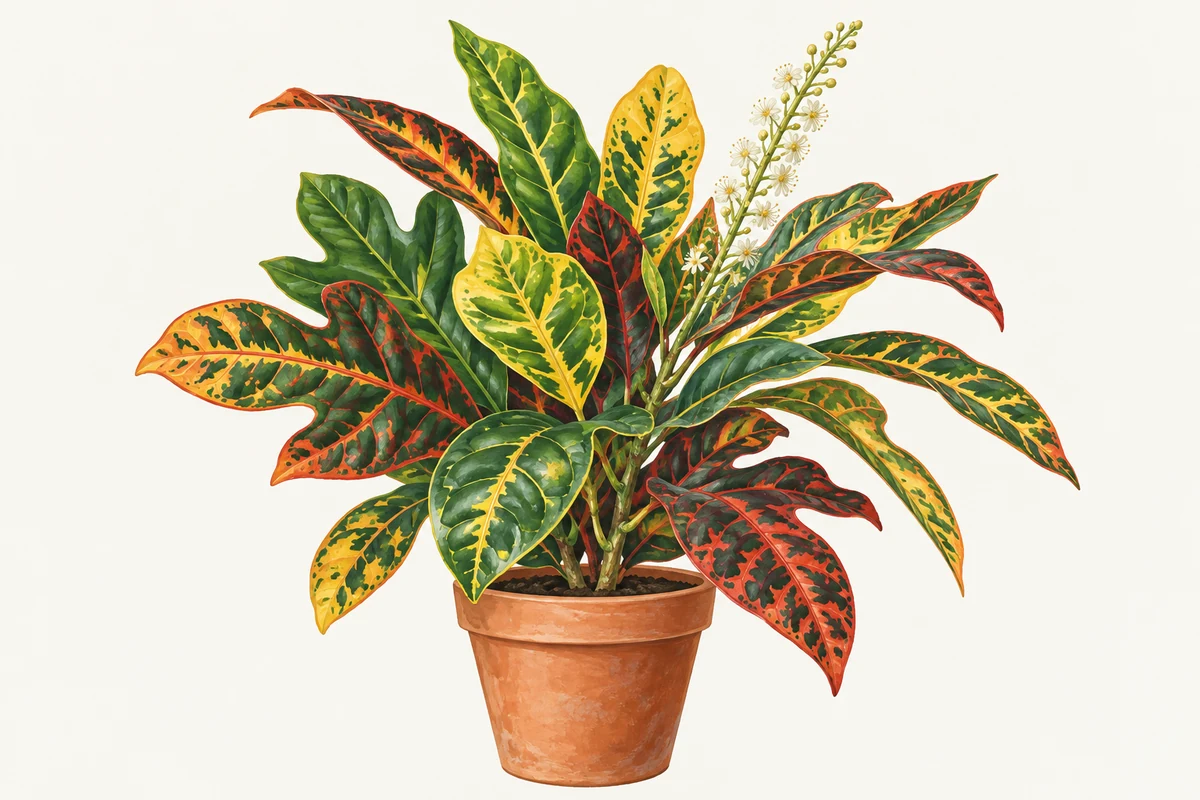
An upright shrub with thick, leathery, glossy leaves splashed in yellow, orange, red, pink, purple and green, alternate on a woody stem. Here is what to check.
In short
A croton plant (Codiaeum variegatum) is an upright, woody evergreen shrub with thick, leathery, glossy leaves, alternate on the stem and blotched or striped in yellow, orange, red, pink, purple, bronze and green. Leaves can be oval, narrow, lobed or twisted, up to about 18 inches long, and broken leaves ooze sap that can irritate skin. Indoors it usually reaches about 3 feet.
- Thick, glossy, leathery, multicolored leaves, alternate on a woody stem, point to croton.
- Square stems and toothed, opposite leaves mean coleus; long, strap-like leaves in a crowded spiral on red stems mean ti plant.
- NC State lists croton as poisonous to humans and as a cause of contact dermatitis.
Field marks at a glance
- Scientific name
- Codiaeum variegatum
- Family
- Euphorbiaceae (spurge family)
- Type
- Houseplant, perennial, evergreen
- Leaves
- Simple, alternate, up to about 18 inches long; linear to oval, smooth-edged, lobed or wavy, often crinkled or twisted (NC State).
- Leaf surface
- Thick, leathery and glossy, hairless (NC State). The wild type is plain green; cultivars are blotched or striped.
- Leaf colors
- Yellow, pink, orange, red, bronze, purple and green, in blotches, spots, stripes or colored veins (NC State); UF/IFAS adds white. New leaves start green and color up as they mature (UF/IFAS).
- Sap
- Sap oozes from broken leaves and stems; NC State says it can irritate skin, cause itching and swelling, and permanently stain fabric.
- Stem
- New growth green; old growth brown and woody with vertical cracks and oval leaf scars that look pock-marked (NC State).
- Flowers
- Small and easy to miss: slender spikes at the branch tips; male flowers white with five small petals and 20 to 30 stamens, female flowers yellowish without petals (NC State).
- Size
- About 3 ft indoors and up to 8 ft in its native range (NC State); UF/IFAS says up to 10 ft outdoors, with dwarf and larger cultivars.
- Native range
- Malaysia, the Pacific islands and northern Australia (NC State); UF/IFAS says India and Malaysia.
The croton (Codiaeum variegatum) is a tropical shrub in the spurge family grown indoors for its thick, glossy leaves in yellow, orange, red and purple. Its leaves vary so much between cultivars that two crotons can look like different plants, so check the leaf texture, the arrangement, the sap and the stem in the order below.
How to identify a croton plant in four checks
1. The leaf texture. Press a leaf between your fingers. A croton leaf is thick, leathery and glossy, with no hairs. The NC State Plant Toolbox describes simple leaves up to about 18 inches long, linear to oval, with smooth, lobed or wavy edges, often crinkled or twisted. The wild type is green; the cultivars, of which there are hundreds, are grown for their color.
2. The colors. Croton leaves are blotched, spotted or striped in yellow, pink, orange, red, bronze, purple and green, often with the veins picked out in a contrasting color. UF/IFAS Gardening Solutions adds white and notes that new leaves start green and color up as they mature, so the top of a plant can look greener than the base.
3. The arrangement and the stem. The leaves are alternate, one per node, along a stem that is green on new growth and brown and woody lower down. NC State describes old stems with vertical cracks and oval leaf scars that give them a pock-marked look.
4. The sap. If a leaf is already damaged, look at the break: croton stems and leaves ooze sap. NC State warns that the sap can irritate soft tissue, causing itching and swelling, and permanently stains fabric, so wear gloves and wash your hands rather than testing this on purpose.
If a colorful shrub arrives without a tag, Plant Identifier can give a common and scientific name from one photo; include a whole leaf and a bit of stem. The app shows no confidence score and no list of alternatives, so compare its answer with the checks above.
Croton cultivars and sizes
NC State gives a size of 2 to 8 feet tall and 2 to 6 feet wide overall, about 3 feet indoors and up to 8 feet in the narrow climate range of its native Malaysia, Pacific islands and northern Australia. UF/IFAS says the shrub can reach 10 feet outdoors in Florida, with dwarf and larger varieties. Outdoors it is hardy only in USDA zones 11 and 12 (NC State).
Cultivars differ mainly in leaf shape and color pattern. NC State lists these:
- 'Petra': the most common, dark green leaves with yellow, pink and orange-red markings along the veins. UF/IFAS recommends it for indoor light.
- 'Gold Dust': rounded oval, bright green leaves spotted with golden yellow.
- 'Andreanum': broad oval yellow leaves with gold veins and edges.
- 'Eleanor Roosevelt': medium green leaves with golden yellow spots that turn dark red.
- 'Evening Embers': blue-black, metallic leaves with red and green highlights.
- 'Majesticum': yellow and red leaves about 9 inches long.
- 'Spirale': twisted red and green leaves.
The flowers are easy to overlook: NC State describes slender spikes at the branch tips, with white male flowers that have five small petals and 20 to 30 stamens, and yellowish female flowers without petals, followed by small capsules holding three seeds.
Croton vs ti plant, coleus and dracaena
Ti plant and coleus are sold as colorful foliage plants too, and a croton in low light can lose much of its color. The leaf texture, the arrangement and the stem settle it.
| Feature | Croton | Ti plant | Coleus |
|---|---|---|---|
| Leaf texture | Thick, leathery, glossy | Smooth, strap-like | Toothed edge |
| Leaf arrangement | Alternate along the stem | Crowded spiral | Opposite pairs |
| Leaf length | Up to about 18 in | Up to 30 in | 3 to 6 in |
| Stem | Round, woody, brown with leaf scars | Red, erect, clustered | Square, semi-succulent, light green |
Sources: NC State on ti plant and NC State on coleus. For dracaena, see our dracaena page. For other glossy, thick-leaved houseplants, compare the rubber plant, or follow the houseplant identification key.
Is a croton toxic to pets
NC State lists croton as poisonous to humans and as a cause of contact dermatitis. It names diterpene esters as the toxic principle, lists nausea, vomiting and diarrhea when eaten and a skin rash after repeated contact, and lists every part of the plant, including the sap, leaves, stems and seeds, as poisonous. UF/IFAS advises keeping children and pets from nibbling croton leaves because of their irritating and poisonous qualities. We did not find a croton entry in the ASPCA's online plant list on 2026-10-21; that is not a sign the plant is harmless to pets.
If a pet has chewed a leaf or stem, call your vet or the ASPCA Animal Poison Control Center at (888) 426-4435. For a person, call Poison Control at 1-800-222-1222 (poison.org). Plant Identifier's Toxicology tool gives AI-written notes for people, dogs and cats; treat them as a starting point, not as the answer. More houseplants on the ASPCA's lists are in plants toxic to cats and poisonous plants for dogs.
A short care note
NC State recommends full sun or partial shade, well-drained, humus-rich soil that is occasionally dry, liberal watering from spring to autumn and sparing watering in winter, and bringing plants indoors when temperatures reach 50°F. It notes that spider mites can limit indoor use. UF/IFAS adds that new foliage wilts when the plant is thirsty, which can guide watering, and that indoor plants benefit from an occasional wash in a shady spot outside to clear dust and help manage spider mites. If leaves fade or drop, Plant Identifier's Diagnose tool can suggest a likely cause from a photo; check it against the light advice above.
Look-alikes and how to tell them apart
Ti plant (Cordyline fruticosa)
Check the leaf shape and arrangement. Ti plant leaves are long, strap-like and lance-shaped, up to 30 inches long, crowded in a spiral at the top of red stems, in pinks, dark reds and light green (NC State). Croton leaves are shorter, thicker, alternate along a brown woody stem, and often yellow-veined or spotted.
Coleus (Coleus scutellarioides)
Roll a stem between your fingers. Coleus has square, 4-angled, soft green stems with opposite, toothed leaves 3 to 6 inches long (NC State). A croton stem is round and woody, and its leaves are alternate, thick and glossy.
Dracaena
Look at the leaf texture and the stem. A croton leaf is thick, leathery and glossy, alternate on a round, woody stem with pock-marked leaf scars, and a broken leaf oozes sap (NC State). Compare these with the leaf and cane traits on our dracaena page before deciding.
What a photo can't settle
- There are hundreds of croton cultivars (NC State), and many differ only in leaf color pattern; a photo can name the species but often not the cultivar.
- A young croton grown in low light can lose much of its color and look like a plain green shrub; check the leathery leaves, the woody stem and the sap.
- Whether a pet that chewed a leaf needs treatment is for your vet or a poison control center to decide, not for this page or an app.
Questions people ask
Why is my croton losing its color?
Light is the usual reason. NC State says crotons need bright light, with some direct sun, for the best leaf color and may drop lower leaves in too much shade. UF/IFAS adds that even indoor cultivars such as 'Petra' gradually lose color without enough light, while too much sun can cause fading.
Why are my croton's new leaves green?
That is normal. UF/IFAS notes that new croton foliage starts green and develops its color as it matures, so a green shoot on a colorful plant is not a sign of a problem by itself.
What is the most common croton?
NC State names 'Petra' as the most common cultivar: dark green leaves with yellow, pink and orange-red markings along the veins. Other cultivars it lists include 'Gold Dust', with green leaves spotted gold, and 'Spirale', with twisted red and green leaves.
Is a croton plant poisonous to cats and dogs?
NC State lists croton as poisonous to humans, naming diterpene esters, contact dermatitis, and nausea, vomiting and diarrhea if eaten; UF/IFAS advises keeping children and pets from nibbling the leaves. If your pet chewed it, call your vet or the ASPCA Animal Poison Control Center at (888) 426-4435. For a person, call Poison Control at 1-800-222-1222.
Sources
- Codiaeum variegatum — North Carolina Extension Gardener Plant Toolbox (NC State)
- Croton — UF/IFAS Gardening Solutions
- Cordyline fruticosa — North Carolina Extension Gardener Plant Toolbox (NC State)
- Coleus scutellarioides — North Carolina Extension Gardener Plant Toolbox (NC State)
- Poison Control — National Capital Poison Center
Keep reading
- Houseplant profileRubber plant (Ficus elastica): how to identify it
- Houseplant profileDracaena: how to identify corn plant, dragon tree and their relatives
- Houseplant profileHoya (wax plant): how to identify it
- Pet safety guidePoisonous plants for dogs, and what to do if your dog ate one
- Free toolHouseplant identification key