Plant profile
Boston fern (Nephrolepis exaltata): how to identify it
Arching, lacy fronds 2 to 3 feet long, cut once into many narrow leaflets with an ear at the base, spilling from a hanging basket. Here is what to check.
In short
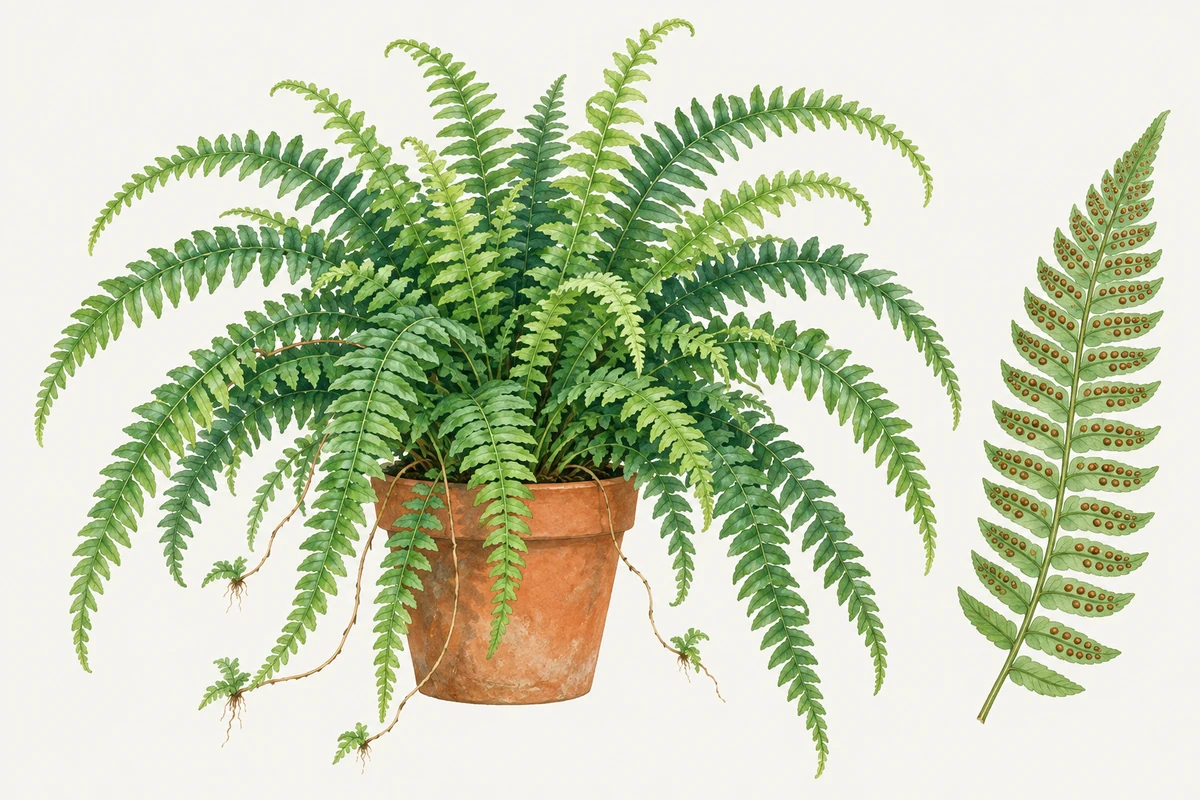
A Boston fern (Nephrolepis exaltata 'Bostoniensis') is an evergreen fern with arching to drooping fronds 2 to 3 feet long, cut once into many narrow, oblong leaflets, each with a small ear at its base. It has no flowers or fruit; round brown spore dots sit under the leaflets, and slender runners spread from a short rhizome. The whole plant reaches 2 to 3 feet.
- Once-divided, arching fronds with many narrow, eared leaflets and thin runners point to Boston fern.
- Underground tubers on the runners and stiffer, upright fronds mean tuberous sword fern (Nephrolepis cordifolia).
- The ASPCA lists Boston fern as non-toxic to dogs and cats; that is its classification, not a guarantee.
Field marks at a glance
- Scientific name
- Nephrolepis exaltata 'Bostoniensis'
- Family
- Nephrolepidaceae (sword fern family)
- Type
- Fern, perennial, evergreen
- Fronds
- Erect to arching or pendent, 2 to 3 feet long, short-stalked, lance-shaped and gradually tapering toward the tip (NC State).
- Leaflets (pinnae)
- Numerous, linear-oblong, cut once from the central stalk; each has an asymmetric ear (auricle) at the base that almost clasps the stalk; edges finely toothed to scalloped.
- Underside
- Round, dark brown to black spore dots (sori) in a neat pattern over the veins. NC State warns not to mistake them for insects or disease.
- Flowers and fruit
- None: Boston fern reproduces by spores (NC State).
- Rhizome and runners
- A short, semi-upright rhizome with slender stolons (runners); fronds are often crowded along them.
- Size and habit
- 2 to 3 feet tall and wide; cascading or weeping, which is why it is so often grown in hanging baskets (NC State).
- Native range
- Tropical and subtropical America; grown outdoors only in USDA zones 10a to 13b, elsewhere as a houseplant (NC State).
- Cultivars
- 'Bostoniensis' is the classic broad, drooping form. 'Fluffy Ruffles' has erect, wavy-edged fronds, 'Tiger Stripe' gold variegation, 'Rita's Gold' chartreuse fronds (NC State).
The Boston fern is a cultivar, 'Bostoniensis', of Nephrolepis exaltata, a fern from tropical and subtropical America that has become a hanging-basket classic. Several related ferns are sold under similar names, so check the frond, the leaflets, the underside and the runners in that order.
How to identify a Boston fern in four checks
1. The frond. Hold one up. A Boston fern frond is long and narrow, 2 to 3 feet, lance-shaped and tapering gradually to the tip, and it arches or hangs rather than standing stiffly. According to the NC State Plant Toolbox, the fronds are short-stalked and often crowded along runners.
2. The leaflets. The frond is cut once (pinnately compound) into many narrow, linear-oblong leaflets. Look at where each leaflet joins the central stalk: there is a small, lopsided ear at the base that almost clasps the stalk. The edges are finely toothed to scalloped, and the plant is hairless.
3. The underside. Turn a mature frond over. Round, dark brown to black spore dots sit in a neat row over the veins. NC State is explicit that these are spores, not insects or disease. There are no flowers and no fruit.
4. The runners. Look at the soil surface and the pot rim. Boston fern grows from a short, semi-upright rhizome with slender runners (stolons), and new plants come up along them. If you find small round tubers on those runners, you are probably looking at tuberous sword fern instead (see below).
When a fern arrives without a tag, Plant Identifier can give a common and scientific name from one photo; include a whole frond and, if you can, its underside. The app shows no confidence score and no list of alternatives, so compare its answer with the checks above.
Boston fern cultivars
NC State lists more than a dozen cultivars of Nephrolepis exaltata. They change size, color and how finely the frond is cut, but not the basic structure:
- 'Bostoniensis': the classic Boston fern, broad drooping fronds, up to 3 feet tall and wide.
- 'Compacta': shorter and upright, with 15 to 18 fronds.
- 'Dallas' ('Dallas Jewel'): small, fast-growing, more tolerant of low light and dry air.
- 'Fluffy Ruffles': small, with erect fronds and a wavy edge.
- 'Florida Ruffle', 'Suzi Wong', 'Verona', 'Whitmanii': leaflets divided again, giving a lacy or fluffy look.
- 'Tiger Stripe', 'Golden Boston', 'Rita's Gold': gold-variegated, yellowish-green or chartreuse fronds.
A lacy, twice-cut or gold-striped fern on the same arching, runner-forming plant can still be Nephrolepis exaltata; a photo can name the species more reliably than the cultivar.
Boston fern vs tuberous sword fern and Christmas fern
| Feature | Boston fern | Tuberous sword fern | Christmas fern |
|---|---|---|---|
| Scientific name | Nephrolepis exaltata | Nephrolepis cordifolia | Polystichum acrostichoides |
| Frond habit | Arching to drooping, soft | Erect, sword-shaped | Stiff, leathery, in a clump |
| Leaflets | Many, narrow, eared at the base | Oblong to lance-shaped, 1.5 to 4 in | Stocking-shaped, eared |
| Spore dots | Along the frond | Along the frond | Only on the last third of fertile fronds |
| Runners | Slender, no tubers | With small round tubers | None; slow-spreading clump |
| Where | Houseplant; outdoors zones 10 to 13 | Invasive in Florida (NC State) | Hardy native of eastern North America |
Sources: NC State on Nephrolepis cordifolia and NC State on Polystichum acrostichoides. NC State names both as plants often confused with Boston fern. For other houseplants with divided leaves, the houseplant identification key and identify a plant by its leaf walk through the options.
Is a Boston fern toxic to pets
The ASPCA lists Boston fern (as Nephrolepis exalta bostoniensis) as non-toxic to dogs and cats. That is the ASPCA's classification, not a guarantee that a pet will have no reaction after chewing a plant. The listing covers Boston fern only, so confirm the plant's name before relying on it.
If a pet has chewed a frond and is unwell, call your vet or the ASPCA Animal Poison Control Center at (888) 426-4435. For a person, call Poison Control at 1-800-222-1222 (poison.org). Plant Identifier's Toxicology tool gives AI-written notes for people, dogs and cats; treat them as a starting point, not as the answer. Other houseplants and their ASPCA listings are in poisonous plants for dogs and on the spider plant page.
A short care note
NC State recommends bright, indirect light, warmth of 60 to 70°F, high humidity and soil that never dries out, with less water in winter, when overwatering can lead to root rot. A kitchen or bathroom, or a tray of wet pebbles, helps with humidity. It notes that scale and spider mites become a problem when the air is too dry, so check the underside of browning fronds before blaming the spore dots.
Look-alikes and how to tell them apart
Tuberous sword fern (Nephrolepis cordifolia)
Tip the plant out and look at the runners. Tuberous sword fern carries small round tubers on them, which Boston fern lacks (NC State). Its fronds are sword-shaped and held more erect, with leaflets 1.5 to 4 inches and stems covered in pale and dark brown scales. NC State lists it as invasive in Florida.
Christmas fern (Polystichum acrostichoides)
Feel the frond and check where the spores sit. Christmas fern fronds are stiff and leathery, deep green, with stocking-shaped leaflets, and spore dots only on the last third of the fertile fronds, whose tips narrow sharply (NC State). Boston fern fronds are soft and lacy, with spores along the whole frond. Christmas fern is a hardy outdoor native of eastern North America.
What a photo can't settle
- Boston fern has many cultivars and close Nephrolepis relatives, and plants are often sold unlabeled; a photo can usually name the genus but not always the species or the cultivar.
- Telling Boston fern from tuberous sword fern may require looking at the runners for tubers, which no photo of the leaves will show.
- Whether a pet that chewed a frond needs treatment is for your vet or a poison control center to decide, not for this page or an app.
Questions people ask
What are the brown dots under my Boston fern's leaves?
Usually spores. NC State describes them as dark brown to black dots in a regular pattern under the leaflets, and warns not to mistake them for insects or disease. It does list scale as a pest in dry air, so look closely at bumps that break the pattern.
Is a Boston fern the same as a sword fern?
Both are Nephrolepis, and 'sword fern' is used loosely for several. Boston fern is a cultivar of Nephrolepis exaltata. Tuberous sword fern, Nephrolepis cordifolia, is often confused with it; NC State notes it has tubers on its runners, which Boston fern lacks, and calls it invasive in Florida.
Does a Boston fern flower?
No. Like all ferns, Boston fern has no flowers and no fruit. NC State notes that it reproduces by spores, which form in round dots under the leaflets. It also spreads by slender runners from its rhizome.
Is a Boston fern poisonous to cats and dogs?
The ASPCA lists Boston fern as non-toxic to dogs and cats. That is the ASPCA's classification, not a guarantee that a pet will have no reaction. If your pet is unwell after chewing it, call your vet or the ASPCA Animal Poison Control Center at (888) 426-4435. For a person, call Poison Control at 1-800-222-1222.
Sources
- Nephrolepis exaltata — North Carolina Extension Gardener Plant Toolbox (NC State)
- Nephrolepis cordifolia — North Carolina Extension Gardener Plant Toolbox (NC State)
- Polystichum acrostichoides — North Carolina Extension Gardener Plant Toolbox (NC State)
- Boston Fern — ASPCA Animal Poison Control Center
- Poison Control — National Capital Poison Center
Keep reading
- Houseplant profileSpider plant (Chlorophytum comosum): how to identify it
- Houseplant profileKentia palm (Howea forsteriana): how to identify it
- Free toolHouseplant identification key
- Field guideHow to identify a plant by its leaf
- Pet safety guidePoisonous plants for dogs, and what to do if your dog ate one