Plant health
Plant disease identification, symptom by symptom
Most sick-looking plants are not diseased at all. Read the symptom, rule out watering, light and pests, and send a sample to a clinic when it matters.
In short
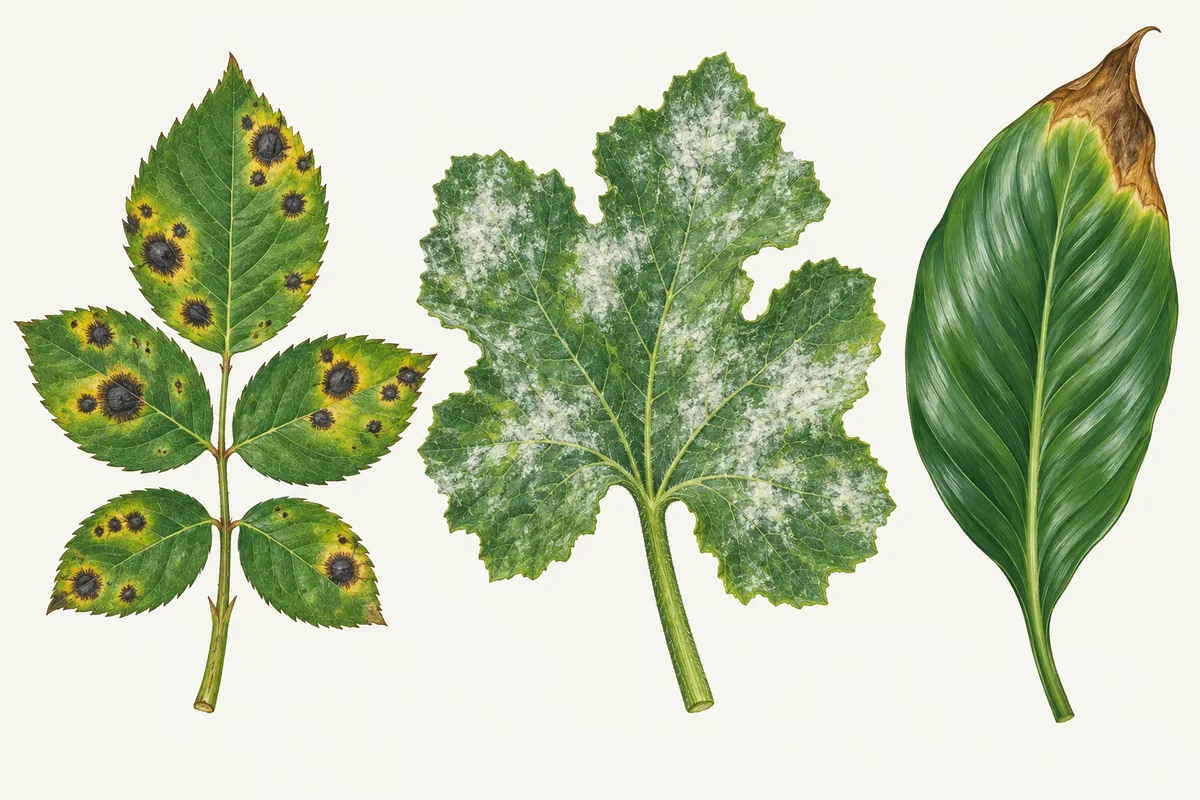
Plant disease identification starts with the exact symptom, not the plant. Water-soaked spots with a yellow halo point to bacteria; brown spots with rings or tiny black dots point to a fungus; a white dusty coating is powdery mildew. Sticky leaves, black film and fine webbing are usually insects. Wilting in wet soil means the roots are failing. Rule out watering and light before blaming a disease.
- Bacterial leaf spots look water-soaked and often carry a yellow halo; fungal spots are brown with yellowish edges, rings or tiny black dots, per Clemson HGIC.
- Black sooty film and sticky leaves are an insect problem first: sooty mold grows on honeydew from aphids, mealybugs, soft scales and whiteflies (UC IPM).
- A plant that wilts while its soil is wet is losing roots: check for soft, dark roots before you water again.
- For a firm answer, a plant clinic tests the sample for bacteria, fungi and viruses; a photo can only point you to what to check.
Most plants that look sick are not diseased. Extension specialists at the University of Maryland note that symptoms are often blamed on insects or diseases when the real problem is the plant's environment: too much water, too little light, a cold draft, salty soil. So plant disease identification works best as elimination. Read the exact symptom, check the care problems that mimic it, look for insects, and only then call it a disease. This guide covers houseplants and garden plants alike; where they differ, it says so.
Symptoms and their likely causes
Start with what you can see on the worst leaf, then check the column on the right before you decide anything.
| Symptom | Most likely causes | What to check first |
|---|---|---|
| Leaf spots with a yellow halo | Bacterial leaf spot (water-soaked spots that may ooze); fungal leaf spot (brown spots with yellowish margins) | Do the spots look wet and translucent (bacteria) or dry with rings and tiny black dots (fungus)? |
| White, powdery coating | Powdery mildew; white cottony tufts may be mealybugs | Does it wipe off like dust? Are there cottony clusters in leaf joints and sticky leaves? |
| Black, sooty coating | Sooty mold growing on insect honeydew | Turn leaves over and check stems for aphids, scale, mealybugs or whiteflies |
| Wilting while the soil is wet | Root rot, overwatering, poor drainage | Tip the plant out: firm white roots or soft brown-black ones? |
| Soft, dark stem base | Stem and root rot | A brown or black ring at or near soil level |
| Sticky leaves or a shiny film | Honeydew from sap-feeding insects | Insects on the undersides and new shoots; ants on the plant |
| Fine webbing, pale speckled leaves | Spider mites | Shake a leaf over white paper and watch for moving specks |
| Ragged holes | Slugs and snails (outdoors), chewing insects | Slime trails, night-time feeding, droppings under leaves |
| Straw-colored patches after watering | Cold water on the leaves, not a disease | Do the patches match where water splashed? |
| Brown tips and edges, white crust on the soil | Salt buildup from fertilizer or hard water | White to gray deposits on the soil or pot rim |
The leaf-spot, rot, cold-water and salt rows follow the Clemson HGIC factsheet on houseplant diseases and disorders. It describes bacterial spots as water-soaked, sometimes with a yellow halo, enlarging and merging in wet conditions, and fungal spots as small brown spots with yellowish margins, often with concentric rings and small black fruiting bodies in the dead tissue.
White coatings: mildew or insects
The RHS describes powdery mildew as a white, dusty coating on leaves, stems and flowers, sometimes with stunted, distorted or discolored leaves. UC IPM adds a detail that surprises many gardeners: powdery mildew does not need moist conditions, and it is favored by shade and moderate temperatures of about 60 to 80°F. The RHS notes that plants under repeated drought stress are more susceptible. A white coating that sits in clumps rather than a film, often with sticky leaves below, points instead to mealybugs.
Black film and sticky leaves
Sooty mold is a fungus, but it is an insect problem. UC IPM's sooty mold Pest Note says it grows on honeydew excreted by aphids, leafhoppers, mealybugs, psyllids, soft scales and whiteflies, and does not infect the plant. It harms the plant indirectly by blocking light, which can stunt growth or make leaves drop early. Ants farming the honeydew protect the insects from their natural enemies, so ants marching up a stem are a clue too.
Webbing and speckles
UC IPM's spider mite Pest Note describes the first damage as stippling, fine light dots on the leaves, sometimes bronzed, followed by yellowing, leaf drop and webbing on heavy infestations. Damage is worst in hot, dusty conditions and on water-stressed plants. To check, shake a few leaves over a white sheet of paper: the mites show up as tiny moving dots.
Tell a disease from a watering, light or pest problem
Four questions sort most cases before you reach for a disease name.
- Is the whole plant affected at once? Care problems hit the plant evenly or by position: every lower leaf, the side facing the window, the leaves that touched the cold glass. Infectious diseases usually start on a few leaves and spread from there. The Maryland Extension page puts it this way: noticing the pattern and progression of symptoms is what leads to the cause.
- What does the soil say? Push a finger into the soil below the surface. Clemson lists yellowing, wilting and leaf drop as overwatering symptoms, because waterlogged soil cuts the oxygen roots need; soft, dark roots mean roots are dying. Bone-dry soil with crisp, curled leaves is the opposite problem. Our yellow leaves guide walks through the watering and light causes in order.
- Can you see an animal or its traces? Look under leaves and along stems with a phone flashlight. Insects, eggs, webbing, honeydew, slime trails and droppings are signs of pests, not disease. The RHS notes that slugs and snails feed at night, so ragged holes and slime trails are often all you will find in the morning.
- Did something change recently? A move, a repot, a cold spell, a new fertilizer or a window opened in winter often comes a week or two before the symptoms. Clemson lists chilling and cold water among the causes of leaf drop and pale patches.
If the answers point to care, fix the care and watch the new growth. Leaves already damaged by spots or scorch will not turn green again, so judge progress on the leaves that appear next.
First steps the sources agree on
Whatever the cause, these non-chemical steps come up again and again in the extension sources cited here:
- Remove affected leaves. Clemson advises removing diseased material for both bacterial and fungal spots; the RHS recommends pruning out mildew-infected shoots promptly and clearing fallen infected leaves. Bag them or put them in the trash rather than leaving them on the soil.
- Keep water off the leaves. Water the soil, not the foliage, especially indoors; wet leaves spread bacterial and fungal spots.
- Improve airflow and light. Space plants so leaves do not touch, and move shade-weakened plants into brighter light. The RHS and UC IPM both link powdery mildew to still air and shade.
- Fix drainage. Use pots with holes, empty saucers after watering, and let the top of the soil dry before watering again. Clemson suggests cutting out a few rotten roots and repotting in fresh, sterile soil; if most roots are dead, starting again with a new plant is the better choice.
- Deal with the insects behind honeydew. UC IPM suggests pruning heavily infested parts and using a strong stream of water; once the insects are under control, sooty mold fades and can be washed off. For spider mites it recommends a daily water spray on the leaf undersides and keeping plants watered so they are not drought-stressed.
- Isolate a sick houseplant from your other plants until you know what you are dealing with.
If you consider a pesticide or fungicide, follow the label and local rules, and identify the cause first: a spray does nothing for a watering or light problem.
Take a sample to a plant clinic
When a valuable plant, a whole bed or a crop is at stake, a lab answer beats any guess. In the US, start with your county Cooperative Extension office; many states run a university plant disease clinic that accepts samples. The Cornell University Plant Disease Diagnostic Clinic, for example, takes samples from homeowners to commercial growers, tests plant material for bacteria, fungi and viruses, and lists its fees on its site. Its sample collection tips are a good checklist for any clinic:
- Send several stages of damage and every affected part of the plant.
- Include the margin between dead and healthy tissue, where early symptoms are easiest to read; skip fully dead material, which carries secondary organisms that hide the real cause.
- Collect the sample before applying any pesticide.
- Wrap it loosely in an unsealed plastic bag inside a sturdy container; wrap roots separately from foliage, and do not water the plant or dampen the packing.
- Ship early in the week so it does not sit in a post office over the weekend; refrigerate it or keep it out of the sun if you cannot ship right away.
- Add photos of the damage pattern and of the whole site.
Call the clinic or your extension office before you send anything: rules, forms and fees differ by state and country.
What a photo can and can't tell
A clear photo shows a lot: the shape and color of spots, a halo, rings, a powdery film, webbing, insects large enough to see. It cannot show roots, cannot tell a wet pot from a dry one, cannot smell rot, and cannot separate diseases that look alike on the surface but need a lab to name. Take several photos: the whole plant, one affected leaf top and bottom in daylight, and the stem at soil level. Our guide to photographing a plant for identification covers light and framing.
Plant Identifier's Diagnose tool reads one photo and writes an AI suggestion: a likely cause, the affected areas, treatment steps and prevention, with a severity badge that the AI writes for that photo. Use it as a first pointer to what to check in the table above, not as a diagnosis. Ask the follow-up chat under the result what else could cause the same symptom, then confirm with the soil, the roots and the undersides of the leaves. If you are not sure which plant you have, the houseplant identification key helps you name it first, because many problems are specific to one kind of plant.
What a photo can't settle
- A photo cannot show the roots, so it cannot tell root rot from simple overwatering or a pot-bound plant; you have to tip the plant out and look.
- Bacterial, fungal and viral diseases can look alike on a leaf; only a laboratory test at a plant clinic confirms which one it is.
- An AI diagnosis, Plant Identifier's included, is a suggestion of what to check, not a confirmed diagnosis or a treatment plan.
Questions people ask
How do I know if my plant has a disease or is just overwatered?
Feel the soil and look at the roots. Clemson HGIC lists yellowing, wilting and leaf drop as overwatering signs, with soft, dark roots when roots are dying. Disease spots usually have a defined edge, a halo, rings or tiny black dots, and they appear on some leaves first rather than across the whole plant at once.
Is the white powder on my plant's leaves a disease?
A white, dusty coating on leaves, stems and flowers is the typical sign of powdery mildew, according to the RHS. White cottony tufts tucked into leaf joints, often with sticky leaves nearby, are more likely mealybugs, one of the honeydew insects UC IPM lists.
What is the black stuff on my plant's leaves?
A black film that wipes off is usually sooty mold. UC IPM explains that it grows on honeydew left by aphids, mealybugs, soft scales, whiteflies and similar insects, and does not infect the plant itself. Control the insects first; the mold then fades and can be washed off.
Can an app identify plant diseases from a photo?
An app can suggest what a symptom looks like and what to check next. It cannot see the roots, culture a fungus or test for bacteria and viruses, which is what a plant diagnostic clinic does. Treat any photo result, including Plant Identifier's Diagnose tool, as a first pointer.
Should I spray a fungicide on a plant with spots?
Not before you know the cause. Many spots come from cold water, salt buildup or insects, and a fungicide does nothing for those. Start with the steps extension services give: remove affected leaves, improve airflow and keep water off the foliage. If you do use a product, follow the label and local rules.
Sources
- Houseplant Diseases & Disorders (HGIC 2251) — Clemson Cooperative Extension, Home & Garden Information Center
- Sooty Mold (Pest Notes, Publication 74108) — UC Statewide IPM Program, University of California Agriculture and Natural Resources
- Spider Mites (Pest Notes, Publication 7405) — UC Statewide IPM Program, University of California Agriculture and Natural Resources
- Powdery Mildew on Vegetables (Pest Notes, Publication 7406) — UC Statewide IPM Program, University of California Agriculture and Natural Resources
- Powdery mildews — Royal Horticultural Society (RHS)
- Slugs and snails — Royal Horticultural Society (RHS)
- Sample collection and submission tips — Cornell University Plant Disease Diagnostic Clinic
- Yellowing Leaves on Indoor Plants — University of Maryland Extension, Home and Garden Information Center