Flower profile
Bluebell (Hyacinthoides non-scripta): what it is and how to identify it
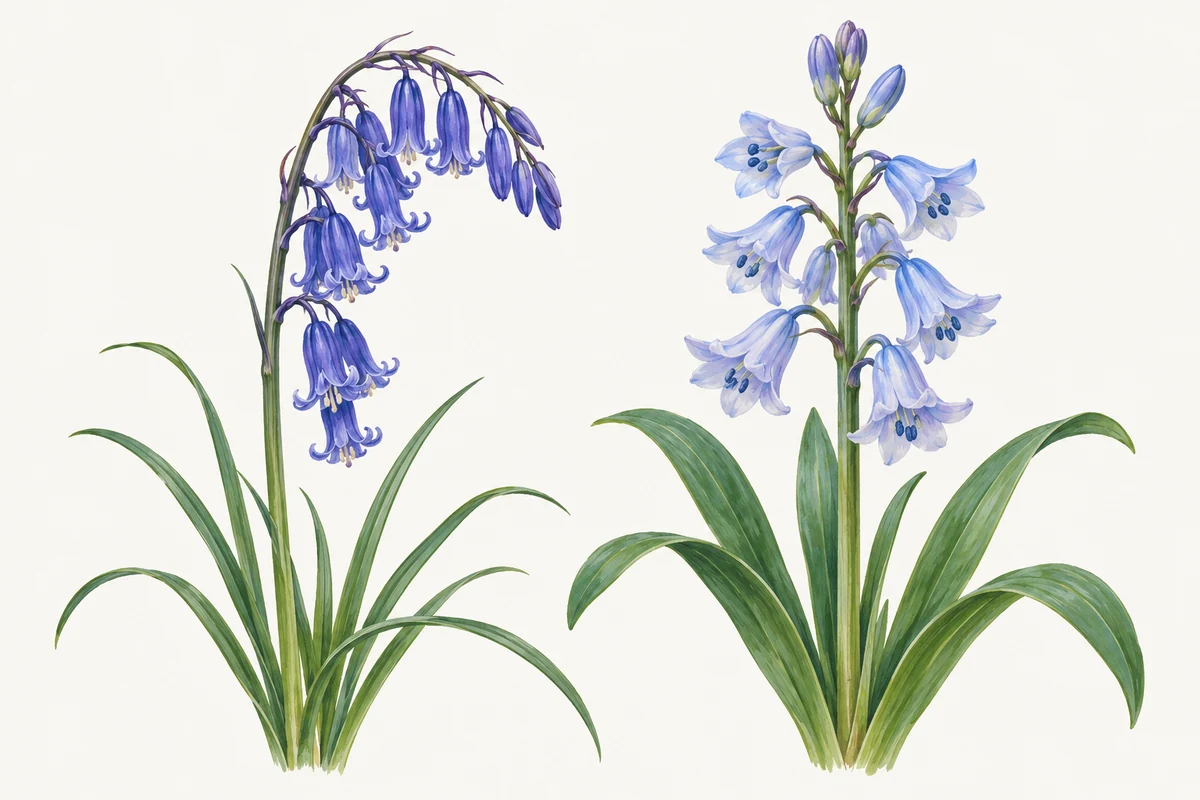
The native British bluebell of ancient woodland, with nodding violet bells hanging to one side. Spanish and hybrid bluebells look similar, and every part of the plant is listed as poisonous.
In short
The bluebell is Hyacinthoides non-scripta, a bulb of western European woodland with the UK as its stronghold. Look for narrow, strap-shaped leaves and, from mid-April to late May, up to 20 sweet-smelling, deep violet-blue bells that droop to one side of the stem and hold cream-coloured pollen. The Woodland Trust lists all parts as poisonous to humans, dogs, horses and cattle.
- Native bluebell flowers nod to one side of the stem and carry creamy white pollen; Spanish bluebells grow upright with flowers all around the stem.
- The hybrid H. × massartiana often looks very like the native bluebell, and the Woodland Trust says it may threaten it by out-competing it and diluting the gene pool.
- The Woodland Trust lists all parts of the bluebell as poisonous to humans, dogs, horses and cattle, and warns its bulbs are easily mistaken for spring onions or garlic; no page or app is a basis for picking a plant to eat.
Field marks at a glance
- Scientific name
- Hyacinthoides non-scripta
- Family
- Asparagaceae (asparagus family)
- Type
- Flowering plant, perennial, deciduous
- Leaves
- Narrow, strap-shaped leaves about 7 to 25 mm wide and up to 45 cm long, smooth and hairless, with a pointed tip (Woodland Trust).
- Flowers
- Bell-shaped, usually deep violet-blue, with six petals and up-turned tips; sweet-smelling. Some are white or pink.
- Flower stem
- Up to 20 flowers per stem, all nodding or drooping to one side.
- Pollen
- Creamy white pollen inside the bells.
- Bloom time
- Mid-April to late May (Woodland Trust).
- Roots
- A bulb; the plant spends most of the year underground.
- Habitat
- Broadleaf woodland, hedgerows and fields; native to western Europe with the UK as a stronghold, and a clue that a wood may be ancient.
The bluebell is the flower behind the violet carpets of British woods in spring. Four marks identify the native plant: the strap-shaped leaves, the bells, the one-sided drooping stem and the cream pollen. The main question in the UK is whether a bluebell is native, Spanish or a hybrid. This page covers identification only. Nothing here, and no app, is a basis for picking any plant to eat.
How to identify a bluebell
1. The leaves. The Woodland Trust's bluebell page describes narrow, strap-shaped leaves around 7 to 25 mm wide and 45 cm long, smooth and hairless, with a pointed tip. They come up in early spring from a bulb; the plant spends most of the year underground.
2. The bells. The flowers are usually deep violet-blue, bell-shaped, with six petals and up-turned tips, and they smell sweet. Some bluebell flowers are white or pink.
3. The stem. Up to 20 flowers grow on one stem, and they nod or droop to one side. This one-sided droop is the first thing to check.
4. The pollen. Look inside a bell: the native bluebell has creamy white pollen.
5. The place and season. Bluebells flower from mid-April to late May. The Woodland Trust says they are native to western Europe with the UK as a stronghold, grow in broadleaf woodland, along hedgerows and in fields, and are one of the clues that a wood may be ancient. The GBIF Backbone Taxonomy accepts the name Hyacinthoides non-scripta (L.) Chouard ex Rothm. in the family Asparagaceae.
A photo of the flowering stem in Plant Identifier gives a name when you find a blue bell-flowered plant you cannot place; the app shows no confidence score and no list of alternatives, so confirm with the one-sided droop and the pollen colour. The flower identifier works through flower shape step by step, and the wildflower identification guide covers other woodland flowers.
Native, Spanish and hybrid bluebells
Three bluebells grow in Britain:
- Native bluebell (Hyacinthoides non-scripta): flowers droop to one side of the stem, with creamy white pollen.
- Spanish bluebell (Hyacinthoides hispanica): the Woodland Trust says it is very similar in appearance, but grows upright with the flowers all around the stem, not drooping to one side.
- Hybrid bluebell (Hyacinthoides × massartiana): a mix of the native and Spanish bluebells. The Woodland Trust says it is often very similar to the native bluebell, but might threaten its existence by out-competing it and diluting the gene pool.
Plantlife says bluebells are threatened locally by habitat destruction, collection from the wild and the escape of Spanish bluebells from gardens, with cross-breeding and loss of true native populations. In one survey, around one in six bluebells found in broad-leaved woodland was a Spanish rather than a native bluebell. Because the hybrid can sit anywhere between its parents, a single photo may not settle which one you have.
What the Woodland Trust says about poison
The Woodland Trust's bluebell facts page says all parts of the bluebell plant contain toxic glycosides that are poisonous to humans, dogs, horses and cattle, and that all varieties of bluebells contain glycosides.
What to do:
- A pet chewed leaves, flowers or bulbs: call your vet or the ASPCA Animal Poison Control Center at (888) 426-4435 at once (the ASPCA says a consultation fee may apply). Do not wait for signs.
- A person swallowed any part: call NHS 111 in the UK, or Poison Control at 1-800-222-1222 in the US; call 999 or 911 if the person is unwell.
This page gives no handling, eating or treatment advice. Plant Identifier's Toxicology tool gives AI-written notes for people, dogs and cats once a plant is named, but it does not replace the call above.
Wild garlic: a warning, not a comparison
Bluebells grow in the same spring woods as wild garlic (ramsons, Allium ursinum), a plant people pick to eat. The Woodland Trust warns that bluebell bulbs are easily mistaken for spring onions or garlic. The German Federal Institute for Risk Assessment (BfR) reports that confusing wild garlic with poisonous look-alikes leads to poisonings every season, some of them fatal.
This page deliberately lists no traits for telling these plants apart. Neither this page nor any app, Plant Identifier included, is a basis for picking any wild plant to eat. If someone has eaten a plant they picked and may have mistaken it, call NHS 111 in the UK or Poison Control at 1-800-222-1222 in the US, or 999 or 911 if they are unwell.
Bluebells and the law
Schedule 8 of the Wildlife and Countryside Act 1981 lists "Bluebell (in respect of section 13(2) only)". Section 13(2) makes it an offence if any person "sells, offers or exposes for sale, or has in his possession or transports for the purpose of sale" any live or dead wild plant included in Schedule 8, or any part of, or anything derived from, such a plant. For anything beyond this wording, check the Act itself or ask the relevant nature agency.
Garden notes
Bluebells are also grown in gardens, where Spanish and hybrid plants are common. Plantlife names the escape of Spanish bluebells from gardens as a threat to native populations. If you grow bluebells, plant them away from places where children or pets play.
Look-alikes and how to tell them apart
Spanish bluebell (Hyacinthoides hispanica)
Very similar, but it grows upright with flowers all around the stem, not drooping to one side like the native bluebell, per the Woodland Trust.
Hybrid bluebell (Hyacinthoides × massartiana)
A cross of native and Spanish bluebells that is often very similar to the native plant; the Woodland Trust says it may out-compete it and dilute its gene pool.
What a photo can't settle
- Native, Spanish and hybrid bluebells overlap; the hybrid is often very similar to the native plant, and a photo cannot confirm parentage.
- Before it flowers, a bluebell is a clump of plain strap-shaped leaves; a photo of leaves alone is no basis for picking any plant to eat.
- A photo cannot tell whether a pet or child swallowed any part, or how much; call a vet or a poison centre instead of waiting for symptoms.
Questions people ask
What is a bluebell?
The British bluebell is Hyacinthoides non-scripta, a spring-flowering bulb in the asparagus family, native to western Europe. From mid-April to late May it carries nodding, deep violet-blue bells on one side of the stem, often in carpets in ancient woodland. The Woodland Trust lists all parts as poisonous.
How do I tell a native bluebell from a Spanish bluebell?
The Woodland Trust says Spanish bluebells grow upright with flowers all around the stem, while native bluebells droop to one side. Native flowers carry creamy white pollen. The hybrid often looks very like the native plant, so a single photo may not settle it.
Are bluebells poisonous to dogs?
The Woodland Trust lists all parts of the bluebell as poisonous to humans, dogs, horses and cattle, because they contain toxic glycosides. If a pet chewed any part, call your vet or the ASPCA Animal Poison Control Center at (888) 426-4435 right away; a consultation fee may apply.
What should I do if a child ate part of a bluebell?
Call NHS 111 in the UK, or Poison Control at 1-800-222-1222 in the US; call 999 or 911 if the child is unwell. The Woodland Trust lists bluebells as poisonous to humans. Keep a sample or photo of the plant to describe it on the call.
Are bluebells protected by law?
Schedule 8 of the Wildlife and Countryside Act 1981 lists "Bluebell (in respect of section 13(2) only)". Section 13(2) makes it an offence to sell, offer or expose for sale, or possess or transport for sale, any listed wild plant or anything derived from it.
Sources
- Bluebell (Hyacinthoides non-scripta) — Woodland Trust
- Are bluebells poisonous? And more bluebell facts — Woodland Trust
- Bluebell — Plantlife
- Wildlife and Countryside Act 1981, Schedule 8 — legislation.gov.uk
- Wildlife and Countryside Act 1981, section 13 — legislation.gov.uk
- Wild garlic: "doppelgangers" often lead to poisoning — German Federal Institute for Risk Assessment (BfR)
- Hyacinthoides non-scripta (L.) Chouard ex Rothm. — GBIF Backbone Taxonomy
Keep reading
- Field guideHow to identify wildflowers in the field
- Free toolFlower identifier by description
- Flower profileGerbera daisy (Gerbera jamesonii): how to identify it
- Flower profileLily of the valley (Convallaria majalis): what it is and how to identify it
- Flower profileFoxglove plant (Digitalis purpurea): how to identify it