Flower profile
Foxglove plant (Digitalis purpurea): how to identify it
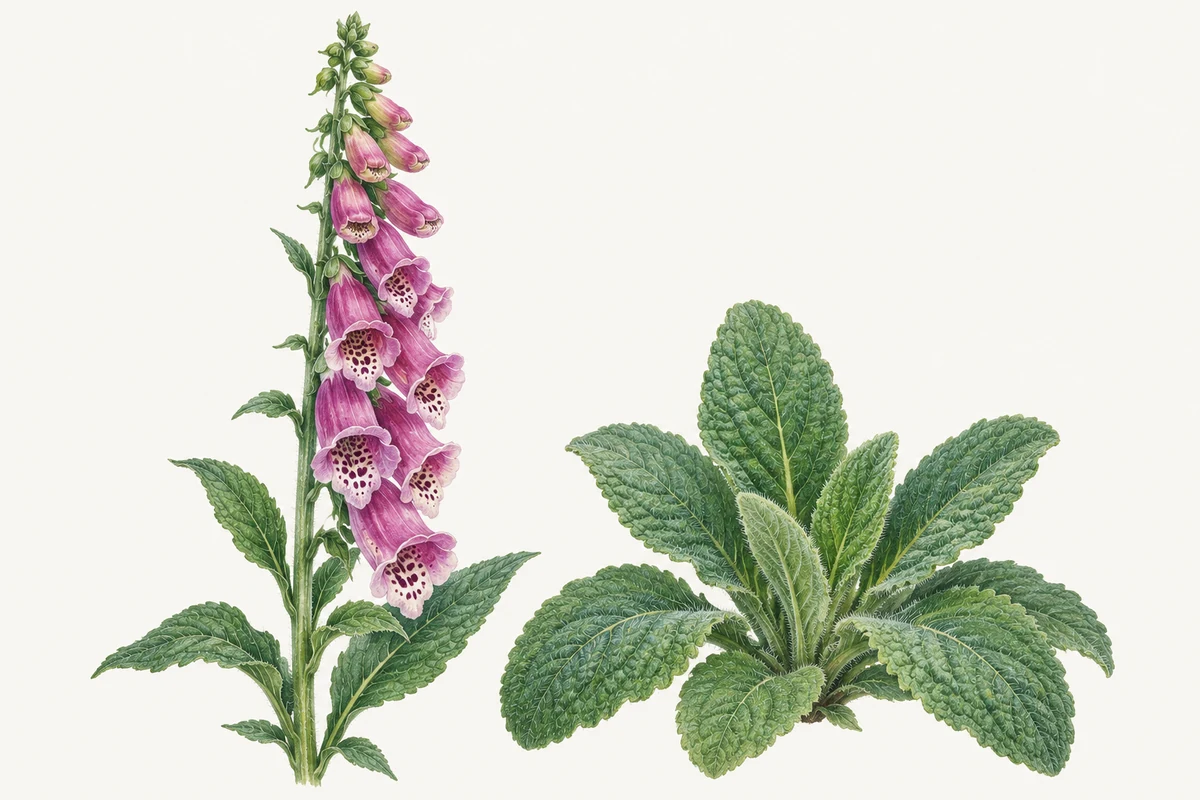
A tall one-sided spike of spotted, tubular bells in its second year, a low rosette of soft, hairy, toothed leaves in its first. Every part is listed as poisonous, and the rosette is the stage people mistake.
In short
The foxglove plant (Digitalis purpurea) is a biennial wildflower of western Europe, grown in gardens and naturalized in the US. In its second year it sends up a one-sided spike 2 to 5 feet tall of nodding purple, pink or white bells spotted inside; in its first it is only a low rosette of soft, hairy leaves with toothed edges. The ASPCA lists it as toxic to dogs, cats and horses.
- In flower, look for a one-sided spike of nodding tubular bells with dark spots ringed in white inside the tube.
- In its first year foxglove is only a rosette of hairy, toothed leaves, the stage people mistake for other plants, including plants that are eaten or brewed.
- The ASPCA lists foxglove as toxic to dogs, cats and horses; Poison Control calls all parts of the plant poisonous, possibly even deadly.
Field marks at a glance
- Scientific name
- Digitalis purpurea
- Family
- Plantaginaceae (plantain family)
- Type
- Flowering plant, biennial
- First-year rosette
- A low, tight rosette of coarse leaves up to about 1 ft long, with prominent veins, gray-white hairs above and woolly or hairy beneath; no flower stem yet.
- Leaf edge
- Toothed or scalloped (crenate) margins; common mullein leaves are untoothed or only shallowly scalloped.
- Flower spike
- In the second year, an upright stem 2 to 5 ft tall (up to 2 m in Britain) with a one-sided spike 1 to 2 ft long of closely packed flowers.
- Flowers
- Nodding, tubular bells 1.5 to 3 in long, purple, pink, white or cream; the inside of the tube and lower lip is spotted with darker purple ringed in white.
- Stem leaves
- Alternate, smaller up the stem, ovate to lance-shaped and hairy, with stalks shortening toward the top.
- Bloom time
- Late spring to summer; June to September in Britain (Woodland Trust).
- Fruit
- A rounded capsule that turns from green to black and splits to release many small brown seeds.
- Native range and habitat
- Western Europe and Morocco. In Britain on woodland edges, heaths and roadsides; naturalized or planted widely in the US.
Foxglove is the tall cottage-garden and woodland-edge flower with a spike of spotted, tubular bells. In flower it is hard to mistake. The year before, it is only a rosette of soft, hairy leaves that look like several other plants. The ASPCA lists it as toxic to dogs, cats and horses, and Poison Control says all parts are poisonous.
How to identify foxglove in flower
1. The spike. The NC State Extension Plant Toolbox describes a tall flower stem, 2 to 5 feet, carrying "a densely packed one-sided raceme" 1 to 2 feet long. The flowers hang mostly from one side of the stem. The Woodland Trust gives up to 2 m for British plants.
2. The bells. Each flower is a large, nodding, inflated tube, 1.5 to 3 inches long, in purple, pale pink or white (mauve or yellowish in some hybrids). Look inside: NC State describes the tube as heavily marked with dark purple spots edged in white, and the Woodland Trust notes the darker spots on the lower lip. The upper lip is shorter than the lower one.
3. The stem leaves. Leaves on the flowering stem are alternate, hairy, ovate to lance-shaped and get smaller toward the top.
4. The season and the fruit. NC State gives spring to summer; the Woodland Trust gives June to September in Britain. The fruit is a rounded capsule that ripens from green to black and splits to release many tiny brown seeds.
When you find a tall spike you cannot place, one photo of the flowers in Plant Identifier gives a name to check against these marks; the app shows no confidence score and no list of alternatives, so confirm with the spotted bells and the one-sided spike. The flower identifier and the wildflower identification guide cover other tall spikes.
What the ASPCA and Poison Control say
The ASPCA's foxglove entry lists Digitalis purpurea as toxic to dogs, cats and horses. The toxic principle it names is cardiac glycosides, and the clinical signs it lists are cardiac arrhythmias, vomiting, diarrhea, weakness, cardiac failure and death.
For people, Poison Control (the National Capital Poison Center) says all parts of the plant are poisonous, possibly even deadly, if swallowed, and that its flowers and fruit attract children. It describes a case in which a man picked young foxglove leaves believing they were borage, and he and his wife both needed hospital treatment for a dangerously slow heart rate.
What to do:
- A dog or cat chewed any part: call your vet or the ASPCA Animal Poison Control Center at (888) 426-4435 at once (the ASPCA says a consultation fee may apply).
- A person swallowed any part: Poison Control says do not induce vomiting; if you are certain the plant was swallowed, go to the emergency room immediately, and if you are unsure, call 1-800-222-1222. In the UK, call NHS 111, or 999 in an emergency.
This page gives identification only: no handling, eating, medicinal or treatment advice, and no drug information. Plant Identifier's Toxicology tool gives AI-written notes for people, dogs and cats once a plant is named, but it does not replace those calls. The poisonous plants for dogs guide lists other common garden plants on the ASPCA's list, including oleander.
The first-year rosette and its look-alikes
Foxglove is a biennial. NC State says it forms "only a rosette of leaves the first year," and flowers the second. That rosette is the stage people misidentify.
Foxglove rosette. NC State describes a tight rosette of coarse leaves up to a foot long, with prominent veins, gray-white hairs on top and woolly or hairy undersides, kept low and close to the ground. The Woodland Trust says the leaves are oval and hairy "with a toothed margin."
Common mullein (Verbascum thapsus). NC State's mullein page describes a first-year rosette of large, silvery-green, velvety leaves, 4 to 12 inches long, pointed at both ends and tapering into a winged stalk, densely covered in woolly hairs, compared to lamb's ear. The Woodland Trust says mullein leaves are untoothed and hairier than foxglove's. In year two, mullein produces a dense spike of flat, five-lobed yellow flowers, never spotted bells.
| Feature | Foxglove | Common mullein |
|---|---|---|
| Life cycle | Biennial | Biennial |
| Leaf edge | Toothed or scalloped | Untoothed or shallowly scalloped |
| Leaf surface | Hairy above, woolly below | Thick silvery wool, felt-like |
| Flowers | Spotted tubular bells, one-sided spike | Flat yellow, dense spike |
Comfrey, borage and other leaves people eat or use as remedies. The Woodland Trust names comfrey as a plant that could be mistaken for foxglove out of flower, and Poison Control's case report above began with foxglove leaves picked as borage. This page deliberately gives no traits for telling foxglove from plants that are eaten, brewed or used as remedies: Poison Control says every part of foxglove is poisonous, possibly even deadly, if swallowed, and neither this page nor any app, Plant Identifier included, is a basis for picking leaves for any of those uses. If someone has swallowed leaves they picked, follow the Poison Control steps above.
Where it grows and naming notes
NC State gives the native range as western Europe and Morocco and grows it in USDA zones 4 to 9. Poison Control says foxglove grows throughout the United States, both in the wild and in gardens. In Britain the Woodland Trust describes it as a familiar wildflower of woodland edges, heathland, roadside verges, gardens and hedgerows, doing best on acidic soil.
Digitalis is the genus name; World Flora Online accepts Digitalis purpurea L. and places it in the plantain family, Plantaginaceae, as NC State does. The ASPCA still lists it under the older family name Scrophulariaceae. If you grow foxglove, NC State notes that deer avoid it; plant it away from vegetable and herb beds so its rosettes are never mixed up with leaves grown for the kitchen, and keep dogs from chewing it.
Look-alikes and how to tell them apart
Common or great mullein (Verbascum thapsus)
Its rosette leaves are thick, silvery gray-green and covered in dense, felt-like wool, taper at both ends into a winged stalk, and are untoothed or only shallowly scalloped. In the second year it sends up a dense spike of flat, five-lobed yellow flowers, never bells.
What a photo can't settle
- A first-year foxglove rosette can look like mullein and other hairy-leaved plants in a photo; without the flower spike, a picture alone is not enough, and no photo is a basis for picking leaves to eat or brew.
- A photo cannot tell whether a pet or person swallowed any part or how much; call a vet or poison control immediately rather than waiting for symptoms.
- Garden hybrids and other Digitalis species differ in flower color and size; a photo may name the genus without settling the species.
Questions people ask
Are foxglove plants poisonous for dogs?
Yes. The ASPCA lists foxglove as toxic to dogs, cats and horses and names cardiac glycosides. Its listed signs are cardiac arrhythmias, vomiting, diarrhea, weakness, cardiac failure and death. If your dog chewed any part, call your vet or the ASPCA Animal Poison Control Center at (888) 426-4435 at once; a consultation fee may apply.
What should I do if a person ate part of a foxglove?
Poison Control says: do not induce vomiting; if you are certain part of the plant was swallowed, go to the emergency room immediately, and if you are not sure, call 1-800-222-1222 right away. In the UK, call NHS 111, or 999 in an emergency.
What does a foxglove look like in its first year?
Only a low rosette of leaves. NC State describes a tight rosette of coarse leaves up to a foot long with prominent veins, gray-white hairs above and woolly undersides; the flower spike appears in the second year. The Woodland Trust notes the leaves are hairy with a toothed margin.
How do I tell a foxglove rosette from mullein?
Check the leaf edge and the wool. The Woodland Trust says great mullein leaves are untoothed and hairier than foxglove's, which have a toothed margin. NC State describes mullein rosettes as thick, silvery and felt-like. In the second year mullein flowers are flat and yellow, never spotted bells.
Is foxglove a wildflower in Britain?
Yes. The Woodland Trust describes it as a well-known plant across the UK that grows up to 2 m tall on woodland edges, heathland, roadside verges, gardens and hedgerows, flowering from June to September and doing particularly well on acidic soil. NC State gives its native range as western Europe and Morocco.
Sources
- Foxglove — ASPCA Poison Control
- Foxglove: Toxic to the heart — Poison Control (National Capital Poison Center)
- Digitalis purpurea — NC State Extension Gardener Plant Toolbox
- Foxglove (Digitalis purpurea) — Woodland Trust
- Verbascum thapsus — NC State Extension Gardener Plant Toolbox
- Digitalis purpurea L. — World Flora Online
Keep reading
- Field guideHow to identify wildflowers in the field
- Flower profileGeranium plant (Pelargonium): how to identify it
- Plant profileHellebore (Helleborus): how to identify it
- Flower profileLily of the valley (Convallaria majalis): what it is and how to identify it
- Plant profileOleander (Nerium oleander): how to identify it