Flower profile
Geranium plant (Pelargonium): how to identify it
The red, pink or white geranium in window boxes is a Pelargonium. Round, scented leaves with a dark ring, ball-shaped flower clusters on long stalks, and no frost hardiness.
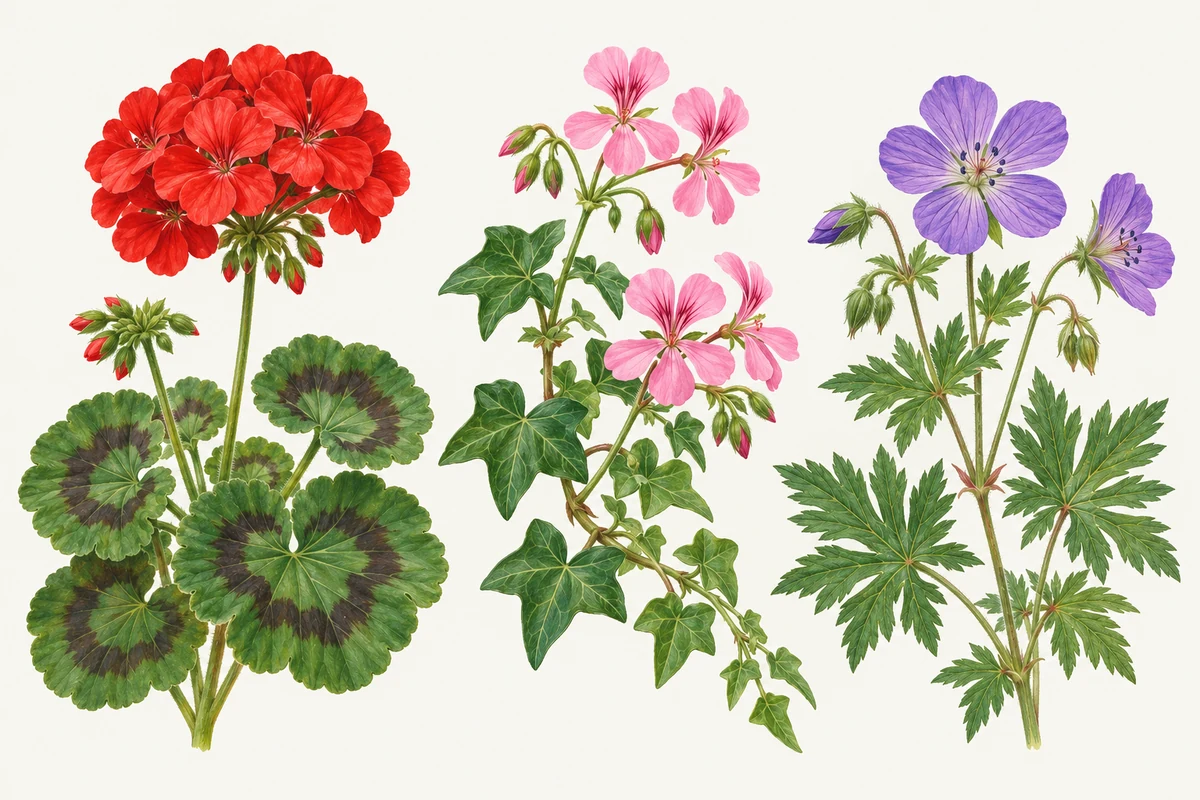
In short
The geranium plant in window boxes and bedding is a Pelargonium: zonal geraniums (P. × hybridum, formerly P. × hortorum) and ivy-leaved geraniums (P. peltatum). Look for round, hairy, aromatic leaves, often with a dark zone inside the edge, and flowers in rounded, umbel-like clusters on long stalks. True geraniums (cranesbills) include hardy perennials with deeply cut leaves and flowers in ones or pairs.
- A round leaf with a dark ring and a ball of flowers on a long stalk: zonal Pelargonium. A shield-shaped, ivy-like leaf on trailing stems: ivy-leaved Pelargonium.
- True geraniums (Geranium, cranesbills) have deeply lobed leaves and radially symmetrical flowers borne singly or in pairs.
- The ASPCA lists geranium (Pelargonium species) as toxic to dogs, cats and horses.
Field marks at a glance
- Scientific name
- Pelargonium × hybridum (syn. P. × hortorum, from P. zonale × P. inquinans) and Pelargonium peltatum
- Family
- Geraniaceae (geranium family)
- Type
- Flowering plant, perennial
- Leaves (zonal)
- Round to kidney-shaped, with a scalloped, wavy edge and a heart-shaped base; hairy and aromatic when bruised; often a dark green or brown zone in from the margin (NC State).
- Leaves (ivy-leaved)
- Peltate: the stalk joins the middle of the blade, not its edge; lobed like English ivy, stiff and fleshy, often with circular zones (NC State, RHS).
- Flowers
- Single, semi-double or double, most often red, pink, salmon or white, in an erect, umbel-like cluster on a long stalk (NC State).
- Flower symmetry
- Five petals, but the upper and lower petals often differ: NC State's photos call ivy geranium flowers zygomorphic, and RHS notes darker markings on the upper petals of Angel types.
- Stems
- Erect, succulent stems on zonals; trailing stems on ivy-leaved types. Large stipules stay at the leaf bases.
- Size and habit
- Zonal: a rounded mound 1 to 3 ft tall (NC State). Ivy-leaved: trailing, for baskets and window boxes.
- Season
- Flowers through the warm months until frost. Not frost hardy: RHS calls pelargoniums tender geraniums.
- Fruit
- Rare on bedding plants: an elongated capsule with a long beak that splits from the beak down and coils (NC State).
- Native range
- The parent species (P. zonale, P. inquinans, P. peltatum) come from the Cape region of South Africa (NC State).
In US and UK garden centers, "geranium" usually means the red, pink or white bedding plant of window boxes and patio pots, which botanists place in Pelargonium. The true Geranium, the cranesbill, is a different genus that includes many hardy perennials. Both are in the geranium family, so the checks below start with the leaf and end with the flower.
How to identify a geranium plant in four checks
1. The leaf outline. Pick a mature leaf. On a zonal geranium it is round to kidney-shaped with a heart-shaped base and a scalloped, wavy edge. The NC State Plant Toolbox adds that the leaves are hairy, aromatic when bruised, and often green with a dark green or brown zone in from the margin, the "zone" of zonal pelargoniums. A deeply cut leaf divided like a hand points instead to a cranesbill or a scented-leaved pelargonium.
2. The leaf stalk. Turn an ivy-like, trailing plant over. In the ivy-leaved geranium, NC State on Pelargonium peltatum explains, the stalk joins the center of the blade rather than its edge (peltate), and the leaf is lobed like English ivy. NC State notes these leaves often carry circular zones too.
3. The flower cluster. Follow a flower stalk down. Bedding geraniums hold many flowers together in an erect, umbel-like ball at the top of one long stalk. Each flower has five petals, and the upper and lower petals are often unequal in size or markings: NC State's photos call ivy geranium flowers zygomorphic. Flora of China describes Geranium flowers as usually paired or solitary and radially symmetrical.
4. Frost. Think about the season. Pelargoniums do not survive frost; the RHS calls them tender geraniums and advises bringing plants in or taking cuttings before temperatures drop. A plant that comes back by itself in a cold-winter border is far more likely to be a hardy cranesbill.
If you have only a photo, one shot of a flower cluster with a leaf in view is enough for Plant Identifier to suggest a common and scientific name. The app shows no confidence score and no list of alternatives, so check its answer against the leaf and the cluster yourself.
Zonal, ivy-leaved and other pelargonium groups
The RHS describes several groups you will meet:
- Zonal: upright and bushy, with succulent stems and leaves often marked with purple or maroon zones; single or double flowers in red, salmon, pink or white. These are the classic bedding geraniums, P. × hybridum, a hybrid of P. zonale and P. inquinans first made in the late 18th century (NC State).
- Ivy-leaved: trailing, with stiff, fleshy leaves that tumble from baskets and window boxes.
- Regal: ruffled, showy flowers in mauve, pink, purple or white, flowering slightly earlier than zonals.
- Angel: like regals but more compact, with darker markings on the upper petals that give a pansy-like look.
- Scented-leaved: grown for scented leaves, often lobed or toothed, with less showy flowers. NC State's genus page lists rose-, lemon-, apple- and peppermint-scented kinds.
NC State also lists Caliente, a zonal × ivy-leaved hybrid group, and zonal sub-groups: Stellar types with pointed leaf lobes, cactus-flowered types with twisted, quilled petals, rosebuds whose tight flowers never fully open, and miniatures no more than 8 inches tall. For flowers you can't place at all, try the flower identifier.
Bedding geranium vs true geranium (cranesbill)
| Feature | Bedding geranium (Pelargonium) | True geranium (Geranium) |
|---|---|---|
| Leaves | Round or ivy-like, scalloped, often zoned | Usually palmately divided or cleft |
| Flowers | Many in an umbel-like ball on one long stalk | Usually 1 or 2 per stalk (some species up to 5) |
| Symmetry | Often zygomorphic (upper petals differ) | Usually radial (actinomorphic) |
| Hardiness | Tender, killed by frost | Many hardy perennials (wild geranium: USDA zones 3 to 11) |
| Origin | Mostly South Africa | Cosmopolitan, about 380 species |
| Fruit | Long beak, splits and coils | Long beak, splits into 5 parts |
The fruit does not separate them: both genera are named for it. NC State notes that Pelargonium comes from the Greek for stork, for the beak-like capsule, and that the cranesbill's beaked seed capsules give it its common name. Flora of China describes the Geranium fruit as a long-beaked schizocarp splitting into five one-seeded parts.
The cranesbill most US readers meet in the wild is the wild geranium: NC State on Geranium maculatum describes a woodland perennial of eastern North America, 1 to 2 feet tall, with 2 to 5 pink to lilac flowers per cluster and fine veins on the petals that guide pollinators. Other cranesbills share the divided leaf and the five separate petals that Flora of China describes for the genus. More wild plants are in identify wildflowers.
Is geranium toxic to pets
The ASPCA lists geranium, under Pelargonium species, as toxic to dogs, cats and horses. It names geraniol and linalool as the toxic principles and lists vomiting, anorexia, depression and dermatitis as clinical signs. NC State rates the poison severity as low, names the leaves, and notes that cats are the most sensitive. This page does not cover a listing for true geraniums (cranesbills).
If a pet has chewed a leaf, call your vet or the ASPCA Animal Poison Control Center at (888) 426-4435. If a person has eaten part of the plant, call Poison Control at 1-800-222-1222 (poison.org). Plant Identifier's Toxicology tool gives AI-written notes for people, dogs and cats, but it does not replace that call. More plants on the ASPCA's list are in plants toxic to cats.
A short care note
NC State and the RHS describe sun lovers that tolerate drought once established: full sun (zonals tolerate some shade, regals prefer partial shade), well-drained soil or compost, and moderate watering that lets containers dry between waterings. In poor light plants become leggy and bloom poorly. Plants can be overwintered indoors or as cuttings in a bright, frost-free place; in the UK the RHS suggests waiting until frosts have passed, usually not before the end of May, before planting out.
Look-alikes and how to tell them apart
True geranium, cranesbill (Geranium species)
Look at the leaf and count the flowers per stalk. Flora of China describes Geranium leaves as usually palmately divided or cleft, flowers usually paired or solitary and radially symmetrical (actinomorphic). A bedding geranium has a round, scalloped leaf and a ball of many flowers on one stalk.
Wild geranium (Geranium maculatum)
Check the habitat and the leaf. NC State describes a woodland perennial of eastern North America with deeply cut, 5-lobed, hairy leaves and 2 to 5 upward-facing, saucer-shaped pink to lilac flowers about 1.25 inches wide, from April to June. It survives winter outdoors, which a bedding geranium does not.
What a photo can't settle
- Hundreds of Pelargonium cultivars and hybrid groups exist (zonal, ivy-leaved, regal, Angel, scented-leaved, zonal × ivy crosses); a photo may settle the group but rarely the cultivar.
- Scented-leaved pelargoniums and some cranesbills both have deeply cut leaves; when no flowers are open, the identification can stay uncertain.
- Neither a photo nor this page can say whether a pet ate enough to matter; that is a question for your vet or the ASPCA Animal Poison Control Center.
Questions people ask
What is the difference between a geranium and a pelargonium?
The bedding and window-box geranium is a Pelargonium: tender, with round or ivy-like leaves and many flowers clustered on one long stalk. True geraniums (Geranium, cranesbills) include hardy perennials with deeply cut leaves and radially symmetrical flowers in ones or pairs. Both belong to the geranium family, Geraniaceae.
Why is a pelargonium called a geranium?
The two genera are close relatives in the same family, and gardeners have long called pelargoniums geraniums; RHS notes they are often called tender geraniums. NC State lists geranium as a common name of Pelargonium × hybridum. Botanically, Geranium is the cranesbill genus.
What is the dark ring on geranium leaves?
It is the zone that gives zonal pelargoniums their name. NC State describes leaves often variegated green with a dark green or brown zone in from the margin, and RHS mentions purple or maroon markings in zones. The BullsEye group has a very broad zone. The ring is normal, not a disease.
Are geraniums toxic to cats and dogs?
The ASPCA lists geranium (Pelargonium species) as toxic to dogs, cats and horses, naming geraniol and linalool, with vomiting, anorexia, depression and dermatitis. NC State notes cats are most sensitive. If your pet chewed a leaf, call your vet or the ASPCA Animal Poison Control Center at (888) 426-4435.
Sources
- Pelargonium × hybridum — North Carolina Extension Gardener Plant Toolbox (NC State)
- Pelargonium peltatum — North Carolina Extension Gardener Plant Toolbox (NC State)
- How to grow pelargoniums — Royal Horticultural Society (RHS)
- Geranium maculatum — North Carolina Extension Gardener Plant Toolbox (NC State)
- Pelargonium — North Carolina Extension Gardener Plant Toolbox (NC State)
- Geranium in Flora of China — eFloras (Flora of China, Vol. 11)
- Geranium — ASPCA Animal Poison Control Center
- Poison Control — National Capital Poison Center
Keep reading
- Free toolFlower identifier by description
- Field guideHow to identify wildflowers in the field
- Vine profileEnglish ivy plant (Hedera helix): how to identify it
- Flower profileBluebell (Hyacinthoides non-scripta): what it is and how to identify it
- Plant profileHydrangea: how to identify it and tell the types apart