Flower profile
Lily of the valley (Convallaria majalis): what it is and how to identify it
A low spring woodland plant with two broad leaves and a one-sided stalk of nodding white bells. Every part is listed as poisonous, and its leaves are mistaken for wild garlic and ramps.
In short
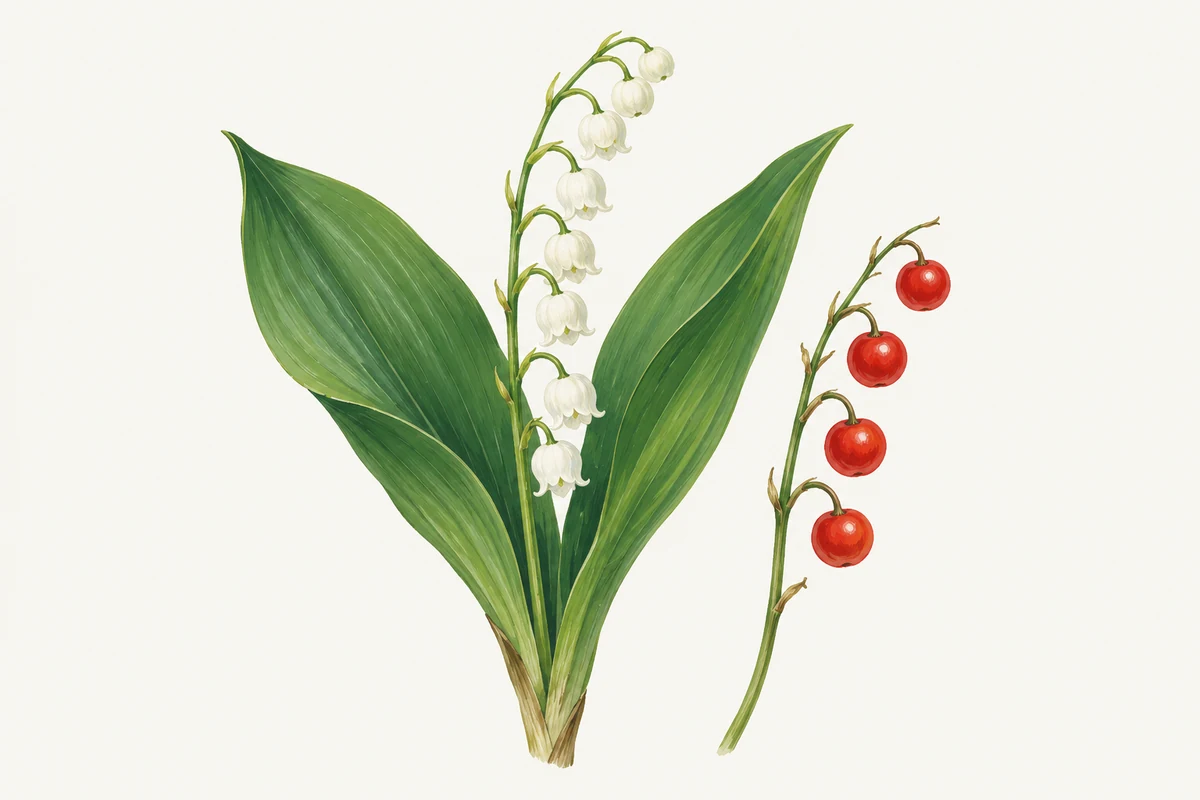
Lily of the valley is the flower of Convallaria majalis, a low, spreading perennial of Eurasian woodlands now grown in shady gardens. Look for two broad, smooth-edged leaves wrapped around one short stalk, a one-sided spray of 6 to 16 small, fragrant, nodding white bells in late spring, and later red berries. The ASPCA lists it as toxic to cats, dogs and horses.
- Two (sometimes three) broad leaves wrap around each other at the base, and the flower stalk carries its white bells on one side.
- The ASPCA lists lily of the valley as toxic to dogs, cats and horses (cardenolides); Poison Control lists it among poisonous plants.
- Its spring leaves are confused with wild garlic and ramps, and Germany's risk assessment institute reports fatal poisonings from such mix-ups; no page or app is a basis for picking a plant to eat.
Field marks at a glance
- Scientific name
- Convallaria majalis
- Family
- Asparagaceae (asparagus family)
- Type
- Flowering plant, perennial, deciduous
- Leaves
- Usually two, sometimes three, broad elliptic leaves 5 to 10 in long and 3 to 5 in wide, smooth-edged, with parallel veins; their stalks wrap around one another at the base.
- Flower stalk
- A leafless, one-sided spray (raceme) 4 to 9 in long, tucked beside the leaves, bending so the bells all hang on one side.
- Flowers
- 6 to 16 small, nodding, white bells about 1/3 in long and wide, with six lobes curling outward; strongly fragrant.
- Bloom time
- Late spring to early summer, for about three weeks (NC State).
- Berries
- Round red berries about 1/4 in across in summer, each with 1 to 6 seeds; often absent, because plants need a genetically different neighbor to set fruit.
- Roots and spread
- Spreads by creeping underground rhizomes into dense patches; plants are 6 to 10 in tall.
- Habitat
- Shady woodland and gardens; in Britain dry woodland on chalky soil and limestone pavement. Native to Eurasia; grown in USDA zones 3 to 7.
Lily of the valley is a small spring flower with an outsized reputation: sweetly scented white bells, two broad leaves, and a place on the ASPCA's toxic list. Five marks identify it: the paired leaves, the one-sided flower stalk, the bells, the red berries and the spreading patch. This page covers identification only. Nothing here, and no app, is a basis for picking any plant to eat.
How to identify lily of the valley
1. The leaves. The NC State Extension Plant Toolbox describes basal, paired, elliptic or narrowly ovate leaves 5 to 10 inches long and 3 to 5 inches wide, with smooth edges and parallel veins; their stalks wrap around a basal stalk that is partly buried. In practice you see two broad leaves standing up together from one point, sometimes three.
2. The flower stalk. A slender, leafless stalk 4 to 9 inches long rises beside the leaves and leans so that every flower hangs from one side. The Woodland Trust describes the flowers as growing "in a one-sided spike which droops to one side."
3. The bells. NC State counts 6 to 16 small, nodding, fragrant white bells per stalk, each about a third of an inch long and wide, with six lobes that curl outward. They open in late spring to early summer for about three weeks. Before they open, the buds are round and green.
4. The berries. Round red berries about a quarter inch across may follow in summer. NC State notes they are seldom formed in gardens, because flowers need pollen from a genetically different plant nearby.
5. The patch. Lily of the valley spreads by underground rhizomes into dense colonies 6 to 10 inches tall. NC State says the plant is native to Eurasia, belongs to the asparagus family (Asparagaceae) and grows in USDA zones 3 to 7; World Flora Online accepts the name Convallaria majalis L. In Britain the Woodland Trust finds it mainly in dry woodland on chalky soil and on limestone pavement, and treats it as an ancient-woodland indicator.
A photo of the flowering stalk in Plant Identifier gives a name when you find a white bell-flowered plant you cannot place; the app shows no confidence score and no list of alternatives, so confirm with the paired leaves and the one-sided spray. The flower identifier works through flower shape step by step, and the wildflower identification guide covers other woodland flowers.
What the ASPCA and Poison Control say
The ASPCA's lily of the valley entry lists Convallaria majalis as toxic to dogs, cats and horses. The toxic principles it names are cardenolides (convallarin and others), and the clinical signs it lists are vomiting, irregular heartbeat, low blood pressure, disorientation, coma and seizures.
For people, Poison Control (the National Capital Poison Center) includes lily-of-the-valley in its illustrated list of poisonous plants. The Woodland Trust calls it "highly poisonous" and says its red berries are poisonous.
What to do:
- A pet chewed leaves, flowers or berries: call your vet or the ASPCA Animal Poison Control Center at (888) 426-4435 at once (the ASPCA says a consultation fee may apply). Do not wait for signs.
- A person swallowed any part: call Poison Control at 1-800-222-1222 in the US, or NHS 111 in the UK; call 911 or 999 if the person is unwell.
- Cut flowers in a vase: Poison Control's spring safety article describes a confused older woman who drank the water from a vase of lily-of-the-valley. Keep vases out of reach of children, pets and anyone who may be confused.
This page gives no handling, eating or treatment advice. Plant Identifier's Toxicology tool gives AI-written notes for people, dogs and cats once a plant is named, but it does not replace the call above.
Wild garlic and ramps: a warning, not a comparison
In spring, lily of the valley leaves come up in the same woods and gardens as wild garlic (ramsons, Allium ursinum) and, in North America, ramps (Allium tricoccum), plants that people pick to eat. The German Federal Institute for Risk Assessment (BfR) reports that confusing wild garlic with poisonous look-alikes such as lily of the valley or autumn crocus leads to poisonings every season, some of them fatal.
This page deliberately lists no traits for telling these plants apart. Neither this page nor any app, Plant Identifier included, is a basis for picking any wild plant to eat. If someone has eaten leaves they picked and may have mistaken the plant, call Poison Control at 1-800-222-1222 in the US or NHS 111 in the UK, or 911 or 999 if they are unwell.
Other look-alikes: Solomon's seal and May lily
Two garden and woodland plants are mixed up with lily of the valley in photos. The Woodland Trust's lily of the valley page names both:
- Solomon's seal (Polygonatum multiflorum) has oval, untoothed leaves that grow alternately up the stem, and its white flowers are longer. Lily of the valley's leaves grow in pairs from the base, beside a separate flower stalk.
- May lily (Maianthemum bifolium) has similar heart-shaped leaves, but they sit halfway up a short stem rather than coming from the base.
Garden notes and invasive behavior
Lily of the valley is grown as a shade groundcover. NC State describes it as tolerant of dry shade and clay, resistant to deer and rabbits, slow to establish but able to spread through dense rhizomes and crowd out other plants. It is reported as invasive in Wisconsin and Arkansas and can become weedy in regions with moist, cool winters, and NC State suggests native alternatives. If you grow it, plant it away from vegetable beds and from places where children or pets play, and keep cut stems and vase water out of reach.
Look-alikes and how to tell them apart
Solomon's seal (Polygonatum multiflorum)
Oval, untoothed leaves grow alternately up the stem, and the white flowers are longer, per the Woodland Trust. Lily of the valley has two or three leaves in a pair from the base and a separate flower stalk.
May lily (Maianthemum bifolium)
Its similar heart-shaped leaves sit halfway up a short stem rather than coming from the base, according to the Woodland Trust.
What a photo can't settle
- Before it flowers, lily of the valley is a pair of plain green leaves; a photo of leaves alone can be confused with wild garlic, ramps and other spring plants, and no photo is a basis for picking any of them to eat.
- A photo cannot tell whether a pet or child swallowed any part, or how much; call a vet or poison control instead of waiting for symptoms.
- Pink-flowered and variegated garden forms exist; a photo names the species but not the cultivar.
Questions people ask
What flower is lily of the valley?
It is Convallaria majalis, a low woodland perennial in the asparagus family, native to Eurasia. In late spring it carries a one-sided spray of small, fragrant, nodding white bells between two broad leaves, followed in some years by red berries. The ASPCA lists it as toxic to dogs, cats and horses.
Is lily of the valley poisonous to dogs and cats?
The ASPCA lists it as toxic to dogs, cats and horses, naming cardenolides (convallarin and others). Listed signs are vomiting, irregular heartbeat, low blood pressure, disorientation, coma and seizures. If a pet chewed any part, call your vet or the ASPCA Animal Poison Control Center at (888) 426-4435 right away; a consultation fee may apply.
What should I do if a child ate lily of the valley berries?
Call Poison Control at 1-800-222-1222 in the US, or NHS 111 in the UK; call 911 or 999 if the child is unwell. Poison Control lists lily of the valley among poisonous plants. Keep a sample or photo of the plant to describe it on the call.
Can lily of the valley be mistaken for wild garlic?
Yes. Germany's Federal Institute for Risk Assessment (BfR) reports that confusing wild garlic with lily of the valley or autumn crocus causes poisonings every season, some of them fatal. This page gives no traits for telling them apart, and neither it nor any app is a basis for picking anything to eat.
Is lily of the valley invasive?
It can be. NC State says the plant naturalizes easily, is reported as invasive in Wisconsin and Arkansas, and may become weedy and aggressive in regions with moist, cool winters, because its dense rhizomes spread and crowd out other plants. NC State suggests considering native alternatives.
Sources
- Lily of the Valley — ASPCA Poison Control
- Poisonous and non-poisonous plants: An illustrated list — Poison Control (National Capital Poison Center)
- True stories for springtime: Avoiding poisons and outdoor hazards — Poison Control (National Capital Poison Center)
- Convallaria majalis — NC State Extension Gardener Plant Toolbox
- Lily-of-the-valley (Convallaria majalis) — Woodland Trust
- Wild garlic: "doppelgangers" often lead to poisoning — German Federal Institute for Risk Assessment (BfR)
- Convallaria majalis L. — World Flora Online