Plant profile
Hellebore (Helleborus): how to identify it
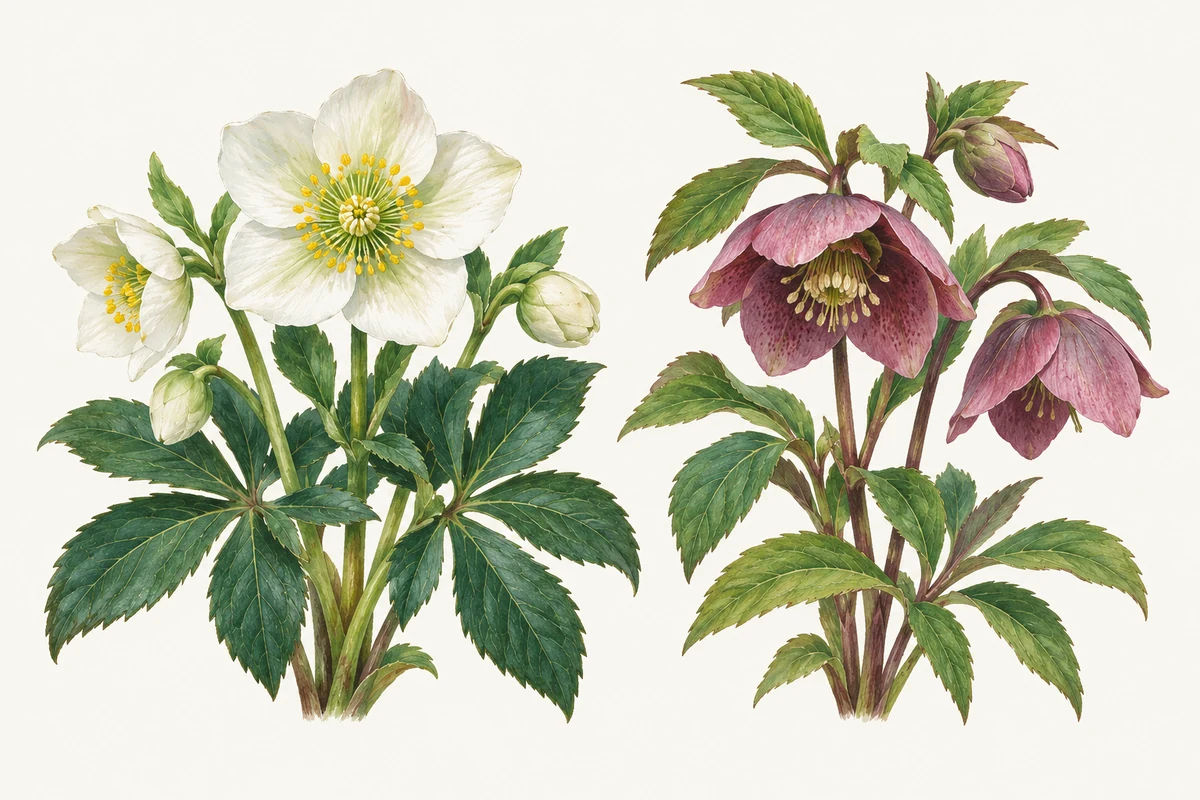
Low clumps of stiff, leathery leaves split like a hand into 7 to 10 toothed leaflets, and nodding, cup-shaped flowers from late winter into spring. Every source here lists it as poisonous.
In short
Hellebore (Helleborus) is an evergreen perennial in the buttercup family, 9 inches to 2 feet tall, with stiff, leathery leaves palmately divided into 7 to 10 toothed leaflets. Its nodding, cup-shaped flowers, 1 to 4 inches across, open from late winter to early spring: white in Christmas rose (H. niger), white to pink, purple or green in Lenten rose (H. × hybridus). Sources list it as toxic.
- Look for the hand-shaped leaf: one stalk ending in 7 to 10 leathery, toothed leaflets, on a low evergreen clump that flowers in winter.
- Christmas rose (H. niger) has white flowers and grows under a foot tall; Lenten rose (H. × hybridus) grows to 2 feet with white, pink, purple or green flowers; stinking hellebore (H. foetidus) has small green bells.
- ASPCA lists Christmas rose as toxic to dogs, cats and horses, and NC State lists all hellebores as poisonous.
Field marks at a glance
- Scientific name
- Helleborus niger
- Family
- Ranunculaceae (buttercup family)
- Type
- Flowering plant, perennial, evergreen
- Leaves
- Palmately divided, like a hand or umbrella, into 7 to 10 leaflets with irregularly toothed edges, on long stalks. Mostly basal; in Lenten and stinking hellebore leaves also grow on the flowering stems.
- Leaf texture
- Stiff, leathery, smooth and dark green, evergreen through winter. Stinking hellebore leaves are narrower-lobed, can reach 8 inches or more across and smell unpleasant when crushed.
- Flowers
- Nodding, cup- to bowl-shaped, with 5 petal-like sepals around a ring of small tubular nectaries and a crowd of yellow stamens. 1 to 4 inches across depending on the species.
- Flower color and season
- Late winter to early spring. Christmas rose: white to rose, around Christmas in warm regions. Lenten rose: white, pink, purple, red, green or near-black. Stinking hellebore: chartreuse bells with purplish rims, February to April.
- Fruit
- Clusters of green, fleshy capsules with long beaks, surrounded by the sepals, which stay on the plant.
- Size and form
- Clump-forming. NC State gives Christmas rose 9 to 12 inches tall, Lenten rose up to 2 feet tall and 30 inches wide, stinking hellebore 1 to 2 feet tall.
- Where it grows
- The genus is native to Europe and Asia. NC State lists Christmas rose for USDA zones 3 to 8, Lenten rose for 4 to 9 and stinking hellebore for 5 to 9, in shade to part shade.
- Other names
- Christmas rose, Lenten rose, Easter rose and winter rose; stinking hellebore is also bear's foot, dungwort and stinkwort. NC State notes many hybrids are misidentified in the trade.
Hellebores (Helleborus) are the low evergreen perennials that flower in shady beds when almost nothing else does, from Christmas in mild areas to early spring. Three are common in gardens in the US, Canada and the UK: Christmas rose (Helleborus niger), Lenten rose (Helleborus × hybridus) and stinking hellebore (Helleborus foetidus). Despite the names, none is a rose: they belong to the buttercup family. Every source on this page lists them as poisonous. Check the leaves first, then the flowers, then the height.
What to check first: leaves, flowers, height
1. The leaves. Each leaf rises on a long stalk and splits at the top into a fan of leaflets, like a hand or an umbrella. The NC State Extension Plant Toolbox describes Lenten rose leaves as palmately compound, leathery and smooth, divided into 7 to 9 segments with irregularly toothed or serrated leaflets. They are stiff and stay green through winter, which is the quickest way to spot a hellebore in January.
2. The flowers. Hellebore flowers nod, so you often have to tip one up to see inside. What look like five petals are petal-like sepals; inside them sits a ring of small tubular nectaries and a crowd of yellow stamens. Because the sepals stay on after flowering, the "flower" can look good for weeks while the green, beaked seed capsules swell in the center.
3. The height and color. Christmas rose is the shortest, 9 to 12 inches, with solitary bowl-shaped white flowers around 3 inches across, with its leaves at the base. Lenten rose forms clumps up to 2 feet tall and 30 inches wide, with flowers 3 to 4 inches across in white, pink, purple, red, green or nearly black. Stinking hellebore grows 1 to 2 feet tall with many small, chartreuse bells, about an inch wide and rimmed in purple.
Plant Identifier can put a name on an unknown plant from one photo of a flower or the whole clump. The app's answer comes without a confidence score or alternatives, so confirm it against the hand-shaped leaves before you act on it.
Hellebore toxicity: what the sources say
Hellebore toxicity is a common reason people look this plant up, so here is exactly how each source lists it.
- ASPCA. The ASPCA Animal Poison Control Center lists Christmas rose (Helleborus niger, also hellebore, Lenten rose and Easter rose) as toxic to dogs, cats and horses. Toxic principles: cardiac glycosides, saponins and protoanemonin. Clinical signs: drooling, abdominal pain, diarrhea, colic and depression.
- NC State Extension. NC State says the genus name comes from Greek words referring to the plant's toxic properties when eaten, and that the leaves and roots of Christmas rose are poisonous. Its Lenten rose page says living and dried plants of all Helleborus species are extremely poisonous. For stinking hellebore it says the plant can be toxic to humans, dogs, cats and horses if ingested.
On handling, NC State says skin irritation can follow contact with the sap and, for stinking hellebore, advises wearing gloves and protective clothing when handling the plant. That is all the handling advice its sources give; this page adds none of its own.
If someone may have eaten any part of a hellebore, call Poison Control at 1-800-222-1222 (poison.org) right away. If a pet may have, call your veterinarian or the ASPCA Animal Poison Control Center at (888) 426-4435 (a consultation fee may apply). Other garden plants on the ASPCA lists are gathered in poisonous plants for dogs and plants toxic to cats.
Plant Identifier's Toxicology tool gives AI-written notes on toxic parts and symptoms. Treat them as background, never as a reason to wait before calling.
Christmas rose vs Lenten rose vs stinking hellebore
The three garden hellebores share the same leaf plan and flower structure; height, flower color and how the flowers are carried tell them apart.
| Feature | Christmas rose (H. niger) | Lenten rose (H. × hybridus) | Stinking hellebore (H. foetidus) |
|---|---|---|---|
| Height | 9–12 in | Up to 2 ft | 1–2 ft |
| Flowers | Solitary, bowl-shaped, about 3 in | Cup-shaped, 3–4 in, often several per stem | Small bells, about 1 in, many per stem |
| Colors | White to rose | White, pink, purple, red, green, near-black | Chartreuse with purplish rim |
| Leaves on flower stem | Leaves at the base | Yes | Yes |
| Leaflets | 7–9, toothed | 7–9, toothed | 7–10, narrow, toothed |
| Smell when crushed | Not noted | Not noted | Unpleasant |
| USDA zones (NC State) | 3–8 | 4–9 | 5–9 |
Sources: NC State Extension pages for Christmas rose, Lenten rose and stinking hellebore.
NC State notes that many hybrid selections are hard to distinguish and are often misidentified in the trade, and that the name Lenten rose, historically tied to H. orientalis, is used loosely for many of them. Other winter and early-spring flowers in shady beds include cyclamen, and foxglove is another poisonous perennial with toothed leaves. For the general method of narrowing down an unknown plant, see how to identify plants.
Where you'll see hellebores
The genus is native to Europe and Asia; NC State gives the alpine and open woodlands of central and southern Europe for Christmas rose, and Western Europe to southern Italy and northern Morocco for stinking hellebore. All three take shade to part shade and are intolerant of bright winter sun and high temperatures. Christmas rose is also sold as a potted florist plant over the winter holidays. NC State notes that hellebores self-seed, and the NC Invasive Plant Council regards all hellebores as potentially invasive, although the threat is low.
A short care note
NC State recommends shade to part shade in rich, well-drained soil with plenty of compost; Lenten rose prefers neutral to alkaline soil, does best with steady moisture and dislikes soggy ground. In colder areas, shelter plants from winter winds. Fungal diseases are the main problem, and NC State says plants with hellebore black death (stunted, deformed growth with black streaks on the leaves) should be removed and destroyed. Removing spent flowering stems of stinking hellebore promotes new growth. For any handling, the gloves advice above applies.
Look-alikes and how to tell them apart
Christmas rose (Helleborus niger) vs Lenten rose (Helleborus × hybridus)
Christmas rose is shorter (9 to 12 inches) with solitary white to rose flowers and leaves only at the base, and blooms around Christmas in mild areas. Lenten rose is a hybrid of H. niger and H. orientalis, up to 2 feet tall, with leaves on the flowering stems and flowers in many colors.
Stinking hellebore (Helleborus foetidus)
Its flowers are much smaller, about 1 inch, bell-shaped and chartreuse with purplish rims, carried many to a stem in large terminal clusters. Its leaflets are narrow, and the leaves and flowers smell unpleasant when crushed.
What a photo can't settle
- NC State notes that hellebore hybrids and species are often hard to tell apart and are misidentified in the trade, so a label or a photo match may name only the genus.
- Out of flower, a young hellebore can be confused with other low plants with hand-shaped leaves. Check for the stiff, leathery, evergreen texture and old beaked seed capsules.
- A photo app, ours included, can name the plant but can't say how much of it a child or pet has eaten or how serious it is. That is a call for Poison Control or a vet, not an app.
Questions people ask
What does a hellebore look like?
A low evergreen clump, 9 inches to 2 feet tall, of stiff, dark green leaves each split like a hand into 7 to 10 toothed leaflets. From late winter into spring it carries nodding, cup-shaped flowers with five petal-like sepals and a center of yellow stamens, in white, pink, purple or green.
What is the difference between a Christmas rose and a Lenten rose?
Christmas rose (Helleborus niger) is a single species, under a foot tall, with white flowers that can open around Christmas in mild areas. Lenten rose (H. × hybridus) is a hybrid of H. niger and H. orientalis, up to 2 feet tall, with flowers in white, pink, purple, red or green. Neither is a true rose.
Is hellebore poisonous to dogs and cats?
The ASPCA lists Christmas rose as toxic to dogs, cats and horses, naming cardiac glycosides, saponins and protoanemonin, with signs including drooling, abdominal pain, diarrhea, colic and depression. If a pet may have chewed any part, call your vet or the ASPCA Animal Poison Control Center at (888) 426-4435 at once. For a person, call Poison Control at 1-800-222-1222.
Is it dangerous to touch hellebore?
NC State tags hellebores for contact dermatitis and says skin irritation can follow contact with the sap. For stinking hellebore it advises wearing gloves and protective clothing when handling the plant. The serious danger its sources describe is from swallowing any part.
Sources
- Helleborus niger — NC State Extension, North Carolina Extension Gardener Plant Toolbox
- Helleborus × hybridus — NC State Extension, North Carolina Extension Gardener Plant Toolbox
- Helleborus foetidus — NC State Extension, North Carolina Extension Gardener Plant Toolbox
- Toxic and Non-toxic Plants: Christmas Rose — ASPCA Animal Poison Control Center
- Poison Control — National Capital Poison Center
Keep reading
- Houseplant profileCyclamen plant: how to identify florist's and hardy cyclamen
- Flower profileFoxglove plant (Digitalis purpurea): how to identify it
- Flower profileGerbera daisy (Gerbera jamesonii): how to identify it
- Free toolFlower identifier by description
- Field guideHow to identify a plant, step by step