Flower profile
Gerbera daisy (Gerbera jamesonii): how to identify it
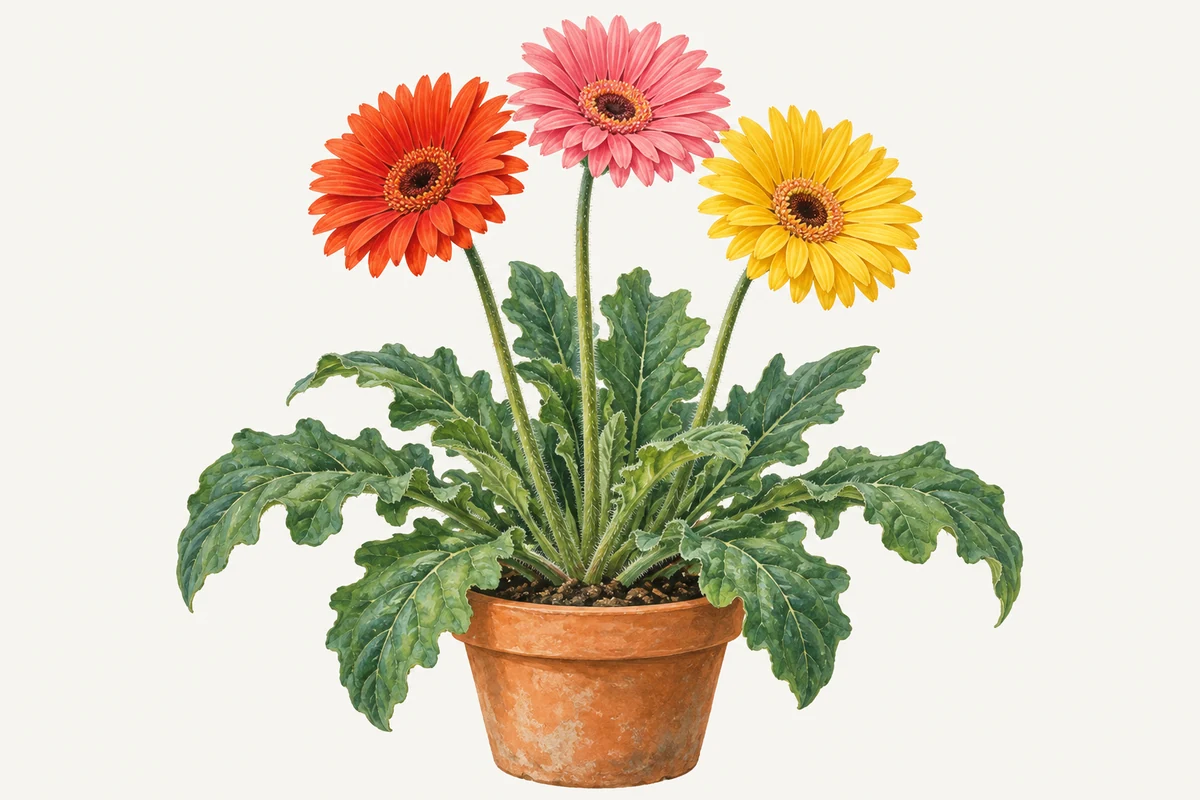
One big daisy-like flower head per leafless stem, held above a low rosette of long, lobed, slightly fuzzy leaves, in red, orange, yellow, pink or white. Here is what to check.
In short
What flower is gerbera? Gerbera is a daisy-like perennial in the aster family, Asteraceae, native to South Africa; most sold today are hybrids of Gerbera jamesonii. Each stem carries one flower head 3 to 4 inches across, ray florets around a darker center, held above a rosette of lobed leaves up to 20 inches long.
- One large flower head per leafless stem, above a basal rosette of long, lobed leaves, points to gerbera.
- A daisy with a black eye at the base of each ray and leaves whitish and hairy underneath suggests gazania.
- The ASPCA classifies Gerber daisy as non-toxic to dogs, cats and horses; that is its classification, not a guarantee.
Field marks at a glance
- Scientific name
- Gerbera jamesonii hybrids
- Family
- Asteraceae (aster family)
- Type
- Flowering plant, perennial, evergreen
- Flower head
- One per stem: ray florets around a darker center of disc florets, single to semi-double, up to 4 inches across (NC State); UF/IFAS gives 3 to 4 inches.
- Flower stem
- Long and leafless, holding the flower about 6 inches above the foliage (UF/IFAS).
- Colors
- Usually red in the wild species, rarely yellow, orange, white or pink (NC State); hybrids come in yellow, white, pink, lavender, red and orange (UF/IFAS).
- Leaves
- Spatulate, lobed or pinnatifid, up to 20 inches long, in a basal rosette (NC State); UF/IFAS calls them long and slightly fuzzy.
- Habit
- A dense, clumping, erect plant about 12 inches tall; NC State gives 1 to 1.5 ft tall and 1 to 1.25 ft wide.
- Bloom time
- Mostly spring and fall, though flowers can appear at any time (NC State).
- Native range
- Southeast Africa; NC State notes the species was found near Barberton, South Africa.
- Other names
- Barberton daisy, Transvaal daisy, African daisy, Gerber daisy, veldt daisy (NC State). Hardy as a perennial in USDA zones 8 to 11.
The gerbera daisy (Gerbera jamesonii and its hybrids) is a South African perennial grown in pots, borders and as a cut flower for its large, bright flower heads. Several other daisy-like flowers share its colors, so check the stem, the leaves and the flower in the order below.
How to identify a gerbera daisy in four checks
1. One flower per stem. Follow a stem down. A gerbera carries a single flower head on a long, leafless stem, about 6 inches above the leaves according to UF/IFAS Gardening Solutions. Branched stems with several flowers point elsewhere.
2. The flower head. Look at the center. Colored ray florets surround a darker center of disc florets. The NC State Plant Toolbox gives heads up to 4 inches across, single to semi-double; hybrids also come in multi-layered and green-petaled forms.
3. The leaves. Part the foliage at the base. The leaves form a low rosette and are spatulate, lobed or deeply cut, up to 20 inches long. UF/IFAS describes them as long and slightly fuzzy.
4. The plant shape. A gerbera grows as a dense clump about a foot tall, with the crown at soil level and the flower stems rising well above the leaves.
When a plant arrives without a tag, Plant Identifier can give a common and scientific name from one photo; include the flower and, if you can, the leaves at the base. The app shows no confidence score and no list of alternatives, so compare its answer with the checks above.
Gerbera cultivars and colors
NC State describes Gerbera jamesonii, the Barberton daisy, as the parent of many of the hybrid gerberas now sold. It names the genus after the German botanist Traugott Gerber and the species after Robert Jameson, who found it near Barberton, South Africa. Cultivars it lists include:
- 'Green Kermit': multi-layered shades of green petals, a good cut flower.
- 'Orange Palmaria': orange petals with black centers.
- 'Pink Kimsey': pink petals, green center, semi-double.
- 'Pink and White Linosa': large bicolored ray florets, 12 to 18 inches tall.
- 'Yellow Lampione': intense yellow blooms.
The GBIF Backbone Taxonomy accepts Gerbera jamesonii Adlam in the family Asteraceae.
Gerbera vs gazania and osteospermum
All three are South African daisies in the aster family, which is why the names get swapped. The stem and leaves usually settle it.
| Feature | Gerbera | Gazania |
|---|---|---|
| Flower head | Up to 4 in, darker center | 3 to 4 in, black eye at ray base, orange-brown center |
| Flower stem | Long, leafless | Up to 10 in |
| Leaves | Lobed, up to 20 in, basal rosette | 1.5 to 4.5 in, whitish and hairy beneath |
| Usual colors | Red, orange, yellow, pink, white | Orange to yellow |
Source: NC State on Gazania rigens. For osteospermum, GBIF now treats Osteospermum ecklonis as a synonym of Dimorphotheca ecklonis (GBIF); we did not find an extension profile for it, so rely on the gerbera checks above. For other flowers, try the flower identifier or how to identify wildflowers.
Is a gerbera daisy toxic to pets
The ASPCA lists Gerber daisy (Gerbera jamesonii, also Transvaal daisy, African daisy, veldt daisy, gerbera daisy and Barberton daisy) as non-toxic to dogs, cats and horses. That is the ASPCA's classification, not a guarantee.
If a pet has chewed a leaf or flower and seems unwell, call your vet or the ASPCA Animal Poison Control Center at (888) 426-4435. For a person, call Poison Control at 1-800-222-1222 (poison.org). Plant Identifier's Toxicology tool gives AI-written notes for people, dogs and cats; treat them as a starting point, not as the answer. Houseplants the ASPCA lists as toxic are in plants toxic to cats and poisonous plants for dogs.
A short care note
NC State recommends moist, well-drained soil rich in organic matter, full sun with some protection from hot afternoon sun, and the crown level with the soil. UF/IFAS adds that the crown should dry out between waterings, since excess moisture leads to root and crown rot, and that gerberas can be short of iron and manganese. Deadhead spent flowers to keep blooms coming.
Look-alikes and how to tell them apart
Gazania, treasure flower (Gazania rigens)
Look at the base of the petals and under a leaf. NC State describes gazania blooms 3 to 4 inches across, orange to yellow with a black eye at the base and an orange-brown center, and leaves only 1.5 to 4.5 inches long, whitish and hairy underneath. Gerbera leaves reach 20 inches.
Osteospermum, Cape daisy (Osteospermum or Dimorphotheca)
Check the stem and leaves against the gerbera traits. A gerbera has a single head on a long, leafless stem rising from a basal rosette of lobed leaves up to 20 inches long (NC State). GBIF now places Osteospermum ecklonis in Dimorphotheca; use a regional flora for the rest.
Other plants called Transvaal or African daisy
Check the scientific name on the label. NC State lists Transvaal daisy, Barberton daisy and African daisy for Gerbera jamesonii, and the ASPCA lists the same names on its Gerber daisy page, but African daisy is used loosely in garden centers.
What a photo can't settle
- Gerberas sold in shops are hybrids with many named cultivars; a photo can name the plant as a gerbera but often not the cultivar.
- Cut flowers have no leaves or rosette to check, which removes the strongest clues; several daisy-like flowers look similar from the front.
- Whether a pet that chewed a plant needs treatment is for your vet or a poison control center to decide, not for this page or an app.
Questions people ask
Is gerbera a daisy?
It belongs to the daisy family, Asteraceae, and UF/IFAS notes it is related to sunflowers and marigolds. Like other daisies, each flower is really a head of many small florets: colored ray florets around a darker center of disc florets.
What is the difference between a Transvaal daisy and a gerbera?
None for Gerbera jamesonii. NC State lists Transvaal daisy, Barberton daisy, Gerber daisy and African daisy as common names of the same species, which is the parent of many of the hybrid gerberas sold today.
Do gerberas come back every year?
NC State says gerbera can be grown as a perennial in USDA zones 8 to 11 and as an annual in colder regions. UF/IFAS adds that where prolonged freezes are likely, it should be treated as an annual or overwintered indoors.
Are gerbera daisies poisonous to cats and dogs?
The ASPCA classifies Gerber daisy as non-toxic to dogs, cats and horses. That is its classification, not a guarantee. If your pet chewed it and seems unwell, call your vet or the ASPCA Animal Poison Control Center at (888) 426-4435. For a person, call Poison Control at 1-800-222-1222.
Sources
- Gerbera jamesonii — North Carolina Extension Gardener Plant Toolbox (NC State)
- Gerbera Daisy — UF/IFAS Gardening Solutions
- Gazania rigens — North Carolina Extension Gardener Plant Toolbox (NC State)
- Gerber Daisy — ASPCA Animal Poison Control Center
- Gerbera jamesonii Adlam — GBIF Backbone Taxonomy
- Osteospermum ecklonis (DC.) Norl. — GBIF Backbone Taxonomy
- Poison Control — National Capital Poison Center
Keep reading
- Free toolFlower identifier by description
- Field guideHow to identify wildflowers in the field
- Pet safety guidePlants toxic to cats, and what to do if your cat chewed one
- Pet safety guidePoisonous plants for dogs, and what to do if your dog ate one
- Flower profileBluebell (Hyacinthoides non-scripta): what it is and how to identify it