Also in Deutsch
Flower color
Weeds with yellow flowers in lawns, beds and roadsides
The yellow-flowered weeds you are most likely to meet, sorted by where they grow and how tall they get, the test that separates each look-alike, and the few that need gloves or a call to poison control.
In short
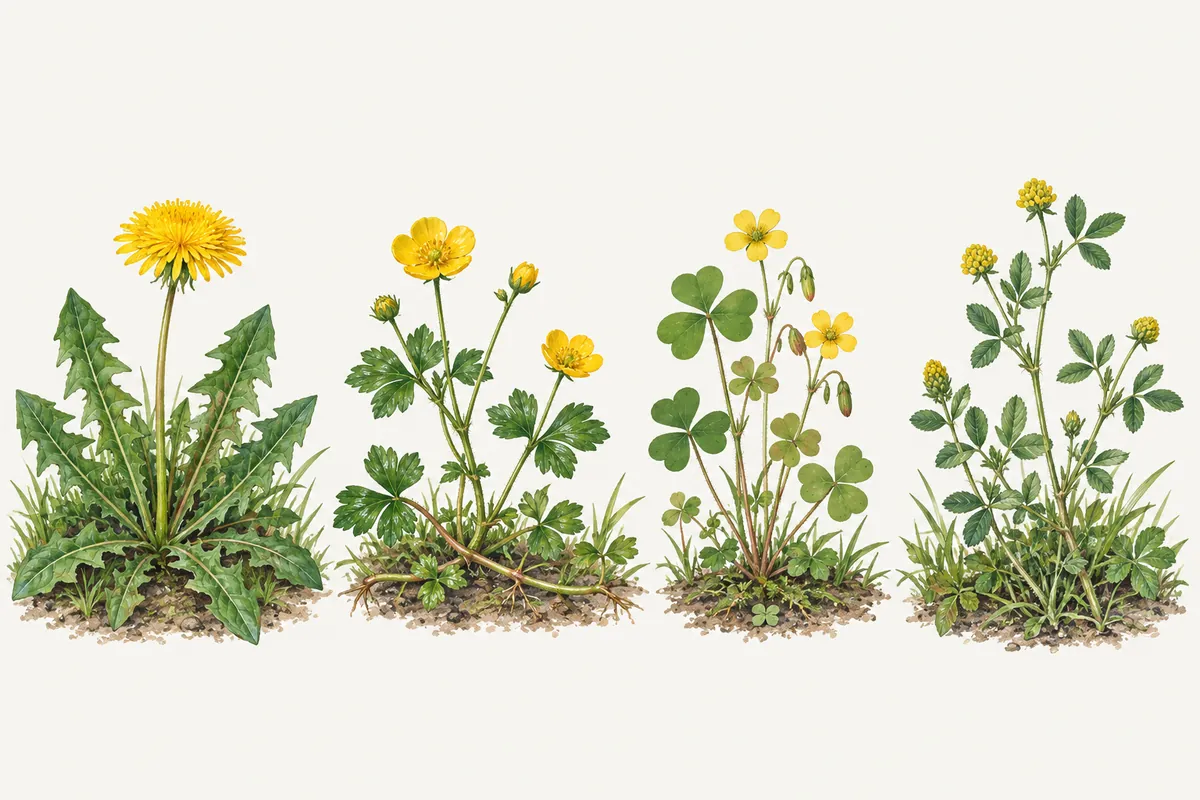
Weeds with yellow flowers in a US lawn are most often dandelion, cat's ear, creeping buttercup, yellow wood sorrel, black medic or hop clover. In garden beds, look for groundsel, sow thistle and purslane; on roadsides, wild parsnip, ragwort, tansy and mullein. Sort by height and leaf first: a flat rosette, three leaflets, a fleshy mat or a tall stalk. Wild parsnip sap can burn skin in sunlight.
- Height sorts yellow weeds fastest: lawn weeds stay under the mower, bed weeds reach knee height, and roadside weeds such as wild parsnip and mullein stand 3 to 10 feet.
- Three-leaflet yellow weeds split on one detail: folded heart-shaped leaflets mean wood sorrel, a tiny point on each leaflet tip means black medic.
- Wild parsnip, St. John's wort and tansy can harm skin; ragwort and groundsel are listed as poisonous to horses and livestock.
Yellow is the commonest flower color among weeds, from the dandelion in the lawn to the 6-foot mullein on the highway verge, so it narrows things less than you'd hope. What does narrow it is where the plant grows and how tall it stands. The table below sorts 18 common yellow-flowered weeds of US lawns, garden beds and roadsides into those three places, with the season and the one field mark for each. Then come the look-alike tests and the weeds that are dangerous to touch or to grazing animals.
The 18 most likely weeds with yellow flowers
Colors and seasons follow the NC State Extension Gardener Plant Toolbox unless another source is named; seasons shift by a few weeks with latitude.
| Where | Weed | Flowers | Field mark |
|---|---|---|---|
| Lawn | Dandelion (Taraxacum officinale) | Mostly spring, some all year | Rosette of smooth leaves with backward-pointing teeth; one flower per hollow, leafless stalk with milky sap |
| Lawn | Cat's ear (Hypochaeris radicata) | Midsummer to early fall | Densely hairy rosette up to 1 ft across; wiry, often branched stalks |
| Lawn, damp beds | Creeping buttercup (Ranunculus repens) | Late spring into fall (RHS) | Three deeply lobed, toothed leaflets, often pale-marked; runners that root |
| Lawn, meadow | Meadow buttercup (Ranunculus acris) | Spring | Upright habit; leaves cut into narrow, pointed lobes; glossy five-petaled flowers |
| Lawn, beds | Yellow wood sorrel (Oxalis stricta) | Spring to fall | Three heart-shaped, folded leaflets; single five-petaled flowers |
| Lawn | Black medic (Medicago lupulina) | Summer | Three leaflets, the middle one stalked; ¼ inch ball of 15 to 50 tiny pea flowers |
| Lawn, meadow | Small hop clover (Trifolium dubium) | May to October | Small heads of 3 to 15 flowers that turn yellowish-brown with age |
| Lawn, shade | Indian mock strawberry (Potentilla indica) | Spring to summer | Three toothed leaflets; ¾ inch five-petaled flower on its own stalk; red strawberry-like fruit |
| Damp lawn, wood edge | Lesser celandine (Ficaria verna) | March to May | Glossy, fleshy heart-shaped leaves; star flowers of about 8 petals; leaves die back by early summer |
| Garden bed | Common groundsel (Senecio vulgaris) | Spring to fall | Small heads with no petals, often nodding; hollow purple stems; lobed leaves |
| Garden bed | Spiny sow thistle (Sonchus asper) | Spring to summer | Glossy leaves with soft spiny teeth and rounded lobes that clasp the stem; ⅔ inch heads |
| Garden bed, cracks | Purslane (Portulaca oleracea) | Spring to fall | Fleshy mat of round, reddish stems; ¼ inch flowers open only in the morning |
| Field edge, bed | Yellow rocket (Barbarea vulgaris) | Spring to summer | Four-petaled cross flowers in clusters; basal leaves with 1 to 4 pairs of side lobes and a large end lobe |
| Roadside, field | Wild parsnip (Pastinaca sativa) | Late spring to summer | Flat yellowish-green umbels 3 to 8 in; grooved hollow stem; sap burns skin in sunlight |
| Roadside, pasture | Common ragwort (Jacobaea vulgaris) | July to October (RHS) | Flat clusters of yellow daisies on stems branched in the upper half; ragged lobed leaves |
| Roadside, waste ground | Common tansy (Tanacetum vulgare) | July to September | Flat clusters of 20 to 200 yellow buttons with no petals; fern-like leaves smelling of camphor |
| Roadside, waste ground | Common mullein (Verbascum thapsus) | June to September | Woolly gray-green rosette in year one; a stalk that can pass 10 ft in year two |
| Roadside, pasture | St. John's wort (Hypericum perforatum) | Spring to summer | Five petals with black dots on the edge; leaves with see-through dots against the light |
Several of these also appear in the lawn weed identification chart, which sorts lawn weeds by leaf and habit regardless of flower color and covers cultural control. This page adds the beds and roadsides, where the tall and harmful yellow weeds grow.
Look-alike tests, pair by pair
Dandelion or cat's ear. Pick a stalk. NC State describes dandelion stalks as hollow, leafless and unbranched with milky sap, and leaves deeply toothed with teeth pointing backward. Cat's ear has densely hairy leaves up to 6 inches in a rosette about a foot across, and wiry stalks that often branch. Hairy leaf plus branched stalk means cat's ear.
Sow thistle or dandelion. Spiny sow thistle grows a leafy, upright stem with clusters of 1 to 5 flower heads, and its glossy leaves have soft spiny teeth and rounded lobes that wrap around the stem. A dandelion never has leaves on its flower stalk.
Creeping or meadow buttercup. Both have glossy five-petaled flowers. The RHS describes creeping buttercup leaves divided into three deeply lobed leaflets with serrated edges, often pale-marked, covered in small pale hairs, on a plant that sends out rooting runners and reaches about 50 cm. NC State describes meadow buttercup as an upright plant whose leaves are cut into narrow, pointed lobes.
Wood sorrel, black medic or hop clover. All three carry three leaflets. NC State gives yellow wood sorrel heart-shaped leaflets and single bright yellow flowers. Black medic's middle leaflet sits on a short stalk, and its flowers sit in tiny ball-shaped heads of 15 to 50. Small hop clover carries 3 to 15 flowers per head from May to October, and the heads turn yellowish-brown with age.
Indian mock strawberry. Indian mock strawberry has three toothed leaflets and a single five-petaled yellow flower on each stalk, with green three-toothed bracts spreading beneath it, and later a red fruit that looks like a small strawberry.
Ragwort, groundsel and tansy. All three are in the daisy family and carry flat-topped yellow clusters. The RHS ragwort guide gives stems up to 1.5 m, branched in the upper half, with large flat-topped clusters of yellow daisy-like flowers from July to October. Common groundsel is a small bed weed with petal-less heads and hollow purple stems. Tansy has button heads without petals and fern-like leaves that smell of camphor when crushed.
Wild parsnip and other yellow umbels. Wild parsnip is the yellow umbel to know. The Government of Ontario describes yellowish-green flower clusters on a tall stalk in the plant's second year, after a low rosette in the first, along roadsides, meadows, open fields and railway embankments. NC State adds a hollow, grooved, hairless stem and compound leaves of about 9 leaflets. Any yellow umbel on a roadside deserves a look-but-don't-touch rule until it is named; our wild parsnip page has the full look-alike list.
Yellow weeds that harm skin, pets or livestock
These listings come from the sources named; a weed missing here has not been shown to be harmless.
- Wild parsnip. The Government of Ontario says its sap contains chemicals that make skin react to sunlight, causing intense burns, rashes or blisters. NC State rates it medium severity and advises protective equipment when handling it.
- St. John's wort. NC State says skin contact with the sap, or eating the plant, can cause photosensitivity in some people, and lists it as a problem for cats, dogs and horses.
- Common tansy. Rated high severity by NC State, which also notes it can cause contact dermatitis.
- Ragwort and groundsel. The RHS says ragwort is poisonous to horses and livestock, that eating it green or dried can cause serious liver damage and can be fatal, and that all parts stay toxic when wilted or dried. NC State rates common groundsel medium severity and lists it as a problem for cats, dogs and horses.
- Buttercups, wood sorrel and lesser celandine. NC State lists meadow buttercup as medium severity, and yellow wood sorrel and lesser celandine as low severity and a problem for cats, dogs and horses. The ASPCA lists the shamrock plant (Oxalis species) as toxic to dogs, cats and horses.
- Dandelion. NC State notes its sap can irritate skin.
Wear gloves and long sleeves when you pull any of these, and wash skin that touches wild parsnip sap straight away, out of the sun. If a pet has eaten one, call your vet or the ASPCA Animal Poison Control Center at (888) 426-4435. For a person, call Poison Control at 1-800-222-1222 in the US, or NHS 111 in the UK. This site gives no edibility advice for any weed on this page.
Removing yellow weeds without guessing
Identification comes first because the method depends on the plant. Dandelion and cat's ear come back from a deep root, so they need the whole root lifted, ideally after rain. Creeping buttercup spreads by rooting runners and dense clumps of roots (RHS), so lift the runners with the parent plant. Ragwort can regrow from root fragments, and the RHS advises removing mature plants before they set seed and not putting the flowers or seedheads in a home compost bin, since cut flowering plants can still set seed. Purslane and groundsel are annuals that set seed fast; pull them before they flower.
If you decide to use a herbicide, follow the label and local rules, and check that the label names the weed you have identified. For grazing land, check local guidance on ragwort control.
How a photo settles it
Yellow daisy-like weeds are where a photo needs help, because the flowers look alike and the deciding traits sit lower down. Take one photo of the open flower and a second of the whole plant with its leaves and stem, so the hairs, the branching and the leaf shape show.
Plant Identifier names the plant from one photo and gives the common and scientific names, which you can check against the field mark in the table. The app shows one answer with no confidence score and no list of alternatives, so run the matching test yourself: hollow stalk, hairy leaf, leaflet tip. If it names wild parsnip, treat that as a reason to keep your hands off. For a dog that grazes the lawn, Plant Identifier's Toxicology tool writes notes for people, dogs and cats; read them alongside the ASPCA entry rather than instead of it.
What a photo can't settle
- Many yellow daisy-like weeds (hawkweeds, hawkbits, sow thistles, cat's ear) are hard to separate from a photo of the flower alone; leaf hairs and stalk branching settle them, so photograph the whole plant.
- Mown lawns hide flowers for weeks, and a weed without flowers loses the color that brought you here.
- No identification tells you which control method is legal or right for your site. If you use a herbicide, follow the label and local rules, or ask your extension office.
Questions people ask
What is the weed with yellow flowers that looks like a dandelion?
Usually cat's ear. Its leaves are densely hairy and its flower stalks are wiry and often branched, while a dandelion's leaves are smooth with backward-pointing teeth and each hollow, leafless stalk carries one flower. Sow thistle is another: several flower heads per leafy stem, with spiny, clasping leaves.
What is the small yellow-flowered weed that looks like clover?
Yellow wood sorrel, black medic or hop clover. Wood sorrel has folded, heart-shaped leaflets and single five-petaled flowers. Black medic has tiny ball-shaped heads and a short point on each leaflet tip. Hop clover has small heads of 3 to 15 flowers that turn yellowish-brown as they age.
What tall yellow weed burns your skin?
Wild parsnip. It flowers in flat yellowish-green umbrellas on a grooved, hollow stem up to about 5 feet, and the Government of Ontario says its sap can make skin react to sunlight, causing burns, rashes or blisters. Don't touch it with bare skin, and wash at once if you do.
Are weeds with yellow flowers edible?
This site gives no edibility advice. Several yellow-flowered weeds on this page, including wild parsnip, ragwort, tansy and groundsel, are listed as poisonous by the sources we cite.
Sources
- Taraxacum officinale (dandelion) — NC State Extension Gardener Plant Toolbox
- Hypochaeris radicata (cat's ear) — NC State Extension Gardener Plant Toolbox
- Trifolium dubium (small hop clover) — NC State Extension Gardener Plant Toolbox
- Senecio vulgaris (common groundsel) — NC State Extension Gardener Plant Toolbox
- Hypericum perforatum (St. John's wort) — NC State Extension Gardener Plant Toolbox
- Creeping buttercup — Royal Horticultural Society (RHS)
- Ragwort — Royal Horticultural Society (RHS)
- Wild parsnip — Government of Ontario
Keep reading
- Lawn and gardenHow to identify weeds in your lawn
- Weed profileWild parsnip (Pastinaca sativa): how to identify it
- Weed profileCommon ragwort (Jacobaea vulgaris): how to identify it
- Houseplant profileOxalis (purple shamrock and woodsorrel): how to identify it
- Flower colorPlant with purple flowers? 25 common ones and how to tell them apart