Flower color
Plant with purple flowers? 25 common ones and how to tell them apart
A table of the purple-flowered plants you are most likely to meet in a garden, on a roadside or on a windowsill, then the second clue that separates each look-alike group.
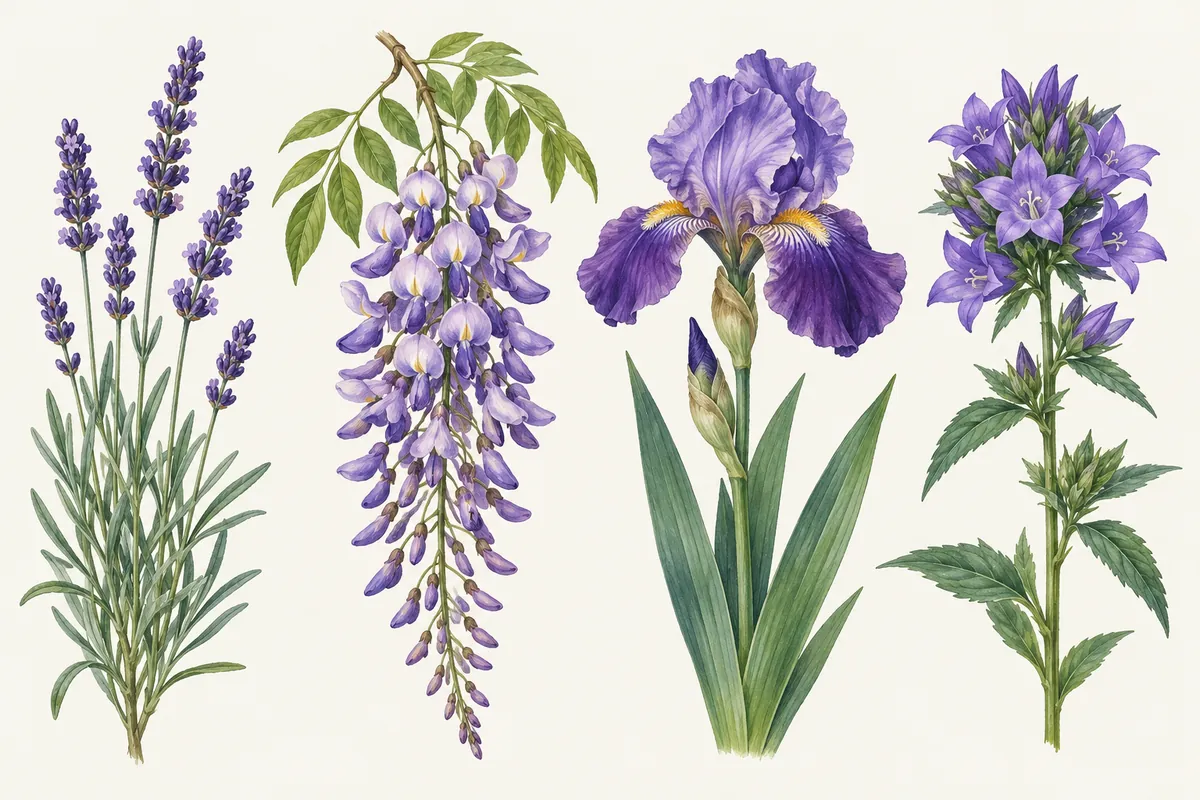
In short
A plant with purple flowers in a US or UK garden is most often lavender, catmint, salvia, butterfly bush, lilac, wisteria or clematis; on a roadside, purple loosestrife, thistle, knapweed, ironweed or New England aster; indoors, African violet. Color alone won't settle it. Check the stem and the season next: a square stem means the mint family, and lilac and wisteria flower in spring, butterfly bush and loosestrife in summer.
- Purple is a weak clue on its own: lavender, catmint and salvia share the color, the square stem and the two-lipped flowers, and split only on leaf shape and smell.
- Season is the fastest second clue: lilac and wisteria flower in spring, butterfly bush, coneflower and purple loosestrife in summer, ironweed and New England aster into fall.
- Wisteria, clematis, lavender, iris, foxglove and oxalis are all listed as toxic to dogs, cats and horses by the ASPCA.
Purple is one of the easiest flower colors to spot and one of the hardest to name from, because it turns up in a dozen unrelated families. The table below lists the 25 purple-flowered plants you are most likely to meet in the US and the UK, grouped by where you find them, with the season and the one field mark that separates each. After that come the look-alike groups, the toxic ones, and how to get a name from a photo.
The 25 most likely plants with purple flowers
Colors and seasons follow the NC State Extension Gardener Plant Toolbox for each plant, and Plantlife for the British wildflowers. Seasons are for the northern hemisphere and shift a few weeks with latitude.
| Where | Plant | Season | Field mark |
|---|---|---|---|
| Garden | Lavender (Lavandula angustifolia) | Summer | Narrow gray-green leaves under 1 inch, square hairy stems, strong scent when bruised |
| Garden | Catmint (Nepeta × faassenii) | Spring to summer | Low gray-green mound; oval leaves with rounded teeth, aromatic |
| Garden | Woodland sage (Salvia nemorosa) | Summer to fall | Violet-blue spikes with reddish-purple bracts; wrinkled toothed leaves 3 to 4 inches |
| Garden | Butterfly bush (Buddleja davidii) | June to September | Shrub; 4 to 10 inch lilac spikes, each tiny flower with an orange throat |
| Garden | Common lilac (Syringa vulgaris) | Spring | Shrub; heart-shaped opposite leaves, very fragrant cone-shaped clusters |
| Garden | Wisteria (Wisteria species) | Spring | Twining woody vine; pea-shaped flowers in hanging chains, compound leaves |
| Garden | Clematis (e.g. C. × jackmanii) | Summer | Climber; flat flowers 3 to 6 inches across made of 4 to 6 colored sepals |
| Garden | Bearded iris (Iris × germanica) | Early summer | Sword leaves in a fan; six-parted flowers with a fuzzy "beard" on the falls |
| Garden | Purple coneflower (Echinacea purpurea) | June into fall | Drooping lavender rays around a spiny, domed brown center |
| Garden | Tall verbena (Verbena bonariensis) | Summer to fall | Tall, wiry, almost leafless stems topped by flat 2 to 3 inch clusters of tiny purple tubes |
| Garden | Garden phlox (Phlox paniculata) | Midsummer to fall | Fragrant domed clusters of flat five-lobed flowers on 2 to 4 ft stems |
| Garden | Giant allium (Allium giganteum) | Late spring to summer | A ball of star-shaped flowers on a bare stalk; plants up to 6 ft |
| Garden, wood edge | Foxglove (Digitalis purpurea) | Spring to summer | One-sided spike of spotted tubular bells; biennial |
| Roadside, wetland | Purple loosestrife (Lythrum salicaria) | July to September | Pink-purple spikes, 5 to 6 petals, square stems, wet ground |
| Roadside, meadow (US) | Ironweed (Vernonia noveboracensis) | July to September | 5 to 8 ft; fluffy deep purple heads with no petals (disc flowers only) |
| Roadside, meadow (US) | New England aster (Symphyotrichum novae-angliae) | August to October | Up to 100 purple rays around a yellow center; hairy leaves clasp the stem |
| Pasture, roadside | Bull thistle (Cirsium vulgare) | June onward | Pinkish-purple heads 1.5 to 2 inches on spiny bracts; spiny leaves |
| Meadow, verge (UK) | Common knapweed (Centaurea nigra) | June to September | Thistle-like head on a hard black-brown knob of triangular bracts; no spines |
| Damp meadow (UK) | Devil's-bit scabious (Succisa pratensis) | June to October | Round blue to purple pincushion heads; long oval leaves; to 100 cm |
| Lawn, field edge | Purple dead-nettle (Lamium purpureum) | Most of the year | Square stem; crowded heart-shaped upper leaves tinted purple |
| Lawn, field edge | Henbit (Lamium amplexicaule) | Spring | Square stem; upper leaves clasp the stem with no stalk |
| Lawn, shade | Ground ivy, creeping charlie (Glechoma hederacea) | Spring to summer | Creeps and roots at every node; scalloped round leaves; minty smell |
| Hedge, wet thicket | Bittersweet nightshade (Solanum dulcamara) | Summer | Scrambling vine; five swept-back purple petals around a yellow cone, red berries |
| Houseplant | African violet (Streptocarpus ionanthus, formerly Saintpaulia) | Year round | Rosette of thick hairy leaves; small two-lipped flowers with yellow anthers |
| Houseplant, patio | Purple shamrock (Oxalis triangularis) | Summer to fall | The purple is in the leaves: three triangular maroon leaflets that fold at night; flowers white to pale pink |
If your plant isn't here, the flower identifier tool filters by color, shape, petal count, height and habitat, and the wildflower guide explains how to read a flower's build before its color.
Which second clue narrows it fastest
Purple tells you very little on its own. Three questions, in this order, cut the table down to two or three rows.
1. Is the stem square? Roll it between finger and thumb. Four corners plus leaves in opposite pairs puts you in the mint family: lavender, catmint, salvia, purple dead-nettle, henbit and ground ivy. NC State describes square stems for lavender, catmint, woodland sage and both dead-nettles. Purple loosestrife also has a square stem, but separate five- to six-petaled flowers instead of two-lipped ones.
2. What month is it? A purple shrub in May is likely lilac; the same color in August is likely butterfly bush. Wisteria flowers in spring, often before its leaves are fully out. Ironweed and New England aster carry purple into September and October, when most garden plants have finished.
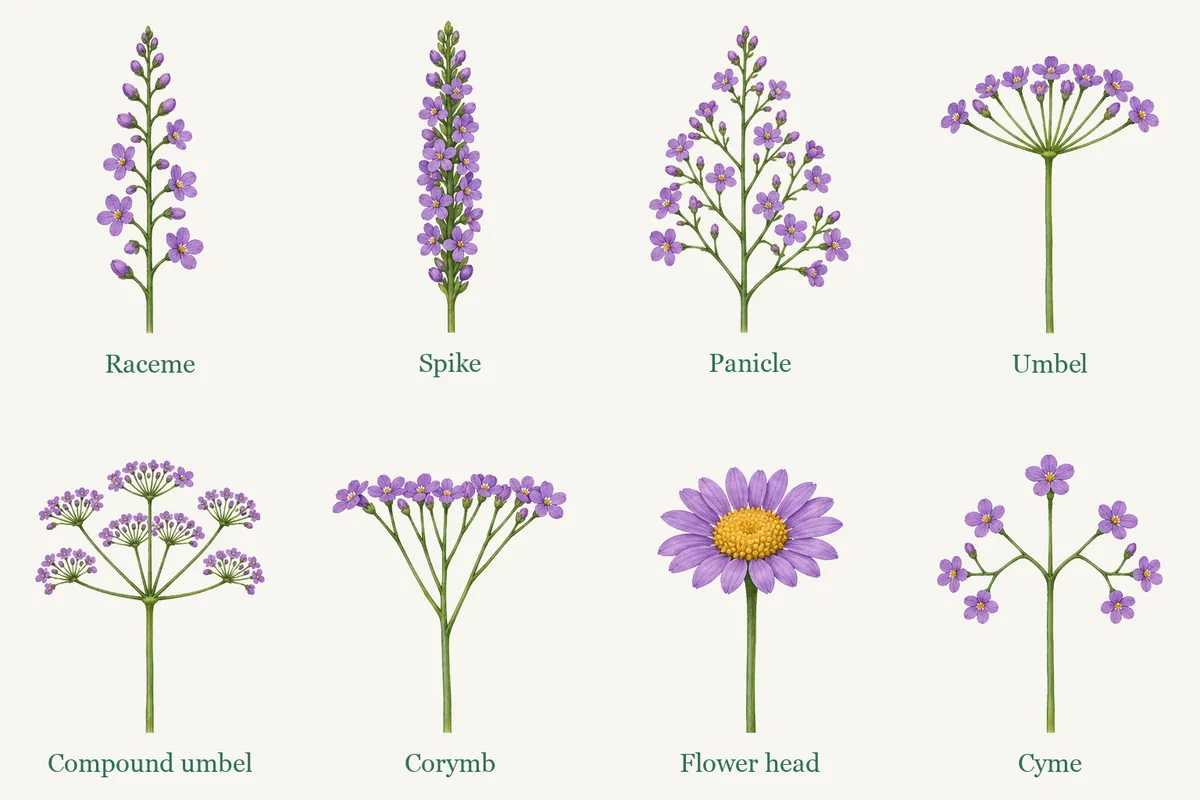
3. Is it a single flower or a head of many? Thistles, knapweed, ironweed, asters and coneflowers carry dozens of tiny flowers packed into one head. Iris, clematis and African violet carry real single flowers. Spikes and chains (lavender, salvia, loosestrife, foxglove, wisteria) are a third build.
The chart puts names on these builds. Thistles, knapweed and asters carry a flower head; lavender, salvia and loosestrife carry a spike. Raceme, panicle, umbel, compound umbel, corymb and cyme cover the other ways flowers branch from a stem, and the arrangement stays the same whatever shade of purple the flowers turn.
Look-alikes: same color, different plant
Lavender, catmint and salvia. All three are aromatic mint-family plants with square stems and violet spikes. The leaves split them: lavender leaves are narrow, under an inch long and white-felted gray-green; catmint leaves are 1 to 2 inch gray-green ovals with rounded teeth; woodland sage leaves are 3 to 4 inches long, green, wrinkled and toothed, and its flower spikes carry reddish-purple bracts (NC State). Crush a leaf: lavender's scent is unmistakable once you know it.
Lilac and butterfly bush. Butterfly bush is sometimes called summer lilac. NC State gives butterfly bush lance-shaped leaves 4 to 10 inches long with white soft hairs underneath and lilac flowers with an orange throat from June to September. Common lilac flowers in spring and has heart-shaped, smooth leaves. NC State also notes butterfly bush can be weedy, so check local guidance before you plant more.
Wisteria and clematis. Both climb fences and pergolas. Wisteria has pea-shaped flowers in hanging chains and compound leaves of 7 to 19 leaflets. Clematis has flat, open flowers made of colored sepals and climbs by twisting its leaf stalks. Our wisteria page covers Chinese, Japanese and American wisteria.
Bull thistle and common knapweed. Both make purple shaving-brush heads in summer pastures. Bull thistle's bracts and leaves are spiny; Plantlife describes knapweed as "somewhat thistle-like" but with a spineless, black-brown knob of triangular bracts under each head, which gave it the name hardheads.
Ironweed and New England aster. Both are tall, purple, late-season natives of eastern North America. NC State says ironweed's heads are fluffy disc flowers only, with no rays, while New England aster has up to 100 purple rays around a yellow center.
Henbit and purple dead-nettle. Both are small spring lawn weeds with square stems and two-lipped flowers. NC State gives purple dead-nettle crowded, overlapping heart-shaped upper leaves on short stalks, tinted purple at the tip; henbit's upper leaves have no stalk and clasp the stem.
Devil's-bit scabious and its relatives. Plantlife says devil's-bit, small scabious and field scabious all carry rounded heads of many tiny flowers, usually blue and sometimes purple; devil's-bit has long oval leaves and prefers damp ground.
Purple shamrock and wood sorrel. On a windowsill, purple shamrock looks purple from across the room, but the color is in its maroon leaflets; its flowers are white to pale pink. Wild yellow wood sorrel has green leaves and yellow flowers.
Purple flowers listed as toxic
These listings come from the sources named; a plant missing from this list is not a sign that it is harmless.
- Wisteria, clematis, lavender, iris, foxglove and oxalis (shamrock plant) are each listed as toxic to dogs, cats and horses by the ASPCA. The ASPCA wisteria entry names lectin and wisterin glycoside, with vomiting and diarrhea as signs; the shamrock plant entry names soluble calcium oxalates.
- Foxglove is rated high-severity in the NC State Plant Toolbox, which lists effects on the heart among its symptoms.
- Bittersweet nightshade is rated high-severity by NC State: its plant page says it is highly toxic and may be fatal if eaten, and every part, including the red berries, is listed as poisonous.
If a pet has chewed one of these, call your vet or the ASPCA Animal Poison Control Center at (888) 426-4435. If a person has swallowed part of a plant, call Poison Control at 1-800-222-1222 in the US, or NHS 111 in the UK. This site gives no edibility advice for any purple flower.
How a photo settles it
Purple is exactly where a photo app earns its place, because the color that confuses you is the one clue a model weighs least. Take the picture in open shade rather than full sun, which bleaches violet toward pink and blue. Fill the frame with one open flower, then take a second photo that shows the stem and a leaf, so the square stem or the compound leaf is visible.
Plant Identifier names the plant from one photo, taken with the camera or picked from your library, and gives the common and scientific names. It shows one answer with no confidence score and no list of alternatives, so check that answer against the field mark in the table above: if it says catmint, the leaves should be gray-green ovals with rounded teeth. For a plant a dog or cat may chew, the Toxicology tool in Plant Identifier writes notes for people, dogs and cats, which you should check against the ASPCA list before you rely on them. If you meet a purple wildflower on a walk and want to come back when it is in seed, Plant Identifier's Plant Map pins the find when you allow location.
What a photo can't settle
- Flower color shifts with the light, the cultivar and the camera: lavender, salvia and catmint photograph anywhere from blue to pink, so a photo can't settle a name on color alone.
- Cultivated varieties of lilac, clematis, phlox and iris are bred in dozens of shades, and a photo app names the species, not the named variety on the nursery label.
- A photo can't tell you whether a pet or child has eaten enough of a plant to be harmed; call your vet, the ASPCA Animal Poison Control Center or Poison Control.
Questions people ask
What is the tall purple flower growing in ditches in summer?
In much of the US and Canada it is often purple loosestrife: pink-purple spikes on stems 2 to 6 feet tall, square stems and stalkless opposite leaves, in wet ground from July to September. Ironweed, blazing stars and fireweed can look similar, so check the stem and leaves before you report it.
What bush has purple flowers in summer?
Most often butterfly bush (Buddleja davidii): lilac flower spikes 4 to 10 inches long with an orange throat in each small flower, from June to September. Lilac looks similar from a distance but flowers in spring and has heart-shaped leaves.
What is the small purple weed in my lawn in spring?
Usually henbit, purple dead-nettle or ground ivy. All three have square stems and two-lipped flowers. Purple dead-nettle has stalked, purple-tinged upper leaves; henbit's upper leaves clasp the stem without a stalk; ground ivy creeps and roots at every node.
Are purple flowers edible?
This site gives no edibility advice. Several purple-flowered plants on this page, including foxglove and bittersweet nightshade, are listed as poisonous by the sources we cite.
Sources
- Lavandula angustifolia (English lavender) — NC State Extension Gardener Plant Toolbox
- Buddleja davidii (butterfly bush) — NC State Extension Gardener Plant Toolbox
- Lamium purpureum (purple dead-nettle) — NC State Extension Gardener Plant Toolbox
- Solanum dulcamara (bittersweet nightshade) — NC State Extension Gardener Plant Toolbox
- Common Knapweed — Plantlife
- Devil's-bit Scabious — Plantlife
- Wisteria — ASPCA Animal Poison Control Center
- Shamrock Plant — ASPCA Animal Poison Control Center
Keep reading
- Weed profilePurple loosestrife (Lythrum salicaria): how to identify it
- Vine profileWhat flower is wisteria? How to identify a wisteria vine
- Field guideHow to identify wildflowers in the field
- Free toolFlower identifier by description
- Leaf shapePlant with heart-shaped leaves? Houseplants first, then garden and weeds