Leaf shape
Plant with heart-shaped leaves? Houseplants first, then garden and weeds
The heart-leaved houseplants you are most likely to own, the vines and weeds with the same leaf outdoors, and the second clue that tells each pair apart.
In short
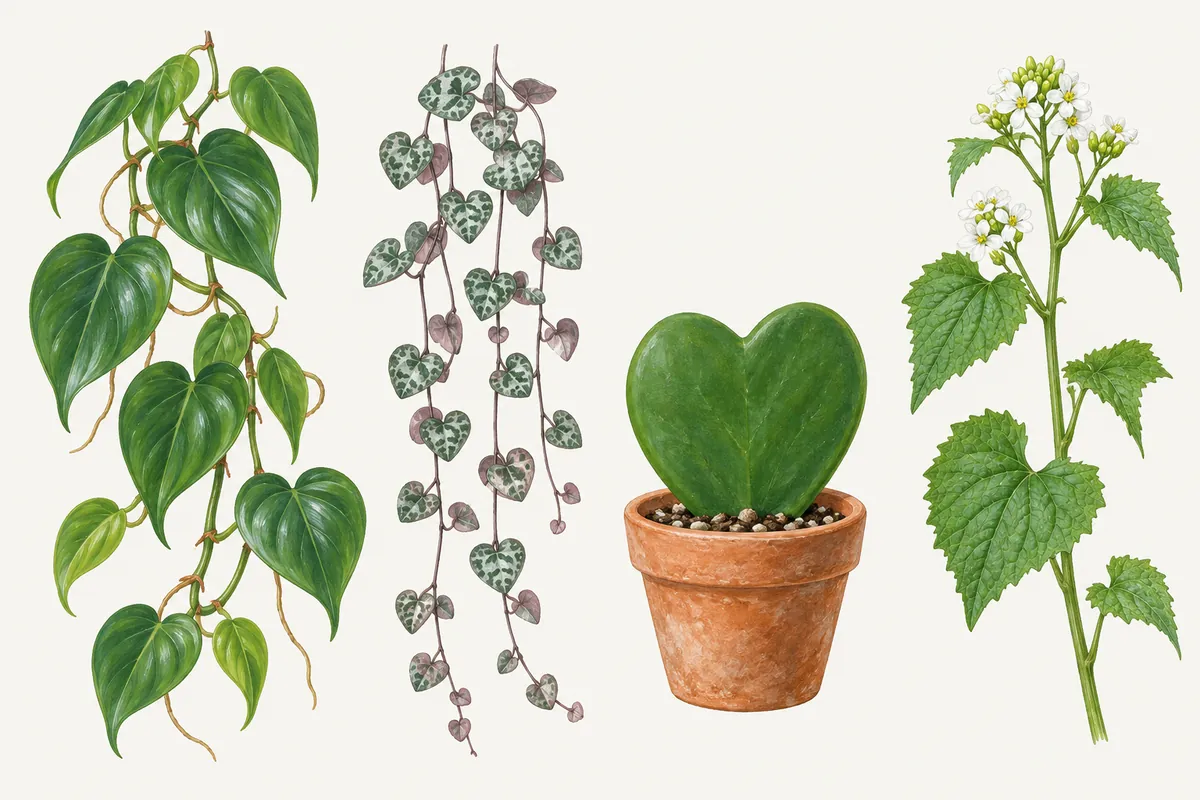
A plant with heart-shaped leaves indoors is most often a heartleaf philodendron, a pothos, a string of hearts, a Hoya kerrii or an anthurium. Outdoors it is usually a morning glory, hedge bindweed, a wild violet, lesser celandine or first-year garlic mustard. The shape alone won't name it: check whether the leaves sit in pairs or one at a time, and whether they are thin, waxy or succulent.
- Leaf arrangement is the fastest split: string of hearts and Hoya kerrii carry their leaves in opposite pairs, pothos and heartleaf philodendron one at a time along the vine.
- Pothos and heartleaf philodendron are the classic mix-up: a grooved leaf stalk means pothos, a papery sheath on each new leaf means philodendron.
- Heartleaf philodendron, pothos, anthurium, alocasia, caladium and morning glory are all listed as toxic to dogs and cats by the ASPCA.
A heart-shaped leaf, with two rounded lobes at the base and a point at the tip, is common enough that it barely narrows things down. Botanists call it cordate, and it turns up in houseplants, garden perennials, wild vines and lawn weeds from at least a dozen families. The tables below start with the houseplants most people are trying to name, then move outdoors, and each row gives the one detail that separates that plant from the others.
Houseplants with heart-shaped leaves
Descriptions follow the NC State Extension Gardener Plant Toolbox for each plant unless noted.
| Plant | Leaf | Arrangement and habit | Quickest check |
|---|---|---|---|
| Heartleaf philodendron (Philodendron hederaceum) | Glossy, leathery, 3 to 6 in; new leaves emerge bronze | One per node on a climbing or trailing vine | Each new leaf emerges from a papery sheath that dries brown |
| Pothos (Epipremnum aureum) | Heart-shaped to oval, glossy, often marbled yellow, cream or white, 3 to 4 in indoors | One per node on a vine | Leaf stalk grooved where it clasps the stem; no sheath |
| String of hearts (Ceropegia woodii) | Under 1 in, dark green marbled silver, purple below | Opposite pairs on thin, wiry, pinkish stems | Small bead-like tubers along the stems |
| Hoya kerrii (sweetheart hoya) | Thick, fleshy, heart-shaped | Opposite pairs on a vine, or sold as one leaf in a pot | Succulent leaf you can't fold; pink waxy star flowers in summer |
| Anthurium (Anthurium andraeanum) | Dark green, 8 to 12 in, heart-shaped | Upright clump, each leaf on a long stalk | Waxy heart-shaped red, pink or white spathe with a straight spadix |
| Alocasia (elephant ear) | Heart- to arrowhead-shaped, often with silver or lime-white veins | Upright, one leaf per long fleshy stalk | Stalk joins the leaf at the notch; wavy edges, purple undersides on A. × amazonica |
| Caladium (Caladium bicolor) | Arrow-shaped, splashed white, pink or red between the veins | Clump from a tuber; grown for summer, tubers stored over winter | Stalk joins the leaf blade inside its edge, not at the notch |
Garden plants and weeds with heart-shaped leaves
| Plant | Where | Leaf | Quickest check |
|---|---|---|---|
| Common morning glory (Ipomoea purpurea) | Garden vine, field edge | Fuzzy, heart-shaped, up to 4 in, long stalks | Purple flowers 1 to 3 in with a white throat, open in the morning; hairy brown-purple stems |
| Hedge bindweed (Calystegia sepium) | Hedges, borders | Heart-shaped, up to 12 cm (5 in) | White or pale pink funnel flowers about 5 cm (2 in), June to September |
| Wild violet (Viola sororia) | Lawn, shade | Basal, heart-shaped, toothed, up to 4 in across | All leaves at the base, rising from underground stems (rhizomes) in clumps |
| Lesser celandine (Ficaria verna) | Damp lawn, woodland, stream bank | Glossy, fleshy, heart- to kidney-shaped, up to 2 in | Yellow star flowers with about 8 petals, March to May; gone by summer |
| Garlic mustard (Alliaria petiolata) | Wood edge, shady garden | First year round to heart-shaped, coarsely toothed, about 2 in | Crushed leaf smells of garlic; second-year leaves turn triangular |
| Purple dead-nettle (Lamium purpureum) | Lawn, bare soil | Crowded, overlapping, up to 2 in, purple-tinged at the top | Square stem; small purple two-lipped flowers |
| Wild ginger (Asarum canadense) | Woodland, shade garden | One pair of velvety, gray-green, heavily veined leaves, 3 to 6 in | Brown-purple bell flower in April and May, often hidden under fallen leaves |
| Siberian bugloss (Brunnera macrophylla) | Shade border | Rough, hairy, up to 6 in, often silver-marked | Sprays of tiny blue flowers in spring |
| Common lilac (Syringa vulgaris) | Shrub border | Smooth, heart-shaped, 3 to 6 in, opposite | Woody shrub; fragrant purple cones in spring |
| Greenbrier (Smilax rotundifolia) | Woods, fence lines (eastern US) | Rounded to heart-shaped, 2 to 5 in, 3 to 5 main veins | Sharply four-angled stems with stiff prickles; climbs with tendrils |
| Chinese yam (Dioscorea polystachya) | Disturbed woods (eastern US, invasive) | Heart-shaped, often with 3 lobes, to 4.5 in | Warty round bulbils in the leaf joints |
The houseplant identification key works through leaf shape, pattern and habit if your plant is indoors and none of these rows fits.
The second clue that tells them apart
Pairs or one at a time. Look at a node, the point where a leaf meets the stem. String of hearts, Hoya kerrii, lilac and purple dead-nettle carry leaves in opposite pairs. Philodendron, pothos, morning glory, bindweed, anthurium and alocasia carry one leaf per node. That one check splits the houseplant table in half.
Thin, waxy or succulent. Pinch a leaf gently. Hoya kerrii leaves are thick and fleshy, string of hearts small and slightly succulent, pothos and philodendron leathery but bendable.
Pothos or heartleaf philodendron. This is the most common mix-up in the whole group. NC State describes pothos leaves as heart-shaped to elliptic, often variegated, on stalks that sheathe the stem; heartleaf philodendron leaves are glossy green and emerge bronze. Run a finger down the leaf stalk: a groove means pothos. Look at the newest leaf: a brown papery sheath beside it means philodendron. Our pothos vs philodendron page has photos of both tests.
String of hearts or a tiny philodendron. NC State gives string of hearts leaves under an inch long, marbled silver, purple underneath, in opposite pairs on wiry pink stems with bead-like tubers. A young philodendron cutting has single, plain green leaves.
Where the stalk meets the leaf. On alocasia the stalk joins at the notch between the two lobes. On caladium, NC State calls the leaf peltate: the stalk attaches inside the blade, a little way in from the edge. Flip the leaf over to see it.
Morning glory or bindweed. Both are twining vines with funnel flowers. The RHS bindweed guide gives hedge bindweed heart-shaped leaves up to 12 cm and white flowers about 5 cm wide; field bindweed has smaller oval to arrow-shaped gray-green leaves up to 6 cm and flowers about 2 cm, usually pale pink. Common morning glory has fuzzy leaves, hairy stems and deep purple flowers with a white throat that last a few hours. The full comparison is on our bindweed page.
Violet, celandine or garlic mustard in the lawn. Wild violets grow in clumps with every leaf at the base; lesser celandine has glossy, fleshy leaves and yellow star flowers in early spring, then vanishes; first-year garlic mustard smells of garlic when crushed. If the leaves are on a creeping stem that roots at every node and smells of mint, you have ground ivy instead, whose leaves are round and scalloped rather than pointed.
Heart-shaped or shield-shaped. Japanese knotweed leaves look like hearts from a distance but have a straight, cut-off base, according to NC State; see our Japanese knotweed page if a bamboo-like stem carries them.
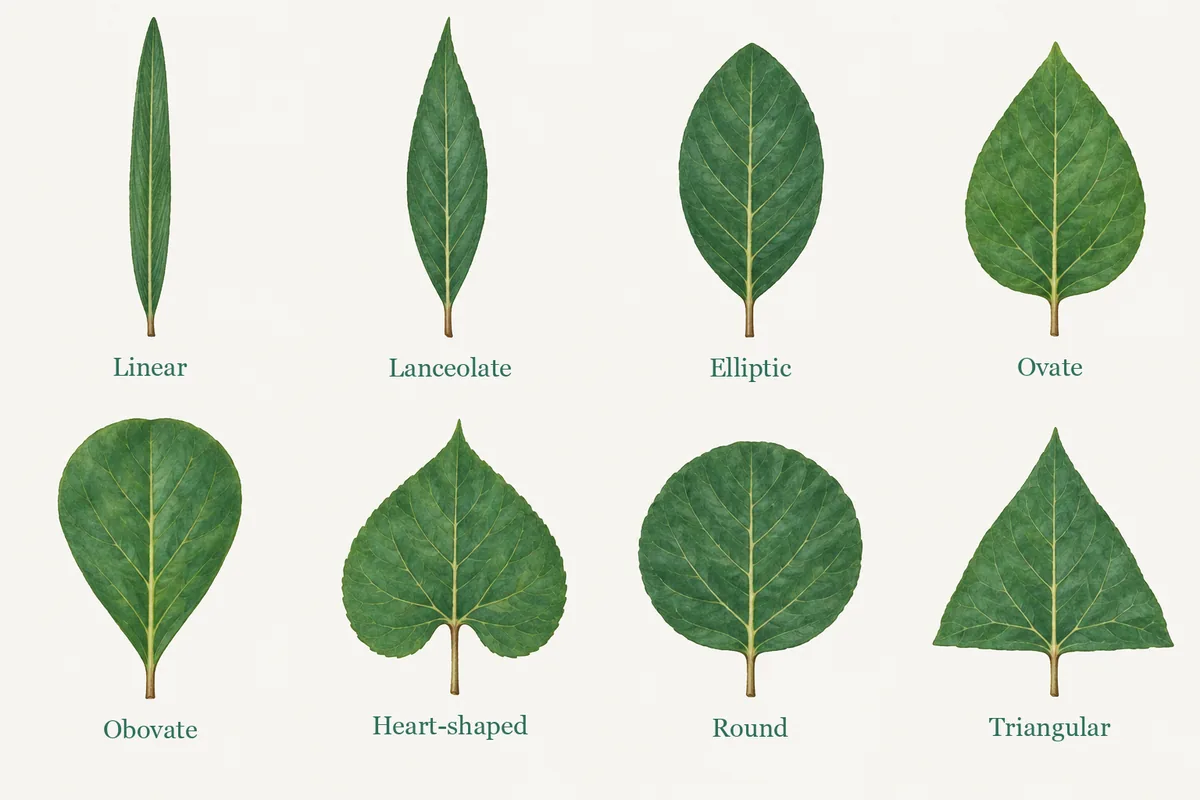
Heart-shaped or another outline. Several plants above sit on the border between shapes: pothos leaves run from heart-shaped to elliptic, greenbrier from round to heart-shaped, and garlic mustard turns triangular in its second year. The chart sets the heart-shaped leaf beside seven other outlines, linear, lanceolate, elliptic, ovate, obovate, round and triangular, so you can check the base of your leaf against each.
Heart-leaved plants listed as toxic
These listings come from the sources named; a plant missing here has not been shown to be harmless.
- Heartleaf philodendron, anthurium (flamingo flower), alocasia and caladium are listed as toxic to dogs, cats and horses by the ASPCA, which names insoluble calcium oxalates; the heartleaf philodendron entry lists oral irritation, drooling, vomiting and difficulty swallowing.
- Pothos is listed as toxic to dogs and cats by the ASPCA.
- Morning glory is listed as toxic to dogs, cats and horses by the ASPCA; the morning glory entry says large amounts of seeds may cause hallucinations.
- Lesser celandine is rated a low-severity poison and a problem for cats, dogs and horses in the NC State Plant Toolbox. Wild ginger is rated medium severity: NC State says it contains aristolochic acid and that no part of it should be consumed.
If a pet has chewed one of these, call your vet or the ASPCA Animal Poison Control Center at (888) 426-4435. For a person, call Poison Control at 1-800-222-1222 in the US, or NHS 111 in the UK. This site gives no edibility advice on any heart-leaved plant.
How a photo settles it
A single leaf held up to the camera is the weakest photo you can take of a heart-leaved plant, because the shape is the part they share. Photograph a stretch of stem with two or three nodes so the arrangement shows, and include the newest leaf: the sheath on a philodendron or the groove on a pothos stalk is often visible. For a vine outdoors, wait for a flower if you can.
Plant Identifier names the plant from one photo and gives the common and scientific names; it shows one answer with no confidence score, so check it against the quickest-check column above. If the answer is pothos and the stalk has no groove, ask the follow-up chat under the result how to tell pothos from philodendron. For a plant within reach of a cat or dog, Plant Identifier's Toxicology tool writes notes for people, dogs and cats, which you should read alongside the ASPCA entry. Once you know the name, the Care Guide in Plant Identifier covers light and watering for that plant.
What a photo can't settle
- Young leaves often have a different shape: garlic mustard, monstera and many aroids start with heart-shaped leaves and change as they mature, so one leaf can mislead a photo app.
- Named varieties of pothos and philodendron (Brasil, Neon, Marble Queen) differ mainly in color, and a photo app names the species, not the cultivar on the label.
- A photo can't tell you how much of a leaf a pet chewed or whether it is dangerous; call your vet or the ASPCA Animal Poison Control Center.
Questions people ask
What houseplant has small heart-shaped leaves on long strings?
Usually string of hearts (Ceropegia woodii): pairs of heart-shaped leaves under an inch long, dark green marbled with silver and purple underneath, on thin trailing stems with small bead-like tubers. A heartleaf philodendron trails too, but its glossy leaves are 3 to 6 inches long and grow one at a time.
What is the plant sold as a single heart-shaped leaf in a pot?
That is Hoya kerrii, the sweetheart hoya. NC State says it is often sold around Valentine's Day as a rooted leaf cutting. A single leaf can live for a long time, but a cutting without a piece of stem may never grow a vine.
What weed has heart-shaped leaves and climbs?
In gardens it is usually hedge bindweed or morning glory, both twining vines with funnel-shaped flowers. In the eastern US, Chinese yam has heart-shaped leaves with warty bulbils in the leaf joints, and greenbrier has rounded heart-shaped leaves with prickly green stems.
Are plants with heart-shaped leaves edible?
This site gives no edibility advice. Several heart-leaved plants on this page, including philodendron, pothos and morning glory, are listed as toxic by the ASPCA.
Sources
- Philodendron hederaceum (heartleaf philodendron) — NC State Extension Gardener Plant Toolbox
- Epipremnum aureum (pothos) — NC State Extension Gardener Plant Toolbox
- Ceropegia woodii (string of hearts) — NC State Extension Gardener Plant Toolbox
- Hoya kerrii (sweetheart hoya) — NC State Extension Gardener Plant Toolbox
- Ipomoea purpurea (common morning glory) — NC State Extension Gardener Plant Toolbox
- Bindweed: Identification and Control — Royal Horticultural Society (RHS)
- Heartleaf Philodendron — ASPCA Animal Poison Control Center
- Morning Glory — ASPCA Animal Poison Control Center
Keep reading
- Houseplant comparisonPothos vs philodendron: how to tell them apart
- Plant profileString of hearts (Ceropegia woodii): how to identify it
- Weed profileBindweed (Convolvulus arvensis, Calystegia sepium): how to identify it
- Free toolHouseplant identification key
- Flower colorPlant with purple flowers? 25 common ones and how to tell them apart