Leaf color
Houseplant with red leaves? 16 common ones and how to tell them apart
The red-leaved houseplants you are most likely to own, sorted by where the red sits on the leaf, the second clue that separates each pair, and which ones the ASPCA lists as toxic.
In short
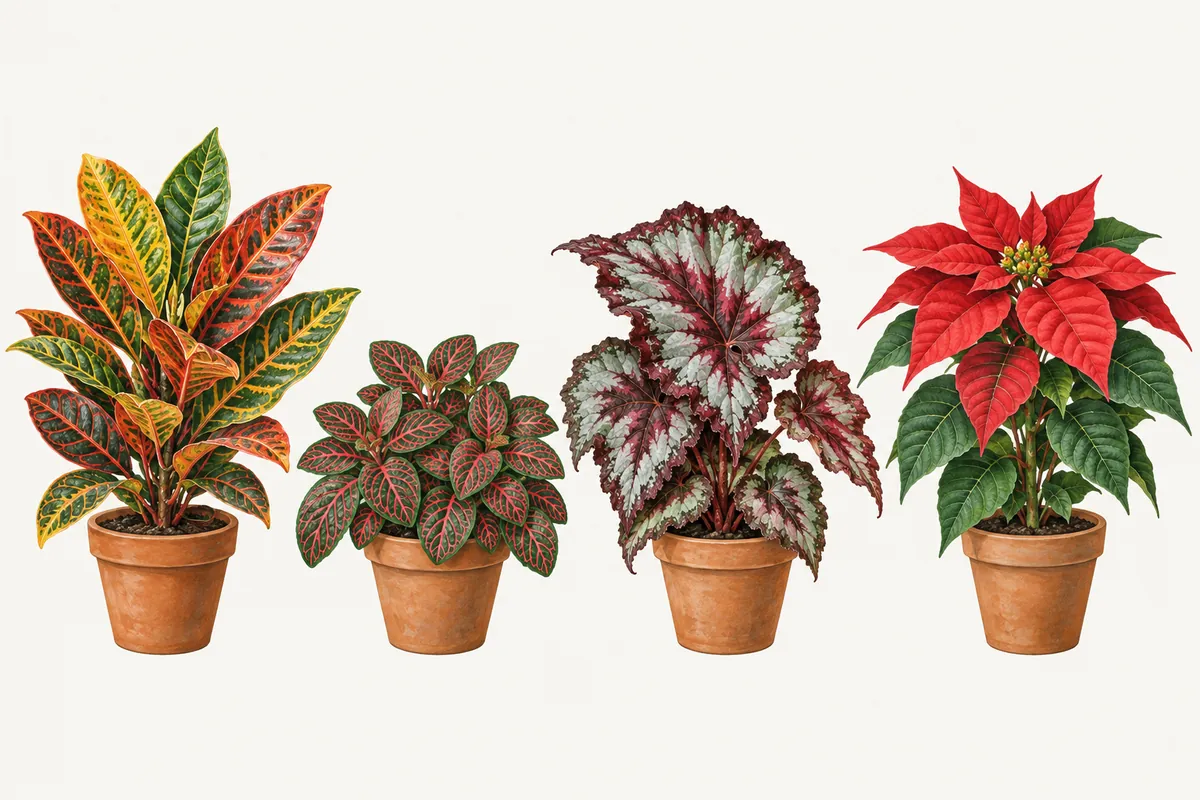
A houseplant with red leaves is most often a croton, a Ti plant, a rex begonia, a red Chinese evergreen, a coleus or a bloodleaf. Red veins on a green leaf point to fittonia, red spots to the polka dot plant, red edges to Dracaena marginata, and a red underside to stromanthe or calathea. The red on a poinsettia is not a leaf: those are bracts around tiny yellow flowers.
- Look at where the red sits: the whole leaf, the veins, spots, the edges or only the underside each point to a different short list.
- Poinsettia, anthurium and many bromeliads carry their red in bracts around the flowers, not in the leaves.
- Croton colors fade in low light, according to UF/IFAS, so a dull croton indoors may be a light problem rather than a different plant.
Red leaves are a feature people buy a houseplant for, which is why so many named varieties exist, and why the label is often lost by the time you want the name. The fastest way in is to look at where the red sits on the leaf: across the whole blade, along the veins, in spots, on the edges or only underneath. The table below groups 16 common houseplants that way, then the look-alike pairs, then the toxic ones and how a photo settles it.
The 16 most likely houseplants with red leaves
Leaf descriptions follow the NC State Extension Gardener Plant Toolbox for each plant unless another source is named.
| Where the red is | Plant | Leaf | Second clue |
|---|---|---|---|
| Whole leaf or patches | Croton (Codiaeum variegatum) | Leathery, glossy, up to 18 in, flat, lobed, crinkled or twisted; red, orange, yellow, pink, purple and green | Woody stem with pock-marked leaf scars |
| Whole leaf or patches | Ti plant (Cordyline fruticosa) | Long oblong blades up to 30 in, green to pink and dark red | Leaves crowded in a spiral on grooved stalks |
| Whole leaf or patches | Rex begonia (Begonia Rex group) | Lopsided, toothed leaves grown for their colorful patterns | Low rhizomatous plant that needs humidity above 75 % |
| Whole leaf or patches | Coleus (Coleus scutellarioides) | Toothed, oval, blotched red, burgundy, pink and green | Opposite leaves on a square stem |
| Whole leaf or patches | Bloodleaf (Iresine herbstii) | Reddish-purple ovals up to 4 in with a notched tip | Red stems; paler red or pink veins |
| Whole leaf or patches | Neoregelia bromeliad (Neoregelia) | Strap-shaped, toothed leaves, green, maroon or red, banded or spotted | Rosette forming a central water-holding cup |
| Whole leaf or patches | Caladium (Caladium bicolor) | Arrow-shaped, red, pink or white between green veins | Grows from a tuber and rests over winter |
| Whole leaf or patches | Purple shamrock (Oxalis triangularis) | Three triangular deep maroon leaflets | Leaflets fold up at night |
| Along the veins or in bands | Nerve plant (Fittonia albivenis) | Soft, deep green ovals 2 to 4 in with white, pink or red veins | Leaves in opposite pairs; indoor plants rarely flower |
| Along the veins or in bands | Red Chinese evergreen (Aglaonema cultivars) | Glossy lance-shaped leaves 4 to 12 in, banded or spotted pink-red along the veins | Smooth edges and curved main veins |
| Spots | Polka dot plant (Hypoestes phyllostachya) | Green ovals 1 to 3 in, spotted lavender, red or pink | Opposite leaves; small lilac flowers |
| Edges | Dracaena marginata | Glossy sword-shaped leaves about 2 ft long, ½ in wide, reddish edges | Tan stems with diamond-shaped leaf scars; lower leaves drop with age |
| Underside only | Stromanthe (Stromanthe sanguinea) | Glossy dark green above, burgundy below, 6 to 12 in | Long stalks; leaves fold up at night |
| Underside only | Rose-painted calathea (Goeppertia roseopicta) | Glossy, 6 to 10 in, pink to cream brush strokes, reddish-purple below | Brush-stroke markings on the upper side |
| Bracts, not leaves | Poinsettia (Euphorbia pulcherrima) | Red, pink, white or orange bracts above dark green ordinary leaves | Tiny yellow flowers in the center; milky sap |
| Bracts, not leaves | Anthurium | Waxy heart-shaped red, pink or white spathe; dark green leaves | A straight spadix sticks out of each spathe |
If none of these fits, the houseplant identification key narrows a plant by leaf shape, pattern and habit.
Look-alikes: same red, different plant
Croton or Ti plant. Both are tall, glossy and splashed with red. Croton leaves are leathery, often lobed, crinkled or twisted, in many colors at once, on a woody stem whose old bark is pock-marked with leaf scars. Ti plant leaves are long, smooth, flat blades up to 30 inches, crowded in a spiral, with grooved leaf stalks.
Coleus or bloodleaf. Both have red leaves in opposite pairs. Coleus leaves are toothed and usually blotched with several colors on a square stem. Bloodleaf leaves are a more even reddish-purple with a notch at the tip, on red stems, with veins picked out in lighter red or pink, according to the NC State bloodleaf page.
Fittonia or polka dot plant. Both are small, soft and patterned. Fittonia carries its color as a net along the veins; the polka dot plant carries it as spots scattered across the leaf.
Red aglaonema or rex begonia. Both are low clumps with patterned leaves. NC State describes aglaonema leaves as glossy, lance-shaped and smooth-edged, with color banded along the main veins. Rex begonias, a group of hundreds of hybrids derived from Begonia rex according to the NC State begonia page, have lopsided leaves with toothed edges and grow from a rhizome.
Stromanthe or calathea. Both are prayer-plant relatives with red undersides that fold their leaves at night. NC State gives stromanthe glossy oblong leaves up to 12 inches or more, dark green on top and burgundy underneath; the rose-painted calathea has a deep green leaf with pink to cream brush strokes around the midrib and edges, reddish-purple below. Turn a leaf over and look at the top: plain green means stromanthe, painted means calathea.
Dracaena marginata or Ti plant. Both carry long, strap-like leaves marked with red on upright stems. NC State gives Dracaena marginata narrow leaves about half an inch wide with reddish edges, on tan stems with diamond-shaped leaf scars. Ti plant leaves are up to 6 inches wide.
When the red is not a leaf
Three common houseplants carry their red outside the leaves. On a poinsettia, UF/IFAS says the showy parts most people think of as the flower are colorful leaves called bracts, which can also be pink, white, orange or purple; the true flowers are the small yellow structures in the middle. NC State calls them showy red leafy bracts. On an anthurium, the red is a waxy spathe around a finger-like spadix. On many bromeliads the color sits in bracts or in the central cup: NC State describes the urn plant (Aechmea fasciata) with small purple flowers surrounded by pink bracts, and neoregelia with small flowers held inside the cup.
Color also changes with age and light. New leaves on some plants emerge bronze and turn green; NC State notes this for heartleaf philodendron. Croton can lose its red. UF/IFAS says even croton cultivars chosen for indoor use will eventually lose part of their color without enough light. If a red plant is turning yellow or brown rather than green, the yellow leaves guide covers the usual causes.
Red-leaved houseplants listed as toxic
These listings come from the sources named; a plant missing here has not been shown to be harmless.
- Rex begonia is listed as toxic to dogs, cats and horses by the ASPCA, which names soluble calcium oxalates; its rex begonia entry lists vomiting and salivation in dogs and cats.
- Poinsettia, Chinese evergreen, Dracaena marginata (Madagascar dragon tree), caladium, anthurium (flamingo flower) and purple shamrock (shamrock plant) are each listed as toxic to dogs, cats and horses by the ASPCA. The ASPCA describes poinsettia as irritating to the mouth and stomach and generally over-rated in toxicity.
- Ti plant is listed as toxic to dogs and cats by the ASPCA.
- Croton: NC State rates it a low-severity poison that can irritate skin, and UF/IFAS says crotons are known to have irritating and poisonous qualities and that the sap can stain. Coleus: NC State lists minor skin irritation.
If a pet has chewed one of these, call your vet or the ASPCA Animal Poison Control Center at (888) 426-4435. For a person, call Poison Control at 1-800-222-1222 in the US, or NHS 111 in the UK.
How a photo settles it
For a red-leaved houseplant, light matters more than for a green one: a warm lamp turns burgundy into brown and pink into orange. Photograph the plant near a window in daylight, and take two shots: one of the whole plant so the habit shows (cane, rosette, trailing stems), and one close-up of a single leaf, with a second of its underside if only the back is red.
Plant Identifier names the plant from one photo and gives the common and scientific names. It shows one answer with no confidence score, so check that answer against the second-clue column above. If the leaves have started to spot or curl, the Diagnose tool in Plant Identifier looks at a photo of the damage, and the Care Guide covers light and watering once you know the name. For a cat or dog in the house, Plant Identifier's Toxicology tool writes notes for people, dogs and cats; read them alongside the ASPCA entry rather than instead of it.
What a photo can't settle
- Many red-leaved houseplants are sold as named cultivars (aglaonema 'Siam Aurora', Ti plant 'Red Sister', dozens of croton and rex begonia hybrids); a photo app names the species, not the cultivar.
- Color is not fixed: new leaves can emerge bronze and turn green, and croton loses color in low light, so one photo of one leaf can point to the wrong variety.
- A photo can't tell you whether a pet has eaten enough of a leaf to be harmed; call your vet or the ASPCA Animal Poison Control Center.
Questions people ask
What houseplant has green leaves with red veins?
Usually fittonia, the nerve plant: small, soft, oval leaves 2 to 4 inches long in opposite pairs, netted with white, pink or red veins. The polka dot plant has spots scattered across the leaf instead of a net of colored veins.
What plant has long thin leaves with red edges?
Dracaena marginata, the Madagascar dragon tree. NC State gives glossy sword-shaped leaves about 2 feet long and half an inch wide with reddish edges, on tan stems marked with diamond-shaped leaf scars.
Is a poinsettia's red part a leaf?
Not quite. UF/IFAS says the showy parts most people take for the flower are colorful leaves called bracts; the true flowers are the small yellow structures in the middle. The green leaves below are ordinary leaves.
Why is my croton losing its red color?
Often light. UF/IFAS says even croton cultivars chosen for indoor use will lose part of their color if they don't get enough light. Move it closer to a bright window, and watch the new leaves rather than the old ones.
Sources
- Codiaeum variegatum (croton) — NC State Extension Gardener Plant Toolbox
- Crotons — University of Florida IFAS Extension, Gardening Solutions
- Fittonia albivenis (nerve plant) — NC State Extension Gardener Plant Toolbox
- Hypoestes phyllostachya (polka dot plant) — NC State Extension Gardener Plant Toolbox
- Cordyline fruticosa (Ti plant) — NC State Extension Gardener Plant Toolbox
- Dracaena marginata (Madagascar dragon tree) — NC State Extension Gardener Plant Toolbox
- Poinsettia — University of Florida IFAS Extension, Gardening Solutions
- Rex Begonia — ASPCA Animal Poison Control Center
Keep reading
- Houseplant profileCroton (Codiaeum variegatum): how to identify it
- Houseplant profilePoinsettia plant (Euphorbia pulcherrima): how to identify it
- Houseplant profileAglaonema (Chinese evergreen): how to identify it
- Houseplant profileCalathea (Goeppertia): how to identify it
- Leaf shapePlant with heart-shaped leaves? Houseplants first, then garden and weeds